Timeless Myths Logo
Aphrodite Apollo Ares Artemis Athena Atlas Coeus Crius Cronus Demeter Dionysus Gaia Hades Hephaestus Hera Hermes Hestia Hyperion Iapetus Mnemosyne Oceanus Phobos Phoebe Poseidon Prometheus Rhea Tethys Themis Uranus Zeus
Bacchus Ceres Diana Juno Jupiter Mars Mercury Minerva Neptune Pluto Venus Vesta Vulcan
Amun Anubis Aten Atum Babi Bastet Bes Geb Hapi hathor heqet Horus Isis Khepri Khnum Khonsu Maat Nephthys Nut Osiris Ptah Ra Seshat Seth Shu Sobek Thoth
Alfheim Baldur Freya Freyr Frigg Heimdallr Helheim Idun Jotunheim Loki Nerthus Njord Odin Thor Tyr
Aengus Arawn Badb Brigid Cailleach Ceridwen Cernunnos Cu Chulainn Dagda Danu Gwydion Herne the Hunter Lugh Medb Morrigan Neit Nuada Taliesin Taranis
Chalchiuhtlicue Coatlicue Huitzilopochtli Mictlantecuhtli Mixcoatl Ometeotl Quetzalcoatl Tezcatlipoca Tlaloc Tonatiuh Xipe Totec Xochiquetzal Xolotl
Amaterasu Ame no Uzume Benzaiten Bishamonten Daikokuten Ebisu Fujin Fukurokuju Inari Izanagi Kagutsuchi Raijin Susanoo Tsukuyomi
Caishen Cangjie Dragon King Eight Immortals Erlang Shen Fuxi Guanyin Hou Yi Huxian Jade Emperor King Yama Leizi Lu-ban Mazu Nezha Nuwa Pangu Shennong Sun Wukong Xiwangmu Yue Lao Zhong Kui
Norse Classical Celtic Arthurian
Literature Stories Names
Aphrodite Apollo Ares Artemis Athena Atlas Coeus Crius Cronus Demeter Dionysus Gaia Hades Hephaestus Hera Hermes Hestia Hyperion Iapetus Mnemosyne Oceanus Phobos Phoebe Poseidon Prometheus Rhea Tethys Themis Uranus Zeus
Bacchus Ceres Diana Juno Jupiter Mars Mercury Minerva Neptune Pluto Venus Vesta Vulcan
Amun Anubis Aten Atum Babi Bastet Bes Geb Hapi hathor heqet Horus Isis Khepri Khnum Khonsu Maat Nephthys Nut Osiris Ptah Ra Seshat Seth Shu Sobek Thoth
Alfheim Baldur Freya Freyr Frigg Heimdallr Helheim Idun Jotunheim Loki Nerthus Njord Odin Thor Tyr
Aengus Arawn Badb Brigid Cailleach Ceridwen Cernunnos Cu Chulainn Dagda Danu Gwydion Herne the Hunter Lugh Medb Morrigan Neit Nuada Taliesin Taranis
Chalchiuhtlicue Coatlicue Huitzilopochtli Mictlantecuhtli Mixcoatl Ometeotl Quetzalcoatl Tezcatlipoca Tlaloc Tonatiuh Xipe Totec Xochiquetzal Xolotl
Amaterasu Ame no Uzume Benzaiten Bishamonten Daikokuten Ebisu Fujin Fukurokuju Inari Izanagi Kagutsuchi Raijin Susanoo Tsukuyomi
Caishen Cangjie Dragon King Eight Immortals Erlang Shen Fuxi Guanyin Hou Yi Huxian Jade Emperor King Yama Leizi Lu-ban Mazu Nezha Nuwa Pangu Shennong Sun Wukong Xiwangmu Yue Lao Zhong Kui
Norse Classical Celtic Arthurian
Literature Stories Names
  1. Classical Literature
    Greece Rome Other Ancient Civilizations Timeline of Classical Literature Alphabetical List of Authors Index of Individual Works Index of Important Characters Sources About Us
  2. Greece
    Homer Hesiod Aesop Sappho Pindar Aeschylus Sophocles Euripides Aristophanes Menander Apollonius of Rhodes
  3. Aristophanes
    The Acharnians The Knights The Clouds The Wasps Peace The Birds Lysistrata Thesmophoriazusae The Frogs Ecclesiazusae Plutus (Wealth)
  4. The Knights
    The Knights

The Knights

(Comedy, Greek, 424 BCE, 1,408 lines)

Introduction

"The Knights" (Gr: "Hippeis") is a comedy by the ancient Greek playwright Aristophanes. It won first prize at the Lenaia festival when it was produced in 424 BCE. The play functions as satire on political and social life in 5th Century BCE Athens, with particular focus as a diatribe against the pro-war populist politician, Cleon. In the narrative, a sausage-seller named Agoracritus competes with Paphlagonian (representing Cleon) for the approval of Demos (symbolizing the Athenian citizenry), ultimately triumphing through contests and miraculously restoring Demos to youth and glory.
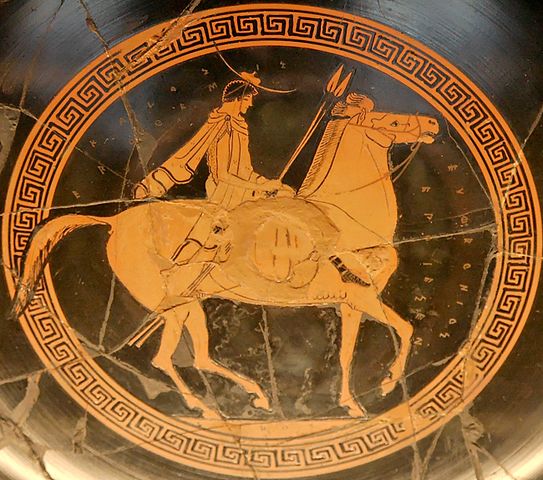
Greek rider on horseback by Euphronios, from the Louvre

A Greek rider depicted on pottery by Euphronios, representing the Knights class of Athens

Fact

Information

Author

Aristophanes

Date produced

424 BCE

Genre

Old Comedy

Setting

Athens, ancient Greece

Key Themes

Political satire, demagoguery, democracy, corruption, war

Synopsis - The Knights Summary

Dramatis Personae – Characters

  • DEMOSTHENES, slave of Demos

  • NICIAS, slave of Demos

  • AGORACRITUS, a Sausage-Seller

  • CLEON (as Paphlagonian)

  • DEMOS

  • CHORUS OF KNIGHTS

Plot Summary

Nicias and Demosthenes, two enslaved attendants of elderly Athenian Demos, flee the house complaining of beatings received from fellow slave Paphlagonian (Cleon's representation). Paphlagonian has manipulated their master's trust and regularly takes credit for their work while provoking beatings. After drinking wine, they steal Cleon's secret oracle collection and discover oracles predicting Cleon's replacement by a sausage-seller.
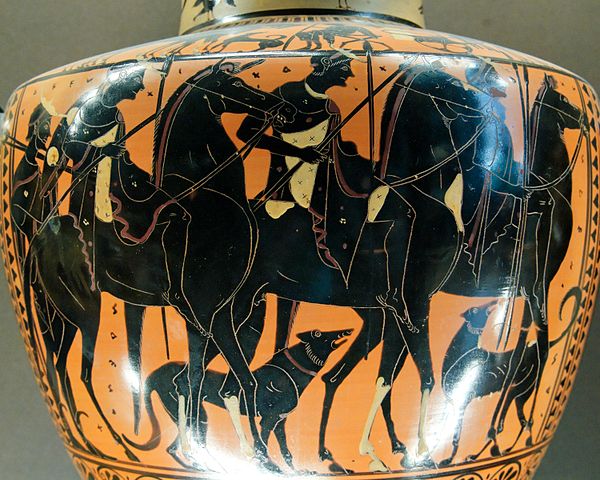
Greek riders from the Leagros Group, Louvre

Greek riders depicted on a vase from the Leagros Group, representing the cavalry class that forms the Chorus in the play

When sausage-seller Agoracritus passes by, they inform him of his supposed destiny. Though initially skeptical, Cleon's suspicious reaction confirms something is amiss. Demosthenes appeals to the Knights of Athens for aid. The Chorus of Knights enters, confronting Cleon and accusing him of manipulating the political and legal system for personal gain.

A verbal contest ensues between Cleon and the sausage-seller, each demonstrating shamelessness and unscrupulousness. The Knights declare the sausage-seller victorious, causing Cleon to storm away threatening treason charges.

The Chorus addresses the audience, praising Aristophanes' methodical career approach and honoring the older generation that made Athens great. The passage includes imagery of Greek horses participating in a Corinth assault.

When the sausage-seller returns, he reports winning Council support through extravagant food offerings. Cleon challenges him to submit their dispute directly to Demos. The sausage-seller accuses Cleon of indifference to the war-time sufferings of ordinary people and claims Cleon prolongs the war out of fear that he will be prosecuted when peace returns. Demos accepts these arguments.

The competition escalates into increasingly vulgar exchanges. The sausage-seller wins additional contests involving oracle readings and demonstrations of service to Demos.
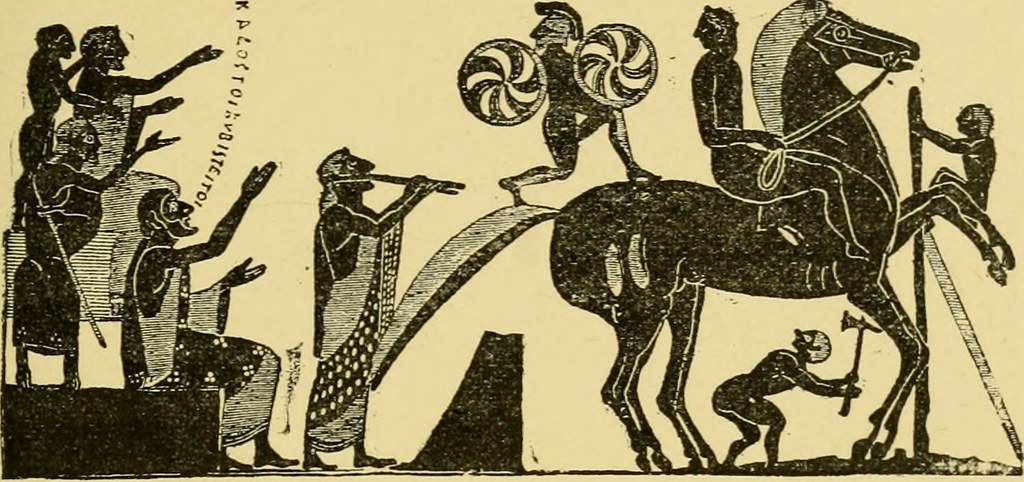
Illustration depicting a scene from The Knights by Aristophanes

An illustration depicting the satirical contest between Cleon and the sausage-seller in The Knights

Desperate, Cleon presents his oracle, questioning whether the sausage-seller matches the prophesied successor's description in all vulgar details—which he does. Cleon accepts his defeat and surrenders his position.

The Chorus mocks dishonorable figures including Ariphrades and Hyperbolus. Agoracritus announces having rejuvenated Demos through cooking treatment, introducing him restored to youth in Marathon-era clothing. Two beautiful girls representing "Peace-treaties" that Cleon had kept hidden are presented. Demos invites Agoracritus to a state banquet, and all exit cheerfully except Paphlagonian/Cleon, now reduced to selling sausages at the city gate as punishment.

Analysis

The play exemplifies Aristophanes' early satirical approach to Athenian social and political life during the Peloponnesian War, distinguished by its singular focus on one individual: the pro-war populist, Cleon, who had previously prosecuted Aristophanes for slandering the polis.

Aristophanes had promised revenge in "The Acharnians" (425 BCE) and delivers it fully in "The Knights" (424 BCE). Notably, Aristophanes had the prudence not to actually use the name Cleon anywhere in the play, substituting the allegorical Paphlagonian instead but making identification unmistakable.

No mask-maker dared create Cleon's likeness from fear of his faction, so Aristophanes bravely resolved to play the part himself, merely painting his own face. The Knights chorus represented the wealthy class of Athens, politicized and educated enough to see through Cleon's demagoguery.

Accusations leveled include questions about social origins, law court manipulation for personal gain, attempts at political censorship (including of Aristophanes), misuse of state office audits, and manipulation of census lists to impose crippling financial burdens on his choice of victims. Cleon would likely have attended the Lenaia performance.

The play relies heavily on allegory, though critics note it's not entirely successful in this regard. Main characters derive from real life (Cleon as primary villain), but allegorical figures are pure fantasy, with Paphlagonian presented as responsible for almost all evils in the world. This creates awkwardness, with some ambiguities never fully resolved.

Imagery proves crucial to Aristophanes' comic poetry. Paphlagonian/Cleon receives bizarre descriptions: variously described as a monstrous giant, a snoring sorcerer, a mountain torrent, a hook-footed eagle, a garlic pickle, a mud-stirrer, a fisherman watching for shoals of fish, a butchered pig, a bee browsing blooms of corruption, a dog-headed ape, a storm by sea and land, a giant hurling crags, a thieving nurse, a fishermen hunting eels, a boiling pot, a lion fighting gnats, a dog fox and a beggar.

Gluttony emerges as dominant thematic element through imagery, with exaggerated focus on food and drink and food-related puns on some of the names alongside cannibalism references creating a rather nightmarish and nauseating vision of the world, making the final vision of reformed Athens notably brighter by contrast.

Resources

  • English translation (Internet Classics Archive)

  • Greek version with word-by-word translation (Perseus Project)

By Timeless Myths

Aristophanes:

  • • The Acharnians
  • • The Knights
  • • The Clouds
  • • The Wasps
  • • Peace
  • • The Birds
  • • Lysistrata
  • • Thesmophoriazusae
  • • The Frogs
  • • Ecclesiazusae
  • • Plutus (Wealth)
Frankish Knights

Frankish Knights

Here are the other Frankish warriors who served Charlemagne, but were not the Twelve Peers, which the twelve paladins have a page of their own. See also the Twelve Peers for the other Frankish paladins, including Roland and Oliver.

November 1st, 2006 • Jimmy Joe
Tales of the Knights

Tales of the Knights

The Tales of the Knights, contain collection of popular stories of the Arthurian romances. They includes the tales of Sir Erec (Gereint), Sir Yvain (Owain) and Sir Gareth. There will be more tales in the future.

April 12th, 2000 • Jimmy Joe
Knights of Lazarus: The Order of Knighthood and Leprosy

Knights of Lazarus: The Order of Knighthood and Leprosy

The Knights of Lazarus were a group of knights diagnosed with leprosy in Jerusalem. The order of St Lazarus was a haven for leprosy-ridden knights where they were taken care of. In addition to being a nursing home for the affected knights, the ord...

January 11th, 2022 • Timeless Myths
The Knight with the Sword

The Knight with the Sword

The Knight of the Sword or Le Chevalier à l'Épée, is a rather short Old French romance about Sir Gawain. It was written perhaps in the mid-13th century or later. In this tale, Gawain won a wife, but she was a different woman from Lady Ragnell. Gaw...

December 16th, 2001 • Jimmy Joe
Grail Castle

Grail Castle

The Grail Castle was the enchanted home of the Grail Keeper. The Grail Keeper was sometimes called the Fisher King or Maimed King. According to the Vulgate Cycle and the Malory's Le Morte d'Arthur, this Fisher King was King Pelles of Listinoise. T...

April 2nd, 2000 • Jimmy Joe
Round Table

Round Table

The Arthurian knights who sat with King Arthur around a circular table became the focal point of fellowship between knights. Some of them are famous as heroes and champions of just cause. In theory, they were brothers; however, jealousy, envy and ...

February 4th, 2000 • Jimmy Joe
Twelve Peers

Twelve Peers

The Twelve Peers were Charlemagne's elite paladins or knights - the corps d'elite. The Twelve Peers were sort of like Arthur's Knights of the Round Table. According to all tales, Roland was the leader of the Twelve Peers. Roland was Charlemagne's ...

January 11th, 2006 • Jimmy Joe
Sir Perceval

Sir Perceval

The original Grail Knight. The legend of Perceval began with Chretien de Troyes' medieval romance titled Conte du Graal ("Story of the Grail"), which is also sometimes titled Perceval, written around 1180. People were fascinated with both the hero...

February 4th, 2000 • Jimmy Joe
Sir Bors

Sir Bors

A Grail knight. Bors was the son of King Bors of Gaunes and Evainne. Bors was also the brother of Lionel and cousin of Lancelot and Hector. Bors once slept with a maiden, and became the father of a son named Helin le Blank. After this, Bors remain...

February 4th, 2000 • Jimmy Joe
Age of Chivalry

Age of Chivalry

It was time of high adventure and romance. Knights would seek out adventure, hoping to test their skills, mettle and prowess as a warrior. A knight would also try to win the love of a lady or damsel, either by rescuing her from an adversary or dem...

April 2nd, 2000 • Jimmy Joe
Timeless Myths

Exploring mythology and legends from around the world.

Explore Myths

All Stories Characters All Articles Search Site Map

Mythologies

Norse Mythology Classical Mythology Celtic Mythology Arthurian Legends Mythology Gods Ancient Literature

About Us

Introduction About Jimmy Bibliography FAQs Retro Version

Resources

Timeless Myths All Stories All Articles Characters
© 1999-2026 Timeless Myths • Copyright • Privacy Policy • Cookie Policy • Contact
Follow us: