Timeless Myths Logo

Explore myths and legends from cultures around the world

Featured

Classical Mythology
Classical Mythology Greek and Roman myths, gods, heroes, and epic tales
Norse Mythology
Norse Mythology Vikings, Asgard, Ragnarok, and the nine realms
Celtic Mythology
Celtic Mythology Irish, Welsh, and Gaelic legends and folklore
Ancient Literature
Ancient Literature Classical texts, translations, and literary analysis

All Mythologies

Arthurian Legends King Arthur, Camelot, the Round Table, and the Holy Grail Egyptian Mythology Pharaohs, pyramids, and ancient Nile deities Japanese Mythology Shinto gods, spirits, and legendary creatures Chinese Mythology Dragons, immortals, and celestial beings Aztec Mythology Mesoamerican gods, rituals, and creation myths

Discover gods and goddesses from every pantheon

Featured

Greek Gods
Greek Gods The Olympians, Titans, and primordial deities
Norse Gods
Norse Gods Odin, Thor, Loki, and the Aesir and Vanir
Egyptian Gods
Egyptian Gods Ra, Osiris, Isis, Anubis, and more
Japanese Gods
Japanese Gods Amaterasu, Susanoo, and Shinto kami

All Gods & Deities

Roman Gods Jupiter, Mars, Venus, and the Roman pantheon Celtic Gods The Tuatha Dé Danann and Celtic deities Aztec Gods Quetzalcoatl, Tezcatlipoca, and Aztec deities Chinese Gods Jade Emperor, Dragon Kings, and celestial beings View All 150+ Deities Browse the complete collection of mythological deities
View all gods & deities

Tales, legends, and character profiles from mythology

Featured

All Stories
All Stories Browse 800+ mythology and history stories
Characters
Characters Profiles of 67 mythological heroes, gods, and villains

All Stories

Mythology Stories Ancient myths and legends retold History Stories Historical tales from ancient civilizations Religion & Culture Religious traditions and cultural beliefs
View all stories

Tools, references, and site information

Featured

Name Generators
Name Generators Generate fantasy and mythology-inspired names
All Articles
All Articles Browse 1,800+ articles on mythology and history

All Resources

About Timeless Myths Learn about this mythology resource Bibliography Sources and references used on this site FAQ Frequently asked questions Contact Get in touch with us
Search
Classical Mythology Greek and Roman myths, gods, heroes, and epic tales Norse Mythology Vikings, Asgard, Ragnarok, and the nine realms Celtic Mythology Irish, Welsh, and Gaelic legends and folklore Arthurian Legends King Arthur, Camelot, the Round Table, and the Holy Grail Egyptian Mythology Pharaohs, pyramids, and ancient Nile deities Japanese Mythology Shinto gods, spirits, and legendary creatures Chinese Mythology Dragons, immortals, and celestial beings Aztec Mythology Mesoamerican gods, rituals, and creation myths Ancient Literature Classical texts, translations, and literary analysis
Greek Gods The Olympians, Titans, and primordial deities Roman Gods Jupiter, Mars, Venus, and the Roman pantheon Norse Gods Odin, Thor, Loki, and the Aesir and Vanir Egyptian Gods Ra, Osiris, Isis, Anubis, and more Celtic Gods The Tuatha Dé Danann and Celtic deities Aztec Gods Quetzalcoatl, Tezcatlipoca, and Aztec deities Japanese Gods Amaterasu, Susanoo, and Shinto kami Chinese Gods Jade Emperor, Dragon Kings, and celestial beings View All 150+ Deities Browse the complete collection of mythological deities View all gods & deities
All Stories Browse 800+ mythology and history stories Characters Profiles of 67 mythological heroes, gods, and villains Mythology Stories Ancient myths and legends retold History Stories Historical tales from ancient civilizations Religion & Culture Religious traditions and cultural beliefs View all stories
Name Generators Generate fantasy and mythology-inspired names All Articles Browse 1,800+ articles on mythology and history About Timeless Myths Learn about this mythology resource Bibliography Sources and references used on this site FAQ Frequently asked questions Contact Get in touch with us
Search Search the entire mythology archive

Sciron: The Ancient Greek Robber and a Warlord

greek-mythology

Sciron was an infamous robber in Greek mythology. Around the same time, there was a fierce warlord, also named Sciron. On one side was a trickster who robbed people and left them to die at the hands of a sea monster whereas on the other hand was a brave war hero that won many wars for the Greek empire.
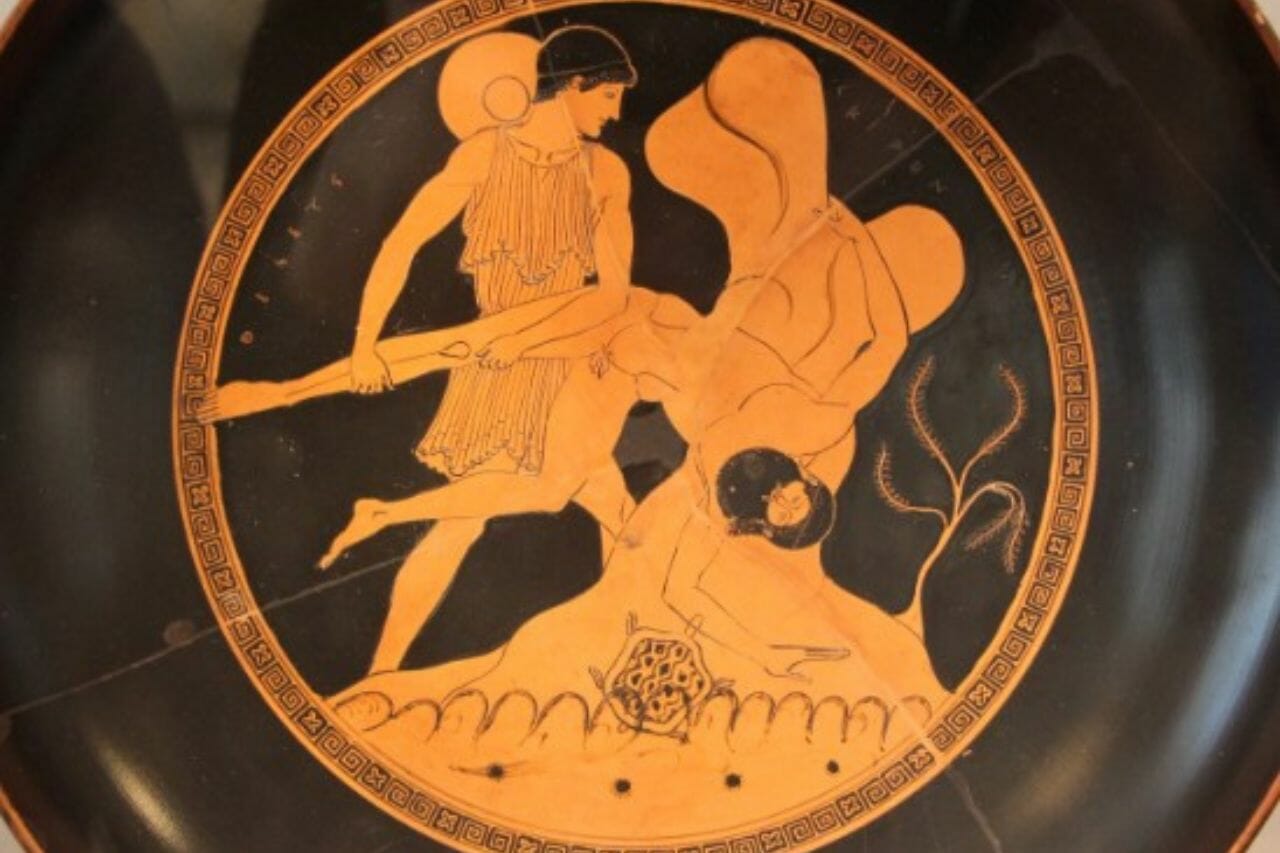
Sciron: is he a robber or a warrior

Sciron: is he a robber or a warrior

Here we bring you a detailed account of Sciron, the warlord and the robber, his origin, life, and death.

Sciron's Origin

Sceiron, Skeiron, and Scyron are all names of the same Greek mythology bandit, the Sciron god, whose origin story of Sciron is very confusing. His parentage has been attributed to many different sets of parents across literature which makes it impossible to decide who truly birthed Sciron. Here is a list of "possible parents of Sciron:"

  • Pelops and Hippodameia (King and Queen of Pisa)

  • Canthus (Arcadian Prince) and Henioche (Princess of Lebadea)

  • Poseidon and Iphimedeia (Thessalian Princess)

  • Pylas (King of Megara) and an unknown Mistress

The above list contains some of the wealthiest people of the time. It is, therefore, a mystery why Sciron reverted to a life of bandits and robbers. In the same way, we can look at the list and understand why and how Sciron must have managed to become a famous warlord. Nevertheless, in both cases, Sciron had access to a lavish lifestyle and also royalty.

Sciron married more than once and had many offsprings. Some of which would go down in history as great Greek warriors. Endeis and Alycus are the most mention-worthy children of Sciron. Endeis is the mother of Telamon and Peleus, the infamous Greek war heroes among which Alycus has a noble status as well.

Sciron The Robber

Most famously Sciron is known as a notorious robber who robbed travelers. In ancient times, the traveling parties would carry a lot of belongings with them because the journeys were long and no one was sure if they would make it back to their homes alive. Hence, precious things like gold, gems, and money were always found by travelers. Sciron took advantage of this.

He would wait in the shadows and when he saw a wealthy traveling party he would rob them. What Sciron would do next is both appalling and genius. He would take the travelers down a narrow path and ask them to wash their feet in the river. As soon as they would kneel before him, Sciron would push them into the river.

A humongous sea turtle would be waiting in the river to grab the travelers. By doing this, Sciron would get rid of any evidence of his robbery and also take all the riches for himself. This way of robbery and then removing the evidence from the scene has made Sciron famous in Greek mythology. Many movies and shows have also attempted to adapt the character of Sciron because of his wit and non-conventional ways of life.

Sciron The Warlord

Plutarch who is a Greek philosopher and biographer argued that Sciron was not a robber but a great man with exceptional warfare qualities. He identified Sciron as the Megarian warlord. The Greek biographer, Plutarch gives some good arguments as to why Sciron could not have been a mere robber but a magnificent warlord and Plutarch might be telling the truth.

Firstly, the list of possible parentage of Sciron enlists some of the wealthiest people of the time. Sciron would not need to get out of his comfort zone to even fetch a glass of water for himself. Secondly, even though Sciron was famous, his offsprings and grandchildren were even more famous. His son, Alycus was a great warrior in the Greek army and his daughter married King Aeacus of Aegina and has Telamon and Peleus.

Telamon and Peleus are very famous warriors in Greek mythology. Peleus married Thetis and was the father of the great Achilles. All in all, Sciron had a well-known and well-off family and his chances of being a robber are less than being a respected warlord.

Sciron's Appearance

Sciron had deep green-colored eyes and locks of curly black hair. He used to dress in long leather boots and leather breeches, furthermore, he is also known to wear a red bandana that would cover half of his face and a tucked-in pirate-style shirt. This looks and sits well with his robber persona.

For his appearance as a warlord, not many details are present. Surely, he must have worn the generic clothes of the army personnel of the time. Highly decorated and ornate clothes with accents of gold and blue color.

Sciron's Death

The mythology only narrates the death story of Sciron as the robber and not the warlord. The death of Sciron was unexpected but became a part of a much bigger and more elaborate plot. Theseus was a great hero of the Attic legend. He was the son of Aegeus, the King of Athens, and Aethra, the daughter of Pittheus, the King of Troezen.

When Theseus reached manhood, Aethra sent him to Athens, and on his way, Theseus encountered many adventures. He was a good man and believed in doing good for others. He came to know of a robber who would first rob and then push the travelers into the water, killing them with the help of a giant sea turtle.

He disguised himself as a mediocre traveler in a traveling party and waited for Sciron to show himself. As soon as Sciron came to rob the travelers, Theseus swing at his head making him unconscious.

Theseus flung Sciron off of the cliff, saving the travelers from a dire fate and this is how the story of Sciron who was the robber came to an end. Theseus then carried on with his journey to Athena and was remembered by the people as the mighty hero who got rid of a robber for them.

Conclusions

Sciron was a robber in ancient Greek mythology. Plutarch argued that he was a well-respected warlord. Here we followed both possibilities and explained the life and death of Sciron. Following are the most important points from the article:

  • Sciron is the son of one of the following pair of parents: Pelops and Hippodameia (King and Queen of Pisa), Canethus (Arcadian Prince) and Henioche (Princess of Lebadea), Poseidon and Iphimedeia (Thessalian Princess) or Pylas (King of Megara) and an unknown Mistress.

  • Sciron had a daughter, Endeis, and a son, Alycus. Endeis is the mother of Telamon and Peleus whereas Peleus is the father of Achilles. All these names have a good reputation in Greek mythology. Achilles is however the most famous in the lineage.

  • Sciron would rob the passing travelers. He would then ask them to wash their feet and take them down a narrow path, near a river. When they would kneel, Sciron would push them into the river where a huge sea turtle would eat the travelers.

  • Theseus killed Sciron when he was on his way to Athens. He came to know of a robber who would first rob and then kill the travelers by pushing them into the river. Theseus disguised himself as a traveling party and when Sciron came to rob them, he swung at him and later threw him down a cliff.
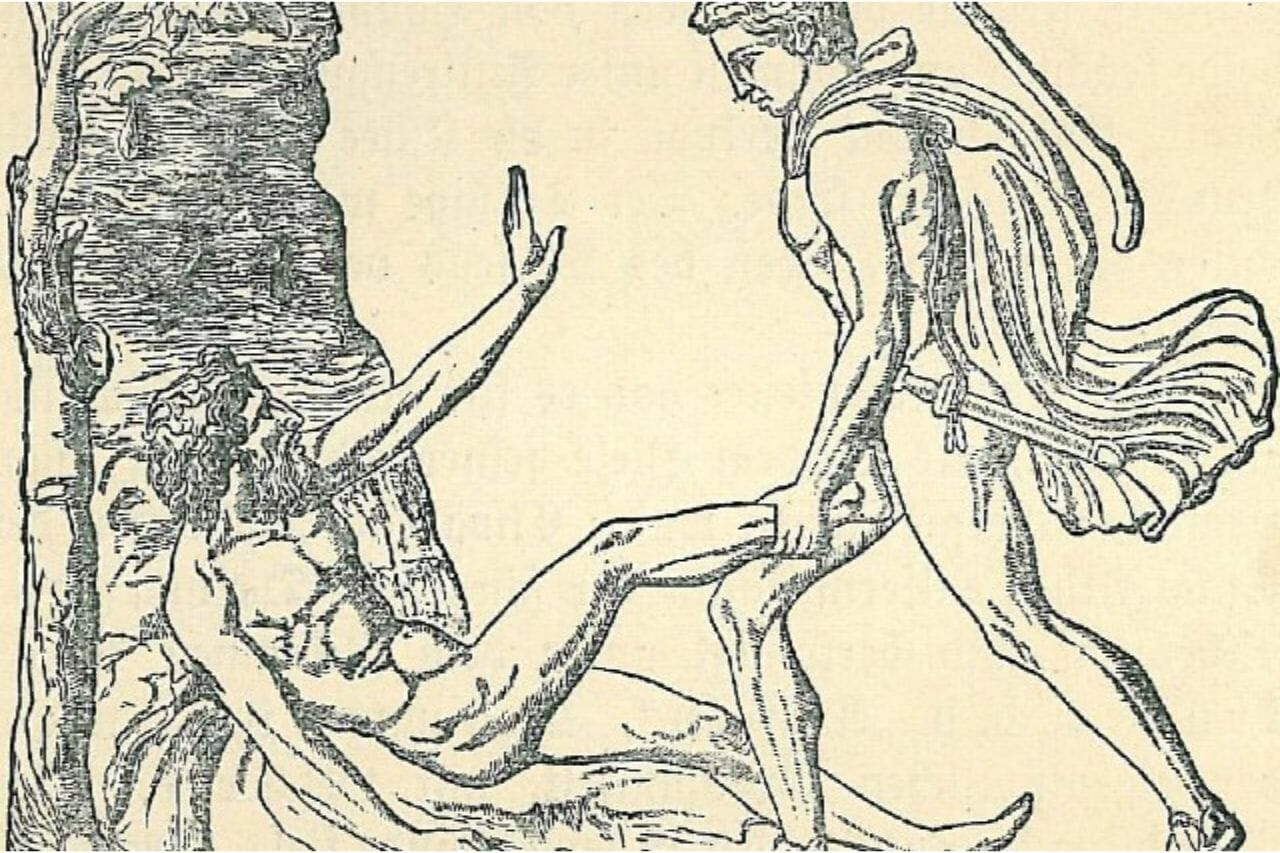
Sciron in Greek mythology

Sciron in Greek mythology

Sciron was surely an interesting character in Greek mythology but his descendants were more famous and widely known than him. Whether he was a robber or a warlord, Sciron left a mark in mythology. Here we come to the end of the tale of Sciron as a robber and also as a warlord.

By Ancient Literature

Created: February 16th, 2024

Modified: January 10th, 2025

Scyrus

Scyrus

Scyrus (Skyrus) was an Aegean island northeast of Euboea. Scyrus was famous because its king, Lycomedes, was host to the aging hero Theseus. Theseus either accidentally fell to his death, or Lycomedes murdered the hero by pushing him off a cliff. ...

August 8th, 1999 • Jimmy Joe
Nisus and Scylla

Nisus and Scylla

During Minos' campaign against Athens, the Cretan army attacked Megara, a kingdom in the Corinthian Isthmus that was allied with Athens. At the time of the siege, Megara's king was Nisus (Νἳσος), the son of Pandion, who was formerly a king of Athe...

September 22nd, 2002 • Jimmy Joe
Theseus

Theseus

Theseus, or Θησεύς, was the greatest hero from Athens. In many aspects he was like his more famous cousin Heracles, strong and extremely brave. Yet his courage and strength were matched with wisdom and compassion. Early Adventures War of the Lapit...

May 22nd, 1999 • Jimmy Joe
Scylla

Scylla

The six-headed monster that resided at the Strait of Messina. Scylla (Σκύλλη) was originally a beautiful maiden who was loved by a minor sea god named Glaucus. The sorceress Circe was in love with Glaucus, but the sea god did not return her love. ...

June 1st, 2000 • Jimmy Joe
Sisyphus

Sisyphus

Sisyphus (Σίσυφος) was the king of Ephyra (Corinth). Sisyphus was the son of Aeolus and Enarete. He was the brother of Cretheus, Athamas, Perieres and Salmoneus. He married a Pleiad named Merope and became the father of Glaucus (Glaucos), Ornytion...

April 27th, 1999 • Jimmy Joe
Aegeus and Theseus

Aegeus and Theseus

Some writers said that Aegeus (Αἐγεύς) was the son of Pandion II, the exiled king of Athens, and Pylia, daughter of Pylas, but the usual tales said that Aegeus was only Pandion's adopted son. This version said that Aegeus was actually the son of S...

January 13th, 2001 • Jimmy Joe
Giants and Monsters

Giants and Monsters

The genealogy above displays most of the principal monsters that are found in classical mythology. Most of the monsters were children of Typhon and Echidna, and of Phorcys and Ceto. Please note that Echidna was sometimes seen as the offspring of G...

September 29th, 2002 • Jimmy Joe
Aegeus: The Reason Behind the Name of Aegean Sea

Aegeus: The Reason Behind the Name of Aegean Sea

Aegeus is associated with founding Athens and being the father of Theseus. There are a lot of important events to his name in the mythology. The death of Aegeus Greek mythology was surely very tragic and a result of a misunderstanding and forgetfu...

February 15th, 2024 • Ancient Literature
Sinis: The Mythology of the Bandit Who Killed People for Sport

Sinis: The Mythology of the Bandit Who Killed People for Sport

Sinis was a robber who was cast out of the Isthmus of Corinth, probably due to his criminal activities. He spent the rest of his life on the road waiting for passersby who he would eventually rob and kill. He became sinister and struck fear in the...

February 16th, 2024 • Ancient Literature
Sicyon

Sicyon

Sicyon was situated on the west coast of the Gulf of Corinth, a city of Sicyonia. The only story of note was during the reign of Epopeus, when he married the girl Antiope, mother of Amphion and Zethus. Her father Nycteus (regent of Thebes) went to...

August 8th, 1999 • Jimmy Joe
Timeless Myths

Exploring mythology and legends from around the world.

Explore Myths

All Stories Characters All Articles Search Site Map

Mythologies

Norse Mythology Classical Mythology Celtic Mythology Arthurian Legends Mythology Gods Ancient Literature

About Us

Introduction About Jimmy Bibliography FAQs Retro Version

Resources

Timeless Myths All Stories All Articles Characters
© 1999-2026 Timeless Myths • Copyright • Privacy Policy • Cookie Policy • Contact
Follow us: