Sphinx Oedipus: The Origin of the Sphinx in Oedipus the King
The sphinx Oedipus was originally an Egyptian creation that was adopted by Sophocles in his tragic play, Oedipus Rex. The gods sent the creature to kill the Thebans, probably as punishment for the sins of a previous king.
The humanlike animal gave a difficult riddle to its victims and killed them if they were not able to solve them, except Oedipus. Read on to find out the origins of the sphinx, what the riddle was, and how Oedipus solved it.
What Is Sphinx Oedipus?
Sphinx Oedipus Rex is a beast that had the features of a woman and several animals who plagued the people of Thebes night and day, in Greek mythology. The Thebans cried for help until Oedipus came, killed the sphinx, and set the Thebans free.
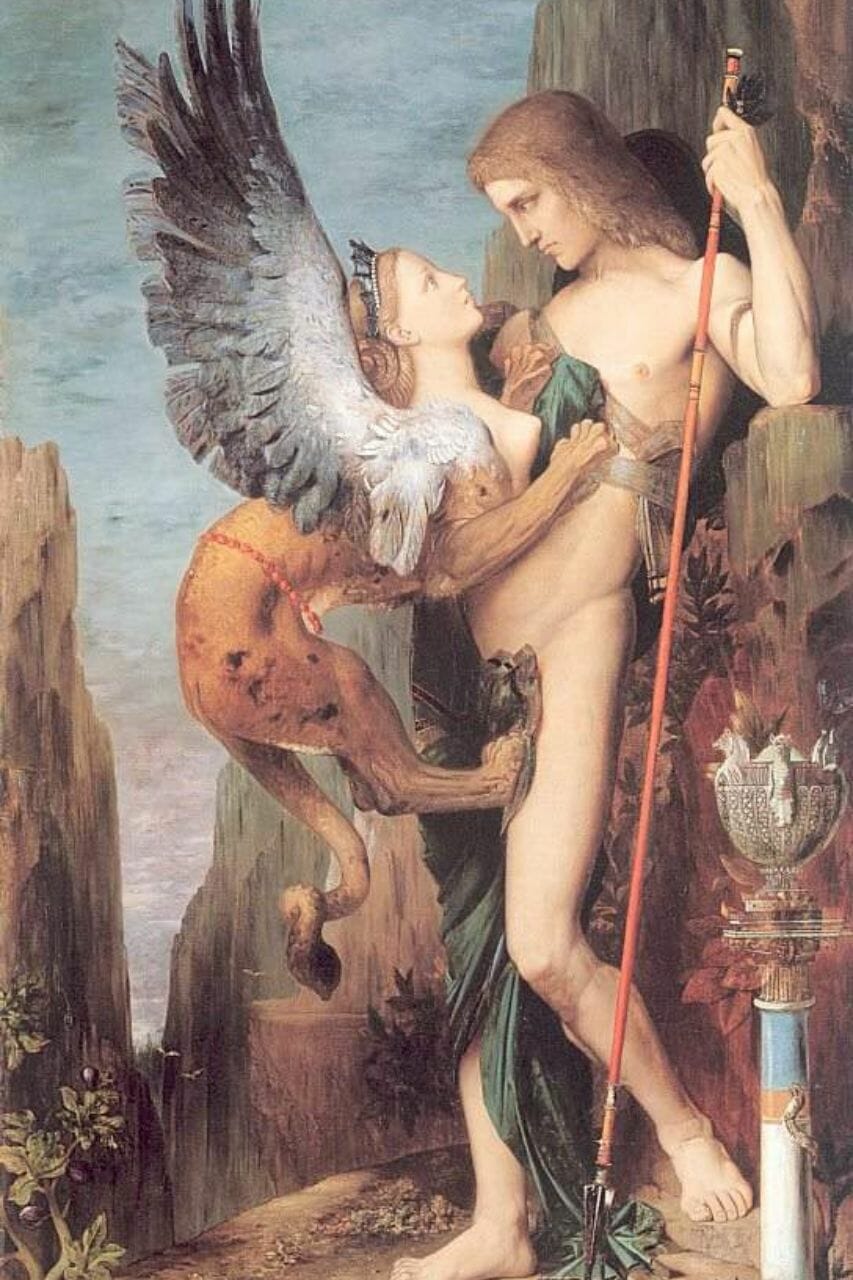
The Sphinx poses her famous riddle to Oedipus
The Description of the Sphinx Oedipus
In the play, the sphinx is described as having the head of a woman and the body and tail of a lion (other sources say she has the tail of a serpent). The monster had paws just like the big cat but had the wings of an eagle with the breasts of a woman.
The height of the sphinx was not mentioned but several artworks depict the creature to be a giantess. Others believed that the monster was just the size of an average person but possessed superhuman power and strength.
The Role of the Sphinx Oedipus Rex
Though the sphinx appears only once in the play, her impact on the events could be felt right to the very end, which was to frighten everyone.
To Terrorize the People of Thebes
The main role of the creature was to kill the Thebans as punishment for either their crimes or the crimes of a king or noble. Some sources narrate that the creature was sent by Hera to punish the city of Thebes for their refusal to bring Laius to book for abducting and raping Chrysippus. She carried off the youth of the city to feed on and on some days stood at the entrance of the city, presenting wayfarers with a difficult riddle.
Anyone who could not solve the riddle became her fodder forcing the Theban regent, Creon, to issue an edict that anyone who could solve the riddle would have the throne of Thebes. The monster promised to kill herself if anyone answered her puzzle. Unfortunately, all who tried to solve the mystery failed and the sphinx fed on them. Fortunately, on a journey from Corinth to Thebes, Oedipus encountered the sphinx and solved the puzzle.
The Sphinx Had a Hand in Making Oedipus King of Thebes
Once Oedipus solved the riddle, the creature died by throwing herself off the cliff, and immediately, he was crowned king.
Thus, had the sphinx not plagued the Thebans, there was no way that Oedipus would be king of Thebes. First, he was not from Thebes (at least, according to Oedipus), talking less of being part of the Theban royal family. He was from Corinth and was the son of King Polybus and Queen Merope. Thus, his inheritance was in Corinth, not Thebes.
Of course, later in the story, we realize that Oedipus was actually from Thebes and was a royal. He was born to King Laius and Queen Jocasta but was sent to death as a baby because of a prophecy. The gods had prophesied that baby Oedipus would grow up to kill his father and marry his mother, and the only way to prevent it was to kill him.
However, by a twist of fate, the young boy ended up in the palace of King Polybus and Queen Merope of Corinth. However, Polybus and Merope refused to inform Oedipus that he was adopted, thus, the boy grew up thinking he was a Corinthian royal. Sophocles, therefore, introduced the sphinx to help Oedipus ascend the throne of Thebes, for it is no coincidence that only he could solve the puzzle. Thus, the sphinx in Oedipus Rex had a hand in crowning the main character, king of the city of Thebes.
The Oedipus Sphinx Served as an Instrument of the Gods
Though Oedipus answered the riddle and saved the Thebans, little did he know that he was rather facilitating the punishment of the gods. As we discovered in the previous paragraphs, the sphinx was sent to punish the Thebans for the crime of their King Laius. Oedipus was the son of King Laius, therefore, he also deserved punishment for the sins of his father. Some literature enthusiasts believe the punishment of Laius should have only been reserved for Laius' household (Oedipus included) and not the entire Thebes.
The gods, through the death of the sphinx, were setting Oedipus up for his punishment for killing his father, albeit unknowingly. On his way from Corinth, he encountered an older man traveling in the opposite direction. An argument ensued and Oedipus ended up killing the man at the path where the three-way crossroads. Unfortunately for Oedipus, the man he just killed was his biological father but the all-knowing gods knew and decided to punish him.
By solving the sphinx's riddle, Oedipus was ready to serve his punishment. He was made the King of Thebes and given the hand of the queen in marriage. Oedipus did not know that Jocasta was his biological mother, and he conducted no investigations before accepting the kingship and agreeing to marry Jocasta. Thus, he fulfilled the gods' punishment, and when he realized the abomination he had committed, he gouged out his eyes.
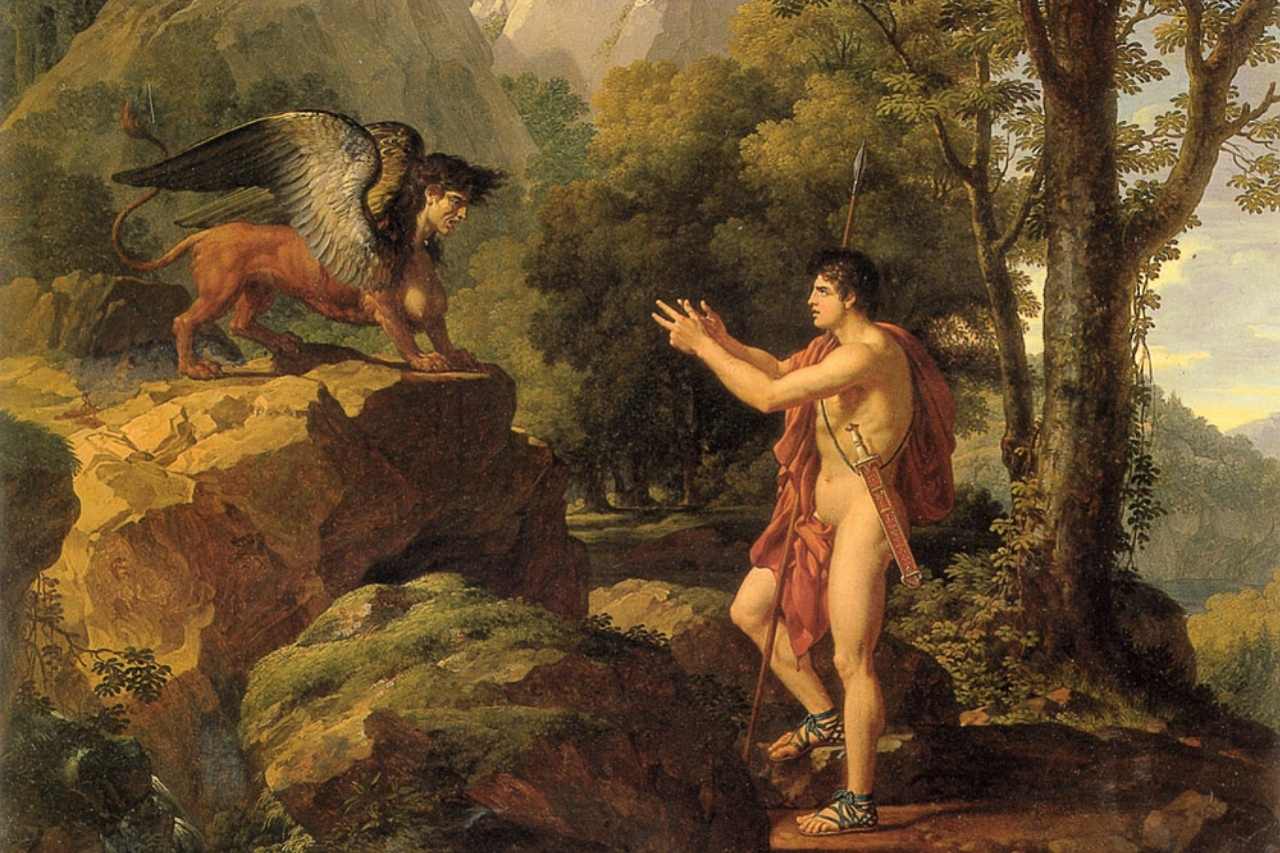
Oedipus confronts the Sphinx outside Thebes
Sphinx Oedipus Riddle
In Oedipus and the Sphinx summary, the tragic hero, Oedipus, encountered the creature at the entrance to the city of Thebes. Oedipus could not pass unless he answered the riddle posed by the monster. The puzzle was: "What walks on four feet in the morning, two in the afternoon, and three at night?"
Oedipus answered, "Man" and then he explained, "as an infant, he crawls on all four, as an adult, he walks on two legs, and in old age, he uses a walking stick." True to his words, the monster killed herself after Oedipus correctly answered her riddle.
The Origin of the Creature of Sphinx Oedipus
Many scholars believe that the sphinx originated from Egyptian folklore and art, where the creature was viewed as a protector of royals. Therefore, the Egyptians built statues of sphinxes near or at the mouth of royal tombs to protect them. It was very different from the vicious sphinxes of the Greeks, which killed their victims. The Egyptian sphinx was associated with the sun god Ra and was believed to fight the enemies of the pharaohs.
This is why the Great Sphinx was built before the Great Pyramid. Egyptologists discovered a stele called the Dream Stele at the foot of the Great Sphinx. According to the stele, Thutmose IV had a dream in which the beast promised him to become Pharaoh. The sphinx then revealed its name Horemakhet, meaning 'Horus on the Horizon.'
The sphinx was then adopted into Greek folklore and plays, with the most significant mention being in the play Oedipus Rex by Sophocles. In Greek culture, the sphinx was vicious and protected no one but looked only to her interests. Before she devoured her victims, she gave them a shot at life by presenting a complicated riddle. Failure to solve it meant their death, usually the result.
Oedipus and The Sphinx Painting
The scene between Oedipus and the sphinx has been a subject of several paintings, with the famous painting made by the French painter Gustave Moreau. Gustave's image, Oedipus and the Sphinx, was first displayed in a French Salon in 1864.
The oil on canvas artwork became an instant success and is still admired today. The Gustave Moreau painting features the scene in the Oedipus story where Oedipus answers the sphinx's riddle. Other paintings by Gustave Moreau include Jupiter and Semele, Salome Dancing Before Herod, Jacob and the Angel, The Young Man and Death, Hesiod and the Muses, and Thracian Girl Carrying the Head of Orpheus on his lyre.
François Émile-Ehrman also has a painting titled Oedipus and the Sphinx 1903 to distinguish it from Moreau's work. Oedipus and the Sphinx Gustave Moreau is one of the best in art history and is displayed at the Metropolitan Museum of Art, New York. Jean-Auguste-Dominique Ingres painted the scene between Oedipus and the Sphinx in 1808. The painting shows Oedipus answering the riddle of the Sphinx.
Conclusion
So far, we've encountered the story of the sphinx in Oedipus Rex and the role she played in facilitating the events of the play. Here is a recap of what we've discovered:
The sphinx had the head and breasts of a woman with the body of a lion, a serpent's tail, and an eagle's wings.
The creature stood at the entrance to the city and blocked Oedipus's passage unless he answered her riddle.
Answering her riddle correctly meant she would commit suicide and whoever got the answer wrong would be killed.
Oedipus answered her riddle correctly, which led to the death of the sphinx.
Oedipus became King of Thebes after the sphinx's death and unknowingly fulfilled his destiny.
The subject of the Oedipus and the creature has captured the interests of many artists over the centuries. Several paintings exist of the scene where Oedipus is answering the riddle of the Sphinx.