Timeless Myths Logo

Explore myths and legends from cultures around the world

Featured

Classical Mythology
Classical Mythology Greek and Roman myths, gods, heroes, and epic tales
Norse Mythology
Norse Mythology Vikings, Asgard, Ragnarok, and the nine realms
Celtic Mythology
Celtic Mythology Irish, Welsh, and Gaelic legends and folklore
Ancient Literature
Ancient Literature Classical texts, translations, and literary analysis

All Mythologies

Arthurian Legends King Arthur, Camelot, the Round Table, and the Holy Grail Egyptian Mythology Pharaohs, pyramids, and ancient Nile deities Japanese Mythology Shinto gods, spirits, and legendary creatures Chinese Mythology Dragons, immortals, and celestial beings Aztec Mythology Mesoamerican gods, rituals, and creation myths

Discover gods and goddesses from every pantheon

Featured

Greek Gods
Greek Gods The Olympians, Titans, and primordial deities
Norse Gods
Norse Gods Odin, Thor, Loki, and the Aesir and Vanir
Egyptian Gods
Egyptian Gods Ra, Osiris, Isis, Anubis, and more
Japanese Gods
Japanese Gods Amaterasu, Susanoo, and Shinto kami

All Gods & Deities

Roman Gods Jupiter, Mars, Venus, and the Roman pantheon Celtic Gods The Tuatha Dé Danann and Celtic deities Aztec Gods Quetzalcoatl, Tezcatlipoca, and Aztec deities Chinese Gods Jade Emperor, Dragon Kings, and celestial beings View All 150+ Deities Browse the complete collection of mythological deities
View all gods & deities

Tales, legends, and character profiles from mythology

Featured

All Stories
All Stories Browse 800+ mythology and history stories
Characters
Characters Profiles of 67 mythological heroes, gods, and villains

All Stories

Mythology Stories Ancient myths and legends retold History Stories Historical tales from ancient civilizations Religion & Culture Religious traditions and cultural beliefs
View all stories

Tools, references, and site information

Featured

Name Generators
Name Generators Generate fantasy and mythology-inspired names
All Articles
All Articles Browse 1,800+ articles on mythology and history

All Resources

About Timeless Myths Learn about this mythology resource Bibliography Sources and references used on this site FAQ Frequently asked questions Contact Get in touch with us
Search
Classical Mythology Greek and Roman myths, gods, heroes, and epic tales Norse Mythology Vikings, Asgard, Ragnarok, and the nine realms Celtic Mythology Irish, Welsh, and Gaelic legends and folklore Arthurian Legends King Arthur, Camelot, the Round Table, and the Holy Grail Egyptian Mythology Pharaohs, pyramids, and ancient Nile deities Japanese Mythology Shinto gods, spirits, and legendary creatures Chinese Mythology Dragons, immortals, and celestial beings Aztec Mythology Mesoamerican gods, rituals, and creation myths Ancient Literature Classical texts, translations, and literary analysis
Greek Gods The Olympians, Titans, and primordial deities Roman Gods Jupiter, Mars, Venus, and the Roman pantheon Norse Gods Odin, Thor, Loki, and the Aesir and Vanir Egyptian Gods Ra, Osiris, Isis, Anubis, and more Celtic Gods The Tuatha Dé Danann and Celtic deities Aztec Gods Quetzalcoatl, Tezcatlipoca, and Aztec deities Japanese Gods Amaterasu, Susanoo, and Shinto kami Chinese Gods Jade Emperor, Dragon Kings, and celestial beings View All 150+ Deities Browse the complete collection of mythological deities View all gods & deities
All Stories Browse 800+ mythology and history stories Characters Profiles of 67 mythological heroes, gods, and villains Mythology Stories Ancient myths and legends retold History Stories Historical tales from ancient civilizations Religion & Culture Religious traditions and cultural beliefs View all stories
Name Generators Generate fantasy and mythology-inspired names All Articles Browse 1,800+ articles on mythology and history About Timeless Myths Learn about this mythology resource Bibliography Sources and references used on this site FAQ Frequently asked questions Contact Get in touch with us
Search Search the entire mythology archive

Analyzing Similes in The Odyssey

greek-mythology

Similes in The Odyssey gave perception and depth to both the greek classic and monologues done by our beloved characters.

They helped shape the classic we know today. A simile is a figure of speech where two, unlike things, are compared.
Similes in the Odyssey

How Similes Shaped The Odyssey

Homer uses similes to create a better and exaggerated description of specific actions in The Odyssey, giving the audience the impact needed to understand. The comparisons from each simile are straightforward and allow the audience to discern the idea made by the author.

Without such, the play would appear bland and lack the recurring themes the audience enjoys to this day. Epic similes in the Odyssey can be seen when Odysseus recounts his adventure to the Phaeacians.

He utilizes multiple similes to create depth and perception, allowing the Phaeacians to experience and feel Odysseus' journey as if they were there with him, gaining their sympathies and help.

List of Epic Similes in The Odyssey

Similes are found throughout The Odyssey. Some are seen in the battle of the cyclops, others on the island of the Laestrygonians, and some in the despair of Penelope, Odysseus' wife, as she struggles to contain the suitors wanting her hand in marriage.

The scattered similes throughout the play are used as a guide, a way for the audience to visualize tales of Odysseus and understand the problematic journey he had gone through. This gives us, the audience, a way to further acknowledge our heroes' merits and just how strong his character is as a whole.

Odysseus Recounts His Story to the Phaeacians

As Odyssey recounts his travels to the Phaeacians, he talks about the battle with Polyphemus. He states, "I drove my weight on it from above and bored it home like a shipwright bores his beam with a shipwright's drill that men below, whipping the strap back and forth, whirl and the drill keeps twisting, never stopping. So we seized our stake with its fiery tip and bored it round and round in the giant's eye"

This Homeric simile in the Odyssey describes his battle with the giant, comparing it to a shipwright. We can surmise that Odysseus used this example to give the Phaeacians a better glimpse of how the action took place. The simile was used to create a distinct perception that the audience, the Phaeacians, can use to visualize the battle itself.

He then continues the story of the and says, "as a blacksmith plunges a glowing ax or adze in an ice-cold bath and the metal screeches steam and its temper hardens – that's the iron's strength – so the eye of Cyclops sizzles around that stake." This can be noted as a figurative language in the Odyssey. Odysseus compares the Cyclops' eye's sizzling sound to that of sticking hot metal into a cold bucket of water.

Next, he talks about the Laestrygonians, to which he stated, "They speared the crews like fish and whisked them home to make their grisly meal," conveying how normal and familiar it was to torture and brutalize human on the strange island.

The Laestrygonians were considered ruthless monsters, hunting his men left and right for dinner. He continues his tales up to his adventures in the Underworld.

Odysseus in the Journey to the Underworld
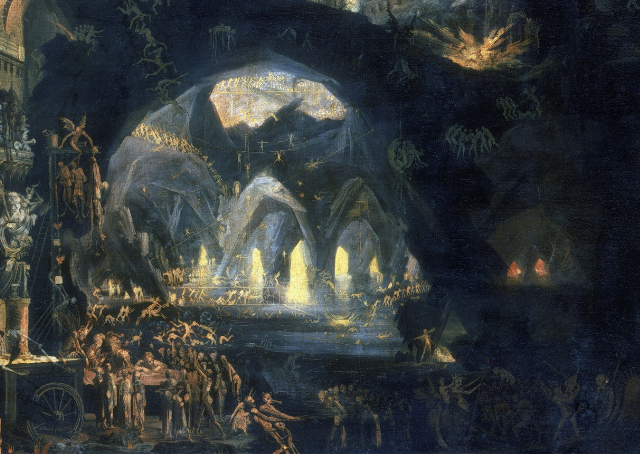
Odysseus journey to the Underworld in the Odyssey

Some similes can be seen during Odysseus' travel to the Underworld to seek out Tiresias. Circe instructed him to summon his spirit by sacrificing a sheep and pouring its blood in a pit. Souls have an affinity to blood, and doing so would attract souls to his pit and hold off the spirits till Teiresias arrives.

As he describes it, "Here slowly came a grand array of women, all sent before me now by august Persephone, and all were wives and daughters once of princes. They swarmed in a flock around the dark blood."

Although considered one of the metaphors in The Odyssey, Odysseus compares the women as frocks—evidently less human because they have lost an essential aspect of themselves in death.

Homeric Similes in the Journey

In a state of torment before Odysseus returns, Penelope was described as "Her mind in torment, wheeling like some lion at bay, dreading the gangs of hunters closing their cunning ring around him for the finish." Penelope expresses her helplessness in this clause by comparing the suitors as hunters and herself to a trapped lion, the noblest animal of them all, ironically trapped by her prey.

Another figurative language in The Odyssey is that of the battle of the suitors. It was described as "Weak as the doe that beds down her fawns in a mighty lion's den – her newborn sucklings – then trail off to the mountain spurs and grassy bends to graze her fill, but back the lion comes to his lair, and the master deals both fawns a ghastly, bloody death, just what Odysseus will deal that mob – ghastly death."

Noting how Odysseus is compared to a lion and the fawns are the suitors. The suitors are to be taught a valuable lesson of entering the lion's den without permission, coveting someone else's wife.

And lastly, the last Homeric simile in The Odyssey is seen in the last leg of the play.

"After the massacre in the palace, Odysseus compares the piles of the dead body to that of a fisherman's catch. He says, "Think of a catch that fishermen haul into a Halfmoon bay in a fine-meshed net from the white caps of the sea: how all are poured out on the sand, in throes for the salt sea, twitching their cold lives away in Helios' fiery air: so lay the suitors heaped on one another." This allows the images of rot and decay to conjure.

Conclusion

Person reading about the major similes in The Odyssey

We've discussed the major similes in The Odyssey and how they shaped the play.

Let's go over some of the critical points of this article:

  • A simile is the comparison of two unlike things linked with "as" or "like" to denote comparison.

  • Similes are made to create a more significant depth, helping the audience understand what the author wants to express and the magnitude of his expression.

  • Without similes, the audience may be unable to comprehend and understand the depth each character's trials and tribulations must go though

  • When Odysseus recounts his journey to the Phaeacians, he starts with the battle with Polyphemus. He compares the struggle to that of a shipwright.

  • In the Island of the Laestrygonians, Odysseus described them as ruthless, going as far as recounting the gruesome deaths his men had to face and how he and his men were hunted like pigs for dinner.

  • In his journey to the Underworld, Odysseus describes his encounter with the spirits, comparing them to frocks—having lost part of their humanity in death, the souls he's encountered flock towards him like a goose looking for a break.

  • Similes were made to describe Penelope's sense of hopelessness—like that of a trapped lion being preyed upon by hunters.

  • The last simile compared the dead suitors' bodies to a fisherman's catch and how their piled-up bodies were equal quantities to that of fish.

In conclusion, similes create a more significant perception of what is written; the Homeric Similes impact The Odyssey so that the audience can grasp the bigger picture being painted by the illustrator.

Odysseus utilizes this method to garner the sympathy of the Phaeacians. In the end, through Odysseus' storytelling, the Phaeacians safely escort our hero home, where he saves both his family and homeland.

By Ancient Literature

Created: February 15th, 2024

Modified: January 11th, 2025

Odyssey

Odyssey

The Voyage Home Return to IthacaThe Voyage HomeOdyssey Odyssey is an epic poem, written by Homer, about the adventures of the Greek hero Odysseus (Ὀδυσσεύς). Odysseus was the son of Laërtes (Laertes) and Anticleia. Odysseus had married Penelope, a...

May 17th, 1999 • Jimmy Joe
Homeric Epithets – The Rhythm of Heroic Descriptions

Homeric Epithets – The Rhythm of Heroic Descriptions

Homeric epithets appear throughout the epic works and help ground the listeners in the writer's expressions of the people and places described. Epithets are more than just flowery descriptive language. They contribute to the poem's form, upholding...

February 16th, 2024 • Ancient Literature
In What Way Is the Odyssey an Epic: A Comprehensive Analysis

In What Way Is the Odyssey an Epic: A Comprehensive Analysis

An epic poem tells the story of heroic acts or significant historical or mythological events. In Homer's Odyssey, the poem recounts Odysseus' epic journey on his way back home. However, how was the poem considered an epic one? Continue reading to ...

February 16th, 2024 • Ancient Literature
Heroism in the Odyssey: Through the Epic Hero Odysseus

Heroism in the Odyssey: Through the Epic Hero Odysseus

Heroism in the Odyssey is one of the prevalent themes easily recognizable in this timeless piece of literature similar to the case of any other epic. Different characters displayed different versions of heroism, and in some cases, you may not read...

February 16th, 2024 • Ancient Literature
Allusions in The Odyssey: Hidden Meanings

Allusions in The Odyssey: Hidden Meanings

In understanding the allusions in The Odyssey, a connection must be made between the reader and the author, who both share an appreciation for knowledge before the reference is made. An allusion is an implied or indirect reference to a person, eve...

February 15th, 2024 • Ancient Literature
Iliad vs Odyssey: A Tale of Two Epics

Iliad vs Odyssey: A Tale of Two Epics

While the Iliad vs Odyssey question is related and even considered sequential by some, there are various subtle and not-so-subtle differences. For example, The Iliad is more liberal with its mixing of the paranormal and fantasy and the mundane. Th...

February 16th, 2024 • Ancient Literature
Symbols in the Odyssey: What Is Their Significance?

Symbols in the Odyssey: What Is Their Significance?

Symbols in the Odyssey can also be seen as allegories in the Odyssey; however, it may seem that the poem is just about the story of a Greek hero and his homecoming while fighting numerous monsters and supernatural phenomena. Here, we've looked at ...

February 16th, 2024 • Ancient Literature
What is an Example of an Epic Simile: Definition and Four Examples

What is an Example of an Epic Simile: Definition and Four Examples

A simile is a figure of speech in which one thing is likened to another in such a way as to clarify and enhance an image. It is an explicit comparison, easily recognizable by using the words "like" or "as," unlike the metaphor, where the said comp...

February 16th, 2024 • Ancient Literature
Irony in the Odyssey: A Literary Device

Irony in the Odyssey: A Literary Device

Irony in the Odyssey was used by its author, Homer, in writing his epic poem. Irony refers to a situation expressing a contrast between reality and expectation. As a figure of speech, irony has three common kinds: verbal irony, situational irony, ...

February 16th, 2024 • Ancient Literature
Epithets in the Iliad: Titles of Major Characters in the Epic Poem

Epithets in the Iliad: Titles of Major Characters in the Epic Poem

The epithets in the Iliad are replete with that are usually titles that praise a character or reveal their unique characteristics. Since the Iliad is a poem and meant to be recited, many scholars believe that epithets help the narrator to remember...

February 17th, 2024 • Ancient Literature
Timeless Myths

Exploring mythology and legends from around the world.

Explore Myths

All Stories Characters All Articles Search Site Map

Mythologies

Norse Mythology Classical Mythology Celtic Mythology Arthurian Legends Mythology Gods Ancient Literature

About Us

Introduction About Jimmy Bibliography FAQs Retro Version

Resources

Timeless Myths All Stories All Articles Characters
© 1999-2026 Timeless Myths • Copyright • Privacy Policy • Cookie Policy • Contact
Follow us: