Gegeines: The Greek Mythology of the Six-Armed Giants of the Propontis
Who Are the Gegeines?
The Gegeines is a mythical creature with six arms that lived on the Marmara Sea coast in Asia Minor. In the epic poem, Argonautica, the Gegeines fought Jason and his men but were unsuccessful. The name also refers to other giants such as Orion, the Actiorione, and Typhon.
The Myth of the Six-Armed Creatures
Jason and the Argonauts stopped over at the island of the Gegeines after their adventure on the island of Lemnos. Jason was on an adventure to retrieve the Golden Fleece from Colchis, sent by his uncle Pelias.
His first stop was the island of Lemnos inhabited by women who had just killed all their husbands. Jason and his men fell in love with the women and almost lost focus but on the timely intervention of Heracles who reminded them of their mission.
They came to an island on the Propontis and settled among the Doliones; a tribe famous for their hospitality. The King of the Doliones, Cyzicus, welcomed them with open arms much to the anger of the Gegeines also known as Earthborn.
When the day broke, Jason and some of his men went to Mount Dindymon to think about their next journey while the others stayed with the ship. The men who stayed with the ship felt it was not secure thus they pulled it to the port of Kyzikos, the capital of the island.
Attack on Argonauts
However, little did they know that their presence in Kyzikos would provoke an attack from the Geigenes. Right after their landing in Kyzikos, the Gegeines pulled a surprise attack throwing huge boulders at them.
They blocked the port to prevent the Argonauts from escaping or calling for reinforcements. Luckily, the Argonauts had Heracles within their ranks who laid waste to some of the Gegeines.
Undeterred, the Gegeines continued the onslaught, this time, turning their attention to Jason and his men. With the backing of Hera, the eternal enemy of Heracles, the Geigenes threw more boulders at the Argonauts.
Jason and the men that went with him to the mountain returned and they joined the battle with the giants. Finally, the Argonauts defeated the Geigenes and were able to retrieve their ship from the port of Kyzikos.
Characters Who Bore the Epithet in Greek Mythology
There are different mythologies that had to do with this giant that had six arms, below is the list:
Typhon
Typhon was a serpentine giant who fought Zeus over the kingship of the gods and control of the cosmos. He was the son of Tartarus, who was the god of Hell, and Gaia who was the mother goddess, Earth, according to Hesiod's Theogony while other sources name Hera as his only parent. Typhon married the giant half-woman half-snake known as Echidna and the couple brought forth many monsters.
His epic battle with Zeus shook the whole cosmos and caused an earthquake that generated gigantic waves in the sea. So great was the earthquake that Hades in the imprisoned Titan trembled. However, Zeus prevailed after he hurled a series of lightning bolts at the monster and later buried him in Tartarus.
Hippolytus Giant
Hippolytus was a member of the Giants race that took part in the Gigantomachy for the supremacy of the universe. The Gigantomachy was a war between the Olympian gods and the Giants who were the offspring of the goddess Gaia and her husband Uranus. Though these creatures fought bravely, then again they were no match for the Olympian gods as the Olympians trounced them.
Hippolytus, in particular, was slain by Athena according to some versions of the myth. Other accounts state that it was a combination of Athena and Heracles or Athena and some other Olympian gods.
Orion the Giant
Orion was a giant hunter who was turned into the Constellation that bears his name by Zeus. Many versions of his mythology exist but the common theme is that he was born in Boeotia and visited the island of Chios.
At Chios he caught the eye of princess Merope but couldn't control his sexual urges thus he raped her. Her father, King Oenopions, became angry and blinded Orion forcing him to seek healing at Lemnos.
Orion also hunted with Artemis, the goddess of the hunt, and subsequently died at the bow of the goddess. Other accounts claim he died by the sting of a giant scorpion and he was sent to live in the heavens as the Constellation Orion while the scorpion became Scorpio.
Argus Panoptes
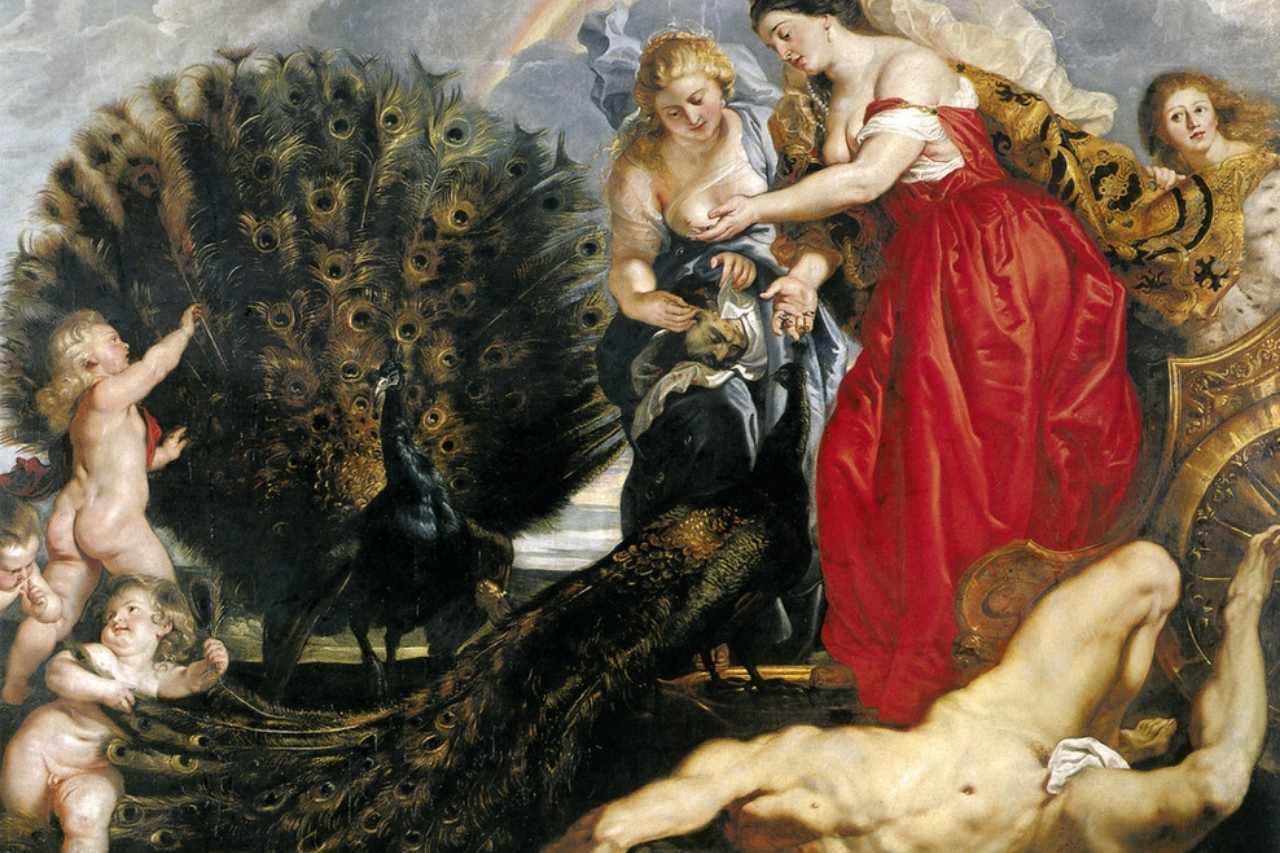
Argus was a giant with 100 eyes and it was believed that nothing escaped his attention because he never slept. When Hera caught Zeus having an affair with the nymph Io, Zeus quickly transformed the nymph into a white heifer to deceive Hera.
However, Hera still suspected Zeus of cheating so she employed Argus to guard the heifer knowing the cunning nature of her husband. He, wanting to be with Io, asked Hermes the rescue his lover from the giant, Argus.
Hermes succeeded in making Argus sleep by playing his melodious music. He later slew the giant by cutting off his head earning him the nickname Argeiphontes which meant Argus Slayer. Hera realized what her husband had done and decided to reward Argus for his efforts. She took the 100 eyes of the giant and placed them on the feathers of the royal bird, the peacock.
Modern Adaptations
The Gegeines are present in Rick Riordan's book series Percy Jackson and the Olympians where they are depicted as six-armed giants. They are also referred to as Earthborn and they reside on an island close to Bear Mountain.
The Gegeines are about seven feet tall and possess superhuman strength which allows them to hurl large sharp boulders. The giants often move about in loincloth and become clay when they are defeated.
Gegenees Pronunciation and Meaning
The name is pronounced |gee-y-en-eh-ess| and gegeneis meaning is Earthborn.
Conclusion
So far we've been reading about the Gegeines in Greek mythology and other characters who shared the epithet 'Gegeines'. Here is a recap of all that we've discovered:
Originally, Gegeines were a race of giants that lived on an island on the Mamara Sea in Asia Minor, however, the term is also an epithet used for other giants.
According to the epic poem Argonautica, Gegeines were six-armed giants who fought Jason and the Argonauts by hurling huge stones at them.
Heracles fought back the Gegeines and routed them but the giants won't give up and kept throwing huge stones until Jason and the other Argonauts arrived.
The Gegeines finally give up and Jason and the Argonauts can retrieve their ship from the docks and set sail for Colchis to fulfill their mission.
Other giants that bore the epithet Gegeines include Argus, Hippolytus and Orion who was turned into a Constellation by Zeus after he died at the hands of Artemis.
The modern adaptation of the Geigenes characters is found in Rick Riordan's book series, Jason and the Argonauts. In the books, the Geigenes also referred to as Earthborn, are similar to the original ones except for where they live and their powers.