Timeless Myths Logo

Explore myths and legends from cultures around the world

Featured

Classical Mythology
Classical Mythology Greek and Roman myths, gods, heroes, and epic tales
Norse Mythology
Norse Mythology Vikings, Asgard, Ragnarok, and the nine realms
Celtic Mythology
Celtic Mythology Irish, Welsh, and Gaelic legends and folklore
Ancient Literature
Ancient Literature Classical texts, translations, and literary analysis

All Mythologies

Arthurian Legends King Arthur, Camelot, the Round Table, and the Holy Grail Egyptian Mythology Pharaohs, pyramids, and ancient Nile deities Japanese Mythology Shinto gods, spirits, and legendary creatures Chinese Mythology Dragons, immortals, and celestial beings Aztec Mythology Mesoamerican gods, rituals, and creation myths

Discover gods and goddesses from every pantheon

Featured

Greek Gods
Greek Gods The Olympians, Titans, and primordial deities
Norse Gods
Norse Gods Odin, Thor, Loki, and the Aesir and Vanir
Egyptian Gods
Egyptian Gods Ra, Osiris, Isis, Anubis, and more
Japanese Gods
Japanese Gods Amaterasu, Susanoo, and Shinto kami

All Gods & Deities

Roman Gods Jupiter, Mars, Venus, and the Roman pantheon Celtic Gods The Tuatha Dé Danann and Celtic deities Aztec Gods Quetzalcoatl, Tezcatlipoca, and Aztec deities Chinese Gods Jade Emperor, Dragon Kings, and celestial beings View All 150+ Deities Browse the complete collection of mythological deities
View all gods & deities

Tales, legends, and character profiles from mythology

Featured

All Stories
All Stories Browse 800+ mythology and history stories
Characters
Characters Profiles of 67 mythological heroes, gods, and villains

All Stories

Mythology Stories Ancient myths and legends retold History Stories Historical tales from ancient civilizations Religion & Culture Religious traditions and cultural beliefs
View all stories

Tools, references, and site information

Featured

Name Generators
Name Generators Generate fantasy and mythology-inspired names
All Articles
All Articles Browse 1,800+ articles on mythology and history

All Resources

About Timeless Myths Learn about this mythology resource Bibliography Sources and references used on this site FAQ Frequently asked questions Contact Get in touch with us
Search
Classical Mythology Greek and Roman myths, gods, heroes, and epic tales Norse Mythology Vikings, Asgard, Ragnarok, and the nine realms Celtic Mythology Irish, Welsh, and Gaelic legends and folklore Arthurian Legends King Arthur, Camelot, the Round Table, and the Holy Grail Egyptian Mythology Pharaohs, pyramids, and ancient Nile deities Japanese Mythology Shinto gods, spirits, and legendary creatures Chinese Mythology Dragons, immortals, and celestial beings Aztec Mythology Mesoamerican gods, rituals, and creation myths Ancient Literature Classical texts, translations, and literary analysis
Greek Gods The Olympians, Titans, and primordial deities Roman Gods Jupiter, Mars, Venus, and the Roman pantheon Norse Gods Odin, Thor, Loki, and the Aesir and Vanir Egyptian Gods Ra, Osiris, Isis, Anubis, and more Celtic Gods The Tuatha Dé Danann and Celtic deities Aztec Gods Quetzalcoatl, Tezcatlipoca, and Aztec deities Japanese Gods Amaterasu, Susanoo, and Shinto kami Chinese Gods Jade Emperor, Dragon Kings, and celestial beings View All 150+ Deities Browse the complete collection of mythological deities View all gods & deities
All Stories Browse 800+ mythology and history stories Characters Profiles of 67 mythological heroes, gods, and villains Mythology Stories Ancient myths and legends retold History Stories Historical tales from ancient civilizations Religion & Culture Religious traditions and cultural beliefs View all stories
Name Generators Generate fantasy and mythology-inspired names All Articles Browse 1,800+ articles on mythology and history About Timeless Myths Learn about this mythology resource Bibliography Sources and references used on this site FAQ Frequently asked questions Contact Get in touch with us
Search Search the entire mythology archive
  1. Classical Mythology
    Pantheon Heroic Age Royal Houses Geographia Facts & Figures Genealogy Bibliography About Classical Myths
  2. Pantheon
    Creation Primeval Deities Titans Olympians Mother Goddesses House of Hades Thracian Deities Anatolian Deities Nymphs Minor Greek Deities Etruscan Deities Roman Deities The Wrath of Heaven Mysteries
  3. House of Hades
    Underworld Elysian Fields Tartarus Hades (Pluto) Persephone (Kore) Hecate Styx Plutus Thanatos Hypnos Morpheus Charon Erinyes (Furies) Three Judges
  4. Hades (Pluto)

Hades (Pluto)

Lord of the Underworld. Hades was the son of the titans, Cronus and Rhea. Hades was the god of the dead, and ruled his world with more absolute power and authority than Zeus. Hades was a grim god, not an evil one.

His other name Aïdoneus (Aidoneus) means the "Unseen One". To the Romans, he was known as Pluto (wealth) and Dis Pater or Dis. Pluto is the name of the ninth planet in the solar system. Charon is Pluto's moon or satellite.

Hades was among the children of Cronus to be swallowed by their father, and later disgorged. Hades was armed with the Cap of Darkness (invisibility), which he used to aid Zeus in the war against the Titans.
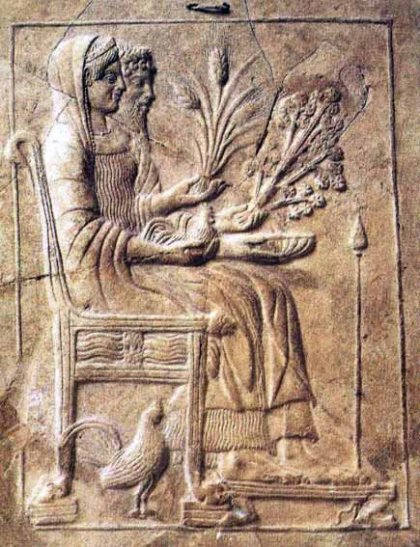
Persephone and Hades in the Underworld

Persephone and Hades in the Underworld
Marble relief, 480-450 BC
Museo Nazionale, Reggio Calabria (Italy)

After aiding brothers Zeus and Poseidon in overthrowing Cronus and sending the other Titans to Tartarus, he received the world of the dead, known as Underworld, as his domain.

Hades rarely left the Underworld. He drove his chariot drawn by black horses and abducted Persephone, daughter of Zeus and his sister, Demeter. He wanted Persephone as his wife and queen of the Underworld. He was forced to compromise with his sister, Demeter: he allowed Persephone to live two-thirds of the year on earth with her mother and a third with him in the Underworld.

In the war between Heracles and the people of Pylus, for some reason Hades left his realm and took the side of Neleus and the Pylians, so he received a wound from the hero.

The Underworld was a place where the souls of humans found their resting places. In the deepest region called Tartarus, it was a place of punishment for mortals who committed the worse sins or crimes. Tartarus also served as a prison for the Titans and other gods. The Underworld was guarded by a three-headed hound named Cerberus. Cerberus kept the living and the dead apart. Cerberus only allowed a few of the living to pass through the gate of Hades: Heracles, Theseus, Orpheus, Aeneas and Psyche.

Heracles, for his last labour, freed Theseus and dragged Cerberus to the surface (see the Twelfth Labour of Heracles). Theseus was there because he was aiding his rash friend Peirithoüs who wanted to abduct Hades' wife, Persephone, and marry her. Knowing of their plan, Hades trapped them in the Chairs of Forgetfulness. Heracles failed to free Peirithoüs. (See also Theseus.)

During the war between Heracles and Neleus, king of Pylos, Hades came to the surface, taking the side of the Pylians, and Heracles wounded him with an arrow. Hades returned to his domain, suffering from his wound.

Hades and Persephone were charmed by the music and song of Orpheus, who had lost his wife Eurydice. Hades allowed Orpheus to bring his wife back to life on the strict condition that Orpheus didn't look at his wife until they reached the light on the surface. Orpheus looked back at his wife too soon, and her shade returned to the abode of the dead. Hades refused Orpheus entrance a second time. (See Orpheus and Eurydice.)

Psyche, wife of Cupid (Eros), was on an errand for her mother-in-law Venus (Aphrodite). She was told to fetch the make-up box from Persephone.

According to Ovid and the geographer Strabo, Hades took the nymph Menthe or Minthe as his mistress. Persephone jealously trampled the unfortunate girl, transforming her into a plant known as mint.

Hades and Persephone weren't the only ones to live in the Underworld. There were Thanatos (Death), the winged-brother Hypnos (Sleep), and Morpheus (Dream), who was the son of Hypnos. Styx was the river goddess of one of the Underworld rivers, and the goddess Hecate also dwelled in this domain.

Hades had cattle which he kept near the cattle of Geryon, near Erytheia. Hades' herdsman was named Menoetes. When Heracles (10th labour) arrived and stole Geryon's cattle, Menoetes went directly to the three-headed king with the news of the stolen cattle. Menoetes met Heracles again in the 12th labour where he wrestled the hero, and would have been crushed to death had not Persephone intervened.

Elis was the only city that built a temple to Hades in one of its precincts. The Eleans were the only ones to worship him. The construction was built after Heracles' war against Neleus in Pylos. Only once a year, the doors to the temple of Hades would open, but no one would enter the temple except the priests.

For more details about the Underworld, Tartarus and Elysian Fields, go to Underworld.

Related Information

Name

Hades, Aïoneus, Ἅιδης – "Unseen One" or "Invisible One" (Greek).
Pluto, Πλούτων – "Rich One" (Greek).

Pluto ("wealth"), Dis, Dis Pater, Orcus (Roman).

Sources

Homeric Hymns.

The Iliad was written by Homer.

Theogony was written by Hesiod.

Library was written by Apollodorus.

Metamorphoses was written by Ovid.

Fabulae was written by Hyginus.

Related Articles

See also Pluto.

Cronus, Rhea, Persephone, Styx, Charon.

Creation, Underworld.

See also Demeter and Persephone in the Mother Goddesses.

Facts and Figures: Astronomy.
Jimmy Joe Timeless Myths

By Jimmy Joe

House of Hades:

  • • Underworld
  • • Elysian Fields
  • • Tartarus
  • • Hades (Pluto)
  • • Persephone (Kore)
  • • Hecate
  • • Styx
  • • Plutus
  • • Thanatos
  • • Hypnos
  • • Morpheus
  • • Charon
  • • Erinyes (Furies)
  • • Three Judges
Hades

Hades

Hades: The Anti-Social Introvert of Greek Mythology Hades, god of the underworld, was one of the original six Olympian gods, but he rarely left the realm of the dead. However, he was not the fearsome, terrible character described by Christians and...

April 2nd, 2002 • Timeless Myths
Pluto

Pluto

Pluto: Roman God of Death Pluto, god of death, was the Roman lord of the underworld. He was also the god of anything that could be extracted from the earth, such as diamonds. He abducted Proserpina, who eventually became his wife. This article exp...

April 2nd, 2002 • Timeless Myths
Pluto (Dis)

Pluto (Dis)

Pluto or Dis was a chthonian god of wealth and the Underworld, the world of the dead. His name means "Rich One" and Dis Pater means "Rich Father". He was often referred to as the "Stygian Jupiter" or "Stygian Jove", meaning he was the "Jupiter of ...

September 10th, 2000 • Jimmy Joe
Underworld

Underworld

The world of the dead or the netherworld was commonly viewed by the ancient religions to be a subterranean realm ruled by a god, a goddess, or both. Almost all mortals would reside in the netherworld after their death. Few gained godhood and fewer...

September 29th, 2002 • Jimmy Joe
Persephone (Kore)

Persephone (Kore)

A goddess of the underworld. Persephone was the daughter of Zeus and Demeter. She was known (or by her title) as Kore (Κόρη, "maiden"). The Romans called her Proserpina. Before she was abducted, she was perhaps the personification of spring and go...

September 29th, 2002 • Jimmy Joe
House of Hades

House of Hades

In Greek mythology, the House of Hades was the world of the dead, the Underworld or the netherworld. A place where Hades and his consort Persephone ruled over the souls of the departed. Below, there are descriptions of the Underworld and the deiti...

September 29th, 2002 • Jimmy Joe
Children of Hades

Children of Hades

In Greek mythology, Hades was the god of the Underworld. He was one of the most prominent gods, being the brother of powerful deities like Zeus and Poseidon. The modern audience often just views him as an isolated villain, and that is largely accu...

February 15th, 2024 • Caleb Howells
Hades' Powers: Must-know Facts About the God of the Underworld

Hades' Powers: Must-know Facts About the God of the Underworld

Hades is a unique figure in Greek mythology, as he is the only one of the key entities in Greek mythology that is not a part of the Twelve Olympians. Therefore he does not reside in Mount Olympus, unlike other well-known gods and goddesses such as...

February 16th, 2024 • Ancient Literature
Thanatos vs Hades: The Carrier of Death and King of the Dead

Thanatos vs Hades: The Carrier of Death and King of the Dead

Thanatos vs Hades is the comparison between the carrier of the dead and the king of the dead in Greek mythology. It is an interesting comparison because not only do their abilities go together but also so do their other characteristics. Similarly,...

February 16th, 2024 • Ancient Literature
Erebus (Darkness)

Erebus (Darkness)

Erebus was born together with Nyx, Gaea, Tartarus, and Eros ("Love"), out of Chaos. With his sister Nyx, Erebus was the father of Aether ("Upper Air") and Hemera ("Day"). See Creation, Theogony of Hesiod. Apart from the part he played in the Creat...

April 19th, 1999 • Jimmy Joe
Timeless Myths

Exploring mythology and legends from around the world.

Explore Myths

All Stories Characters All Articles Search Site Map

Mythologies

Norse Mythology Classical Mythology Celtic Mythology Arthurian Legends Mythology Gods Ancient Literature

About Us

Introduction About Jimmy Bibliography FAQs Retro Version

Resources

Timeless Myths All Stories All Articles Characters
© 1999-2026 Timeless Myths • Copyright • Privacy Policy • Cookie Policy • Contact
Follow us: