Sneferu: The Glorious Pharaoh That Guided the Old Kingdom
Sneferu or Snofru was the first king of ancient Egypt during the fourth dynasty (2475 – 2465 BC). Known for his innovation and development in ancient Egypt, Sneferu’s reign incredibly flourished in the land. His expansion plans paved the way toward the climax of the Old Kingdom (2575 – 2130 BC).
To find out how he contributed to the evolution of ancient Egypt, continue reading and be amazed by his personal story and deeds, which made him extraordinary even among kings.
Who Was Sneferu?
Historical records showed that Sneferu — the first king of the fourth dynasty of ancient Egypt (2475 – 2465 BC) — was raised in a devoted family near Hermopolis. His ascent to the throne happened by marrying a royal princess who was the daughter of his former chief.
King Sneferu reigned during the Old Kingdom (c. 2686–2181 BC), founding the fourth dynasty. Later Egyptian tradition, particularly during the Middle Kingdom, viewed his reign as a golden age in Egypt. He was a charismatic and benevolent ruler. Several places were named after him to honor his goodness and impeccable leadership. Sneferu, the beloved king, has also been immortalized in several stories and popular tales.
You must know his difference from other kings because he doesn’t have many records to validate his name, but his legacy is unchallenged. As a pharaoh, he left an indelible mark in the lives of the early Egyptians through his national reforms and ambitious plans.
In terms of the expansion of his kingdom, Sneferu launched an extensive military campaign against Nubia. Honestly, you must know that it’s how he accumulated wealth. It was followed by successful raids in Libya and Sinai, where Sneferu truly celebrated his exploits. Aside from the invaluable wealth that he acquired in his offensive attacks on other cities, he also gained endless pieces of land for his viziers.
Sneferu: The Constructor of Pyramids
Sneferu’s Hellenized name was “Soris” according to Manetho, a Greek historian. He made impressive changes in the fourth dynasty, which made the people satisfied with his rule. He was succeeded by his son Khufu, another formidable king in ancient Egypt.
In particular, the highlight of his term was the construction of pyramids with all the technical advancements present at that time. He was the overseer of the construction of the three of the greatest pyramids of all time, which were larger than the ordinary monuments and pyramids for the royal family. He also initiated the remodeling of pyramids built in the third dynasty. Their step pyramids were redesigned to flat-sided pyramids modeled in the fourth dynasty.
He wrote on the walls of his pyramid the achievements of the royal family and the officials who were appointed to the highest government levels. For instance, he made the position of the vizier a vital part of the administration. He chose intelligent princes as viziers, who acted on behalf of the pharaoh.
Sneferu passed the interest for building pyramids onto his son, Khufu. The latter was recognized as a great builder, as evidenced by the amazing pyramids of Giza. You must recall that they belong to the seven wonders of the ancient world. All six wonders have been destroyed, and only the pyramids remain until now.
The Pyramids of Sneferu
As you have read above, during his reign Sneferu was able to design and build three pyramids, massive structures housing the burial chambers of the prestigious members of the royal family. They are examples of Egyptian architectural prowess that are still intact up to now. He built his prominent pyramids in Dahshur. It is the necropolis of royal people, which is strategically located in a desert, on the west side of the Nile River.
The Meidum Pyramid
The first of them was Meidum, a colossal structure proudly poised in the desert, overlooking the Nile. Originally started by Huni and completed by Sneferu, it was believed to have a perfect straight side, but it partially collapsed in the past.
Some critics said that it looks unusual after the collapse, such that it has earned the title pseudo pyramid. Despite its imperfections, this peculiar Sneferu pyramid doesn’t fail to attract engineering enthusiasts because of its durability, engineering accuracy and magnitude of size.
The Meidum Pyramid was an ambitious technological breakthrough at that time. It showed the advancement of Egyptian engineering and architecture, which surpassed other civilizations. It’s an epitome of a true pyramid as opposed to the classic stepped pyramid at the beginning of its construction. It’s originally a seven-stepped platform, then modified to look similar to the pyramids found in Saqqara.
Builders really tried to add a new platform in addition to a limestone facing to produce a clean, perfect angled finish of a true pyramid. Meidum was designed with a descending northern passage. It was different because, although it has two underground chambers and a burial vault, sacred burial chambers were uniquely made directly within the body of the pyramid and not underneath the gigantic edifice.
The Bent Pyramid
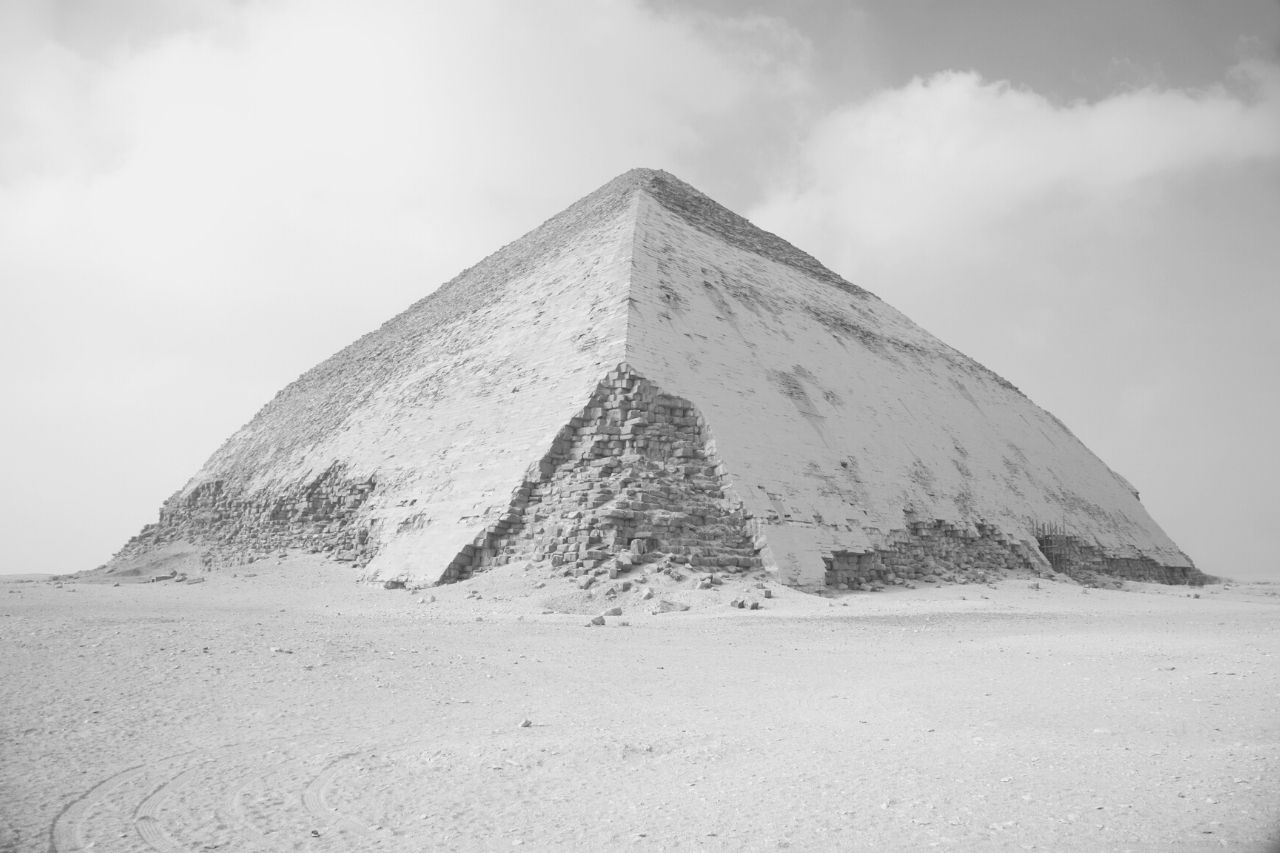
The Bent Pyramid has distinctive features known as rhomboidal or blunted structures because it has some changes in its slope. Architects have found that its inclination angle was changed from 55° to 43° somewhere in the upper tiers. You must know that it’s another promising architectural design applied at the Bent Pyramid.
Similar to the Meidum Pyramid, the Bent Pyramid was modified during its construction to stabilize the structure. It was originally created to be built according to a certain design, but it was modified due to unstable soil layers.

As a means of stabilizing King Sneferu’s Bent Pyramid, the top layers were attached horizontally, deviating from the original steps. Architects also made progressive changes in the components inside, such as the addition of two entrances: the north and west entrances. Chambers in the subterranean region were way larger than usual and beautifully decorated with corbel walls and ceilings having meticulously laid diagonal portcullis.
Pyramid building was in vogue at that time, and builders were apparently testing the high volume of the materials prepared. How could you make a monument of 50 million cubic feet?
The Red Pyramid
Another pyramid was built to serve as a satellite structure near the Bent Pyramid of Sneferu, which was also aimed at breaking the long-standing tradition of a passageway descending northward: the Red Pyramid. This new satellite pyramid was built with a passageway facing the ascending westward direction.
While all pyramids are vital parts of the culture and history of Egypt, the Red Pyramid in particular was the exact place for the sarcophagus and remains of Sneferu. It is believed that his mummy lies in a hidden chamber that has not yet been discovered. Despite this, historians insist that it’s the tomb of Sneferu and the real symbol of his legacy.
You must know that the Red Pyramid was the last structure under the name of Sneferu, and it was the most advanced and complex of the three pyramids. As a matter of fact, it had no ascending passageway. Archeologists contend that it has secret chambers to be unveiled.
Suffice to say, the pyramids of Sneferu have served as an inspiration to all engineers around the world to build structures with precision and strength. These pyramids are perfect symbols of the glory of Egypt that was discovered. To date, the pyramids of Khufu and Sneferu are the most authentic rivals in terms of accuracy and architectural skill.
Background of Sneferu’s Personal Life
Several questions have been raised about Sneferu’s family background because it was not sure whether Huni, his predecessor, was his father. Historians all agreed that his mother was Meresankh I, but Huni’s wife was Queen Hetepheres I.
You might ask how he was included in the royal family, but the truth is that how he succeeded Huni has still been unrevealed up to now. You could easily assume that Sneferu was truly destined to rule Egypt and establish a powerful dynasty for thousands of generations to remember.
Sneferu’s Extended Family
Sneferu was not only famous for his pyramids, but he was also known for his enormous family. Sneferu got married to Hetepheres I to whom he had eight sons named Khufu, Ankhhaf, Kanefer, Nefermaat I, Netjeraperef, Rahotep, Ranefer, and Lynefer I. His five daughters completed the family. They were Hetepheres A, Nefertkau I, Nefertnesu, Meritites I, and Henutsen.
He trained them not just to live like a royal member but to lead. To succeed in his throne, he asked Khufu to be the next king. As viziers under his reign, he appointed Nefermaat I and Kanefer. Even when Khufu was already the king, Kanefer still acted as his vizier, while Nefermaat I decided to be a priest and serve goddess Bastet in her temple.
Another vizier from his family that served the kingdom was Ankhhaf, who worked as his nephew Khafre’s vizier. Rahotep, on the other hand, had chosen the role of a high priest to serve the sun god, Ra, in his prestigious temple in Heliopolis.
You might ask how Sneferu gained so much recognition. Historians agree that his achievements at war and his developments in the country earned him respect. He built temples to worship his gods, as well as for his soul in the afterlife. People from all walks of life were surprised to witness the magnitude of his pyramids, which served as his burial temple.
Sneferu’s Diplomatic Relations
The people revered Pharaoh Sneferu as the greatest ruler of Egypt. He was acclaimed for his devotion to good leadership, efficient decision making, and progressive planning. He was able to build a strong rapport with his people. In this scenario, people remembered him for his achievements and his outstanding service to them.
Aside from his engineering works, he was also favored for his formidable military strategies. You should know that he was a valiant leader and he ruled his army with might, which led him to win against neighboring countries. His military achievements were talked about and feared by other nations because he imprisoned his captives and used them as slaves to build his pyramids.
Moreover, you should recall his ability to build ships by using imported cedar wood from Lebanon. He was honored for the construction of the first ship made in Egypt. He called the maiden ship “Praise of the Two Lands.”
The Legacy of Sneferu
Without any doubt, Sneferu is most famous for his innovations in engineering. He came into power when Egypt needed a model to emulate and he did not disappoint the people. He strengthened the building of so many structures to promote his leadership.
His legacy lies in the enormous pyramids and temples that he constructed during his reign. His originality and innovations matched with the calls of time in Egypt because those temples and pyramids proudly symbolized the power of the king.
With his ingenuity, not only did he make pyramids and temples, but he was also able to build a very particular ship. This vessel was over 50 meters long and made of cedar wood. You must understand why that was a tremendous feat.
Egypt is located in the middle of a desert, such that building something out of wood at that time was a significant triumph. You could not expect a treeless nation to build a massive vessel out of wood. Instead, the business with Lebanon paved the way for the international trade of wood.
Named Praise of the Two Lands, the ship mirrored the political advocacy of Sneferu because he wanted to unite Upper Egypt and Lower Egypt. Hence, the name was coined to symbolize his ambitions.
Conclusion

Sneferu led Egypt toward a more promising era of economic and military progress. Through his leadership, he was able to strengthen the government, as well as the lives of the people. While his ascent to the throne was unclear, his reign was proven to be one of the significant times in the history of Egypt.
With his 24-year reign, he will be remembered as a generous and kind leader and, at the same time, a petrifying enemy because of his outstanding military skills. His own children served the kingdom and followed his footsteps. For instance, his son Khufu emerged as one of the greatest rulers of Egypt, remembered for his amazing pyramids.
Sneferu built three famous pyramids during his reign, which remain popular up to now. Who can defy the greatness of the Bent Pyramid, the Red Pyramid, and the Meidum Pyramid? They all symbolized the power, eminence, and splendor of his rule. Seeing all his achievements, you can understand the evolution of a centralized Egypt, with which other nations could not compete.