The Role of Glaucus, Iliad Hero
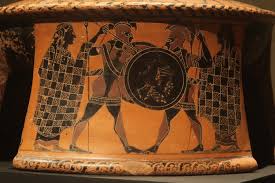
The role of Glaucus in the Iliad was to offer a contrast to the extremes of some of the behaviors of the other characters, in particular Achilles and Patroclus. The more level-headed heroes like Gaucus and his guest-friend Diomedes provide a backdrop to the greater Heroes, the demi-gods and immortals who act outrageously to move the story forward.
Glaucus and Diomedes provide a glimpse into the workings of the social rules and constructs of the day. By providing this backdrop, Homer contrasts and compares the prominent heroes' actions without needing to point out their excesses.
Who Was Glaucus?
Glaucus' name means shiny, bright, or aqua. As a son of Hippolochus and a grandson of Bellerophon, he was well connected and had a family reputation to live up to and uphold.
The captain of the Lycian army, he was under the command of his cousin Sarpedon. The Lycians had come to the Trojans' aid in the war, and Glaucus fought heroically against the Greeks. In battle, Glaucus defended Sarpedon's body until it could be retrieved and returned for proper disposal. He also assisted in other important battles and earned the gods' favor and honor with his efforts in the battle.
His standing as the grandson of a well-known hero put Glaucus in a position of needing to live up to the reputation of those who had gone before him. Bellerophontes, his grandfather, was known as a great hero and slayer of monsters. When he was tasked with defeating a chimera, he captured the winged horse, Pegasus, using Athena's charmed bridle. In a moment of poor judgement, he earned the disfavor of the gods by trying to mount the horse and ride it to Olympus.
Despite Bellerophontes' momentary foolishness, he went on to enter other famous battles riding Pegasus. Having offended the son in law of the king, Bellerophontes was sent out on a series of impossible tasks by the king. He fought the Amazons and a Carian pirate. Following his victories, he returned to the palace of King Iobates. The palace guards came out, and Bellerophontes called upon Poseidon, who flooded the plains below to assist him.
In response, the palace women came out to offer themselves to him in hopes of gaining mercy. Bellerphontes retreated in response, refusing to take advantage of the offering. Seeing that Bellerphontes was a man of character, the King made him rich and famous, marrying him to his younger daughter and providing him half of his kingdom.
The Tale of Glaucus Greek Mythology
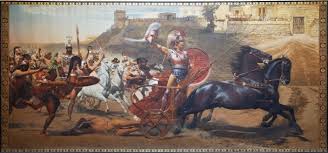
Glaucus came from the line of the man who had tamed Pegasus and therefore had his own reputation to upkeep. He entered the Trojan war intending to make a name for himself, which was a valuable asset to the Trojans. Glaucus was with Sparpedon and Asteropaios when the Trojans came to break through the wall the Greeks had erected.
Their efforts allowed Hector to break through the wall. Glaucus was wounded in this battle and withdrew for a time. When he saw Sarpedon fell, he prayed to god Apollo, asking for help with recovering the body.
Apollo healed Glaucus' wound, allowing him to lead the Trojans to defend the body until the gods took it. When Glaucus himself fell, in the fighting over Achilles' body, his own corpse was rescued by Aeneas and was taken by Apollo himself back to Lycia to be laid to rest in the manner of his people.
Glaucus And Diomedes
While Achilles is out of the battling during Book 6 of the Iliad, Diomedes is fighting alongside Agamemnon. The Greeks are gaining ground, Hector seeks advice and returns to the city to offer sacrifices. He does so, requesting of the gods that the fighter Diomedes be held back in the battle.
While Hector is sacrificing and praying, Glaucus and Diomedes happen to meet in the No Man's Land, a region held by neither army, where fighting is typically temporarily suspended. Diomedes asks Glaucus about his heritage at their meeting, reluctant to enter the battle with an immortal, a god, or any with divine origins. Glaucus proudly announces his mortal heritage, saying that as the grandson of Bellerophontes, he is not afraid to fight anyone.
Diomedes recognizes the name because his own grandfather, Oeneus, was a close friend of Bellerophon. He declares that the two must continue the friendship due to the complex system of Greek hospitality. Being a guest in the house of King Iobates saved Bellerophontes. He had been sent to the King to be murdered by the king's son in law, whose wife had accused Bellerophontes of attempted rape.
King Iobates had feasted with Bellerophontes for nine days before opening the letter from his son in law. Rather than risk the wrath of the gods by killing a guest, he sent Bellerophontes on a series of quests that gained his glory as a Hero.
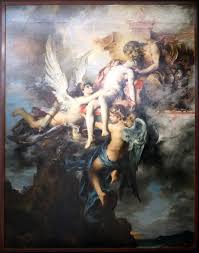
The same rules governing the guest/host relationship were called upon by Diomedes to declare a truce between the two men. As a show of friendship, they exchanged armor. Diomedes gave Glaucus his bronze armor, and Glaucus, his wits confused by Zeus, offered in return his gold armor, which was worth approximately ten times as much. The exchange was symbolic of the laws of civility that governed men's behaviors, even though breaking the gods' laws with purpose was sometimes rewarded with glory and greatness.
Achilles broke the laws of civility with his abuse of Hector's body and was rewarded for his impulsiveness and hubris with a short life, even though he gained glory with his prowess as a fighter. By donning Achilles' armor, Patroclus fought bravely, but his pride and glory-seeking that led him to overstep his rights as Achilles' friend led to his death as well. By contrast, Glaucus and Diomedes survived the fighting to gain even greater glory, and both received honor and proper burial at their deaths. Both followed the laws of civility and earned their reward.
Glaucus' Part in Battle
With the contributions of Glaucus, Troy won several battles in the war that might have otherwise gone poorly. Glaucus assisted in Hector's breach of the Greek wall. During that battle, he suffered a wound. Teucer shot him, but when he saw his cousin and leader wounded, he rejoined the fighting to defend Sarpedon's body.
Later, when Achilles was killed, there was further battling over the possession of his body. Achilles had killed a prince of Troy, Hector, and slaughtered many thousands of Trojan fighters. The fighting for his body was fierce, and the Greeks were determined to retrieve their own. Glaucus took part in the fighting, determined to gain glory for Troy. He was killed in the battle by Ajax, the son of King Telamon.
His body was not to be left or abused as some of the tale's heroes had suffered. Another Trojan hero, Aeneas, protected his body. Apollo came and retrieved Glaucus' body. The corpse was then taken to Lycia to be laid to rest. Glaucus had earned his place in his heroic family line, and he was brought home to be laid to rest.
"Nor did the hapless Trojans leave unwept the warrior-king Hippolochus' hero-son, but laid, in front of the Dardanian gate, upon the pyre that captain war-renowned. But him Apollo's self caught swiftly up out of the blazing fire, and to the winds gave him, to bear away to Lycia-land; and fast and far they bare him, 'neath the glens of high Telandrus, to a lovely glade; and for a monument above his grave upheaved a granite rock. The Nymphs therefrom made gush the hallowed water of a stream for ever flowing, which the tribes of men still call fair-fleeting Glaucus. This the gods wrought for an honour to the Lycian king."