Why Did Achilles Kill Hector – Fate or Fury?
Was it love or pride that led Achilles to kill Hector? The Trojan war was a tale of love and pride, hubris and stubbornness, and a refusal to give up. The victory was won, but at the end of the day, what was the cost?
Hector, prince of Troy, was the firstborn son of King Priam and Queen Hecuba, the direct descendants of Troy's founders. Hector's very name is a derivative of a Greek word that means "to have" or "to hold." He could be said to have held together with the entire Trojan army. As a prince fighting for Troy, he was credited with killing 31,000 Greek soldiers. Hector was beloved among Troy's people. His infant son, Scamandrius, was nicknamed Astyanax by Troy's people, a name meaning "high king," a reference to his place in the royal line.
Tragically, the infant was killed by the Greeks following the fall of Troy, thrown from the walls so that the royal line would be severed and no Trojan hero would rise to take vengeance for Hector's death.
A Fated Battle
Aside from the obvious, there were specific reasons Why Hector was killed by Achilles. Not only did the prince lead the Trojan army out against the Greeks, but Achilles was also taking vengeance for the loss of his dear friend and confidant, Patroclus. There are varying accounts of the nature of the relationship between Achilles and Patroclus. Most assert that Patroclus was his friend and advisor. Some claim that the two were lovers. Whatever the case, Achilles clearly favored Patroclus, and it was his death that brought Achilles back to the field to seek his revenge.
Achilles had retreated to his tent, refusing to fight, after an argument with Agamemnon, a Greek army leader. Agamemnon, as well as Achilles, had taken captives in one of the raids. Among the captives were women taken and held as slaves and concubines. Agamemnon had captured the daughter of a priest, Chryseis, while Achilles had taken Briseis, a daughter of King Lymessus. The father of Chryseis negotiated for her return. Agamemnon, angry that his prize had been taken, demanded that Achilles surrender Briseis to him as a consolation. Achilles left with little choice, agreed, but retreated to his tent in a temper, refusing to fight.
Patroclus came to Achilles and begged the use of his distinctive armor. The armor was a gift of his goddess mother, forged by a blacksmith to the gods. It was well known among the Greeks and Trojans alike, and by wearing it, Patroclus could make it appear as if Achilles had returned to the field. He hoped to drive back the Trojans and earn some breathing room for the beleaguered Greek army.
Unfortunately for Patroclus, his ruse worked a little too well. He went further in a hunt for glory than driving the Trojans back from the Green ships and continued toward the city itself. To stop his forward advance, Apollo interferes, clouding his judgement. While Patroclus is confused, he is hit with a spear by Euphorbos. Hector finishes the job by driving a spear through his stomach, killing Patroclus.
Hector vs. Achilles
Hector strips Achilles' armor from the fallen Patroclus. At first, he gives it to his men to take back to the City, but when he is challenged by Glaucus, who calls him a coward for avoiding a challenge of Ajax the Great, he grows angry and dons the armor himself. Zeus sees the use of the Hero's armor as insolent, and Hector loses favor with the gods. Upon hearing of Patroclus' death, Achilles vows revenge and returns to the field to fight.
Following Patroclus' death, his body is guarded on the field by Menelaus and Ajax. Achilles retrieves the body but refuses to allow it to be buried, preferring to mourn and stoke the fires of his rage. After several days, Patroclus's spirit comes to him in a dream and begs release into Hades. Achilles finally relents and allows a proper funeral. The body is burned in a traditional funeral pyre, and Achilles' rampage begins.
How did Achilles Kill Hector?
In a rage, Achilles goes on a killing spree that overshadows all that has occurred so far in the war. He kills so many Trojan soldiers that the local river god objects to having the waters clogged with bodies. Achilles fights and defeats the god and continues on his rampage. Hector, realizing it was his own killing of Patroclus that brought Achilles' wrath down upon the city, remains outside the gates to fight him. At first, he flees, and Achilles chases him around the city three times before he stops and turns to face him.
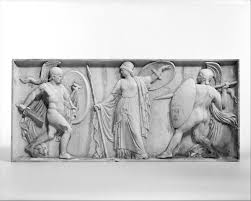
Achilles about to kill Hector in battle
Hector asks Achilles that the victor should return the loser's body to their respective army. Still, Achilles refuses, stating that he intends to feed Hector's body to the "dogs and vultures" as Hector had intended to do with Patroclus. Achilles throws the first spear, but Hector manages to dodge. Hector returns the throw, but his spear bounces off Achilles' shield without doing any harm. Athena, goddess of war, has intervened, returning Achilles' spear to him. Hector turns to his brother to get another spear but finds himself alone.
Realizing he is doomed, he decides to go down fighting. He draws his sword and attacks. He never lands a blow. Although Hector wore Achilles' own enchanted armor, Achilles manages to drive a spear through the space between the shoulder and collar bone, the only place the armor does not protect. Hector dies prophesying Achilles' own death, which will be brought on by his hubris and stubbornness.
From Chariots to Fire
For Achilles, killing Hector wasn't enough. Despite the moral codes surrounding respect and the burial of the dead, he took Hector's body and dragged it behind his chariot, taunting the Trojan army with the death of their princely hero. For days, he continued to abuse the body, refusing to allow Hector the dignity of a peaceful burial. It is not until King Priam himself comes in disguise to the Greek camp to plead with him for his son's return that Achilles relents.
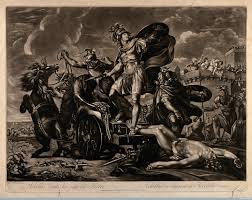
Achilles dragging Hector's body behind his chariot
Finally, he allows Hector's body to be returned to Troy. There is a brief reprieve in the fighting while each side mourns and disposes of their dead. Achilles' wrath has been aroused, and Hector's death only partially appeases his wrath and grief at the loss of Patroclus. Even Helen, the Greek princess whose kidnapping triggered the war, mourns Hector, as he was kind to her during her captivity.
Achilles takes this time to mourn Patroclus, "The man I loved beyond all other comrades, loved as my own life."
Homer does not depict Achilles' death, preferring to end the story with Achilles' return to sense and humanity by releasing Hector's body. Later legends by other stories tell us that it was his famed heel that was Achilles' downfall. His mother, Thetis, was a sea nymph, an immortal. Wishing her son to gain immortality, she dipped the infant in the River Styx, holding him by the heel. Achilles gained the protection granted by the infamous waters, except for the skin covered by his mother's hand.
Although Achilles was unlikely to advertise this tiny weakness, it was known to the gods. The most common story told is that Achilles died when the Trojan prince, Paris, shot him. The arrow, guided by Zeus himself, struck him in the one place he was vulnerable, resulting in his death. A proud, hard, and vengeful man, Achilles dies at the hand of one over whom he had sought to win a victory. In the end, it is Achilles' own thirst for war and revenge that brings about his death. A peaceful end to the war might have been negotiated, but his treatment of Hector's body following the death of Patroclus all but ensured that he would be counted an enemy of Troy forever.
The Trojan war began over the love of a woman, Helen, and ended with the death of Patroclus that led to Achilles' vicious attack and his killing of Hector. The entire war was built upon desire, revenge, possession, stubbornness, hubris, and passion. Achilles' rage and impulsive behavior, Patroclus's search for glory, and Hector's pride all culminate in destroying Troy's heroes, leading to tragic endings for them all.