Fate in the Iliad: Analyzing the Role of Fate in Homer's Epic Poem
Fate in the Iliad
What Is Fate in the Iliad?
Fate in the Iliad is "how the gods determine the destiny of characters" in the epic poem and how the action of the characters drive them towards their fated ends. The Iliad itself is thought of as already fated as it is an old story that was passed down generations.
Zeus and Fate in the Iliad
Though the other deities play a role in determining the fate of the characters in the poem, the ultimate responsibility lies squarely on the shoulders of Zeus. At the start of the Trojan war, the Olympian gods take sides and "try to influence the outcome" of the war through their many actions.
Zeus, however, symbolizes the impartial judge who makes sure that the war follows its destined course. He is "the peacekeeper" who maintains order on both sides of the war and enforces discipline among the gods.
The deities also recognize that that is why they ask permission from Zeus before interfering with the war. His own wife and queen of the gods, Hera, who supports the Greeks, asks Zeus if she can restart the war to ensure the sack of Troy.
Thetis, the nymph, also seeks permission to "tip the scales in favor of the Trojans." All this illustrates the fact that Zeus is the all-powerful deity who has the final say when it comes to fate.
Knowing this, some deities "tried to trick Zeus" into giving judgment in favor of their chosen sides. A prime example is when Hera seduces Zeus to give the Greeks the upper hand during the war.
However, Zeus tries to be fair and maintain a perfect balance, even if it means losing his son, Sarpedon, in the conflict. Zeus' role was to ensure that the fate of the characters and the war came to pass, even if it brought him much grief.
Achilles' Fate in the Iliad
Achilles enters the Trojan war knowing full well that death awaits him, but he doesn't allow it to deter him. His mother will enable him to choose between a long inglorious life and a short life full of glory with his name cemented in the annals of history. Though he initially chooses the long inglorious life, his "best friend's death at Hektor's hands" pushes him to choose the short one. Thus, many think that Achilles completely controls his fate and could choose as he pleases.
However, other scholars believe that "the gods had fated Achilles to choose a short and glorious life." They opine that the gods intentionally set in motion certain events to ensure that Achilles returned to the battlefield.
According to them, the gods intend "to punish Achilles for his hubris (excessive pride)" because he refused to help the Achaeans. This explains why the gods guide an arrow, which would have missed Achilles, to the exact spot on his heel where he is most vulnerable.
However, some believe that Achilles' fate borders on both the controllable and uncontrollable. On the one hand, he controls how long he wants to live; on the other hand, the gods decide his fate. Nonetheless, he could have stayed out of the war but "the death of his friend" and the return of his slave girl forced him into it.
Probably, "Achilles weighed the two choices" and decided that both would end in death, just that one would come sooner but with glory, and the other would come later and end in obscurity. Thus, he chose the former.
The role of fate in the Iliad
Hector's Fate in the Iliad
Hektor doesn't have the luxury of choosing which fate he wants to befall him. He doesn't have the slightest understanding of what is to come his way. He goes into battle with honor, accepting whatever fate will bestow upon him. His wife tells him he will die, but he reminds her of his responsibility to keep Troy safe.
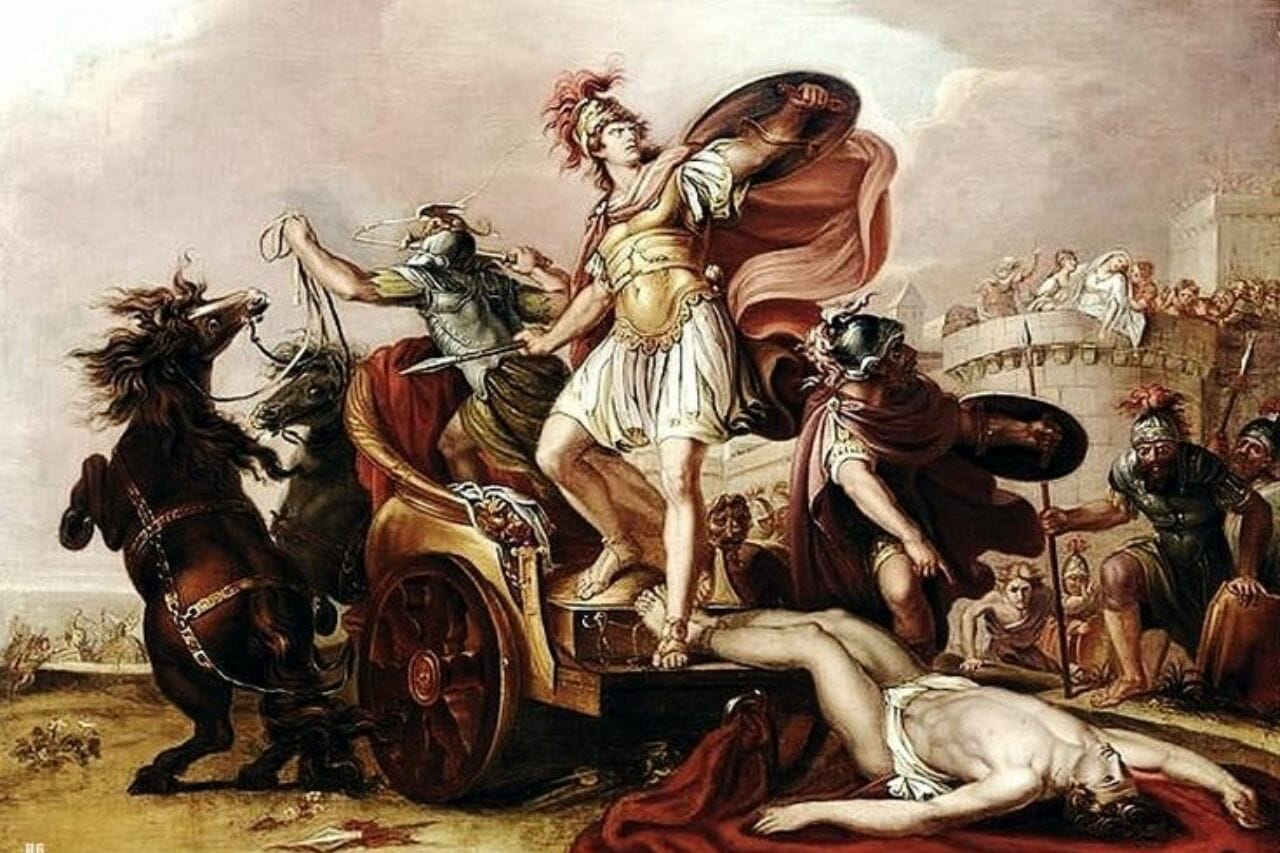
During the battle, Hector meets Patroclus, whom he kills before dying. He prophesies the death of Hektor at the hands of Achilles. However, this does not deter Hektor as he waits outside the city walls of Troy for his foe, Achilles, while the other Trojan warriors run into the city. Faced with Achilles, "Hektor's strength and courage fail him" as he turns to run with Achilles in hot pursuit thrice around the city. Finally, Hektor manages some courage and faces his adversary.
The gods play a part in bringing about "his doomed fate when" Athena disguises herself as Hektor's brother Deiphobus and comes to his aid. This gives Hektor a momentary boost of confidence and he throws a spear at Achilles but misses.
However, he realizes his fate has come when he turns to retrieve more spears but finds no one, for the disguised Athena has abandoned him. Hektor's fate is cast in stone, and there is nothing he can do about it but what is more admirable is that he accepts his fate with remarkable calm.
The Fate of Paris in the Iliad
Unlike Hektor and Achilleus, "the fate of Paris is known" even before his parents birthed him. According to the Iliad, Paris' mother, Hecuba dreams of her would-be son bearing a torch. She consults the seer, Aesacus, who divines that the boy will bring big trouble to the land of Troy that will culminate in the sack of Troy. To prevent the doomed prophecy from being fulfilled, Hecuba and her husband, King Priam, give out the boy to a shepherd to kill.
Unable to carry out the wicked act, the shepherd leaves the boy on a mountain to die, but as fate will have it, Paris is found and nurtured by a bear. The shepherd returns and sees the boy alive and "takes it as a sign" that the gods mean him to live.
He takes the boy to his home and presents a dog's tongue to King Priam and his wife "as a sign of the boy's death". The boy, Paris, embarks on many adventures, but he survives all because his fate has not been fulfilled.
In fact, because he is not fated to die during the Trojan War, Paris survives it even when he almost loses his life to Menelaus. When Menelaus is about to deliver the mortal blow, "the goddess Aphrodite whisks Paris" and sends him straight to his bedroom. The fate of Paris in the Iliad is considered better than his brother, Hektor, who lives a short life and leaves behind a wife and a son, Astyanax. It doesn't seem fair, but that is how fate operates both in Greek literary works and in real life.
Fate and Free Will in the Iliad
Though it seems that the whole story of the Iliad is fated and the characters have no free will, that is not the case. Homer delicately balances fate with free will as "the gods do not force choices" on the characters.
The characters are free to choose whatever they wish but their choices have consequences. One of the examples of free will in the Iliad is when Achilleus is given the opportunity to choose between long inglorious life and a short glorious one.
Initially, he chose the former but his own penchant for revenge led him to the latter. Even after his best friend's death, he could have chosen to stay away from the war but he decided to join it. "Achilleus' choices were not forced on him", he freely made the choice that led to his ultimate fate.
Conclusion
Throughout this article, we've studied one of "the most prominent Iliad themes" and considered some prime examples of fate in the epic poem. Here is a recap of all that we have studied:
Fate refers to how the deities order events to fulfill a mortal's destiny and the actions man takes to expedite it.
Zeus has the final say in determining the fate and is also responsible for enforcing it and ensuring that the deities do not go against it.
Though characters in the Iliad are fated, they still retain the ability to make choices as illustrated by Achilleus when he chose a short life full of honor over a long inglorious life.
Other characters like Hektor, Paris, and Agamemnon also made choices but ultimately couldn't escape their fate.
Homer delicately balances the scales between fate and free will by illustrating that the choices of the mortals are not forced but done freely.
Fate in the Iliad essay shows us that we still have "a hand in our fate" and our actions gradually lead us to our destinies.