Thetis: Iliad's Mama Bear
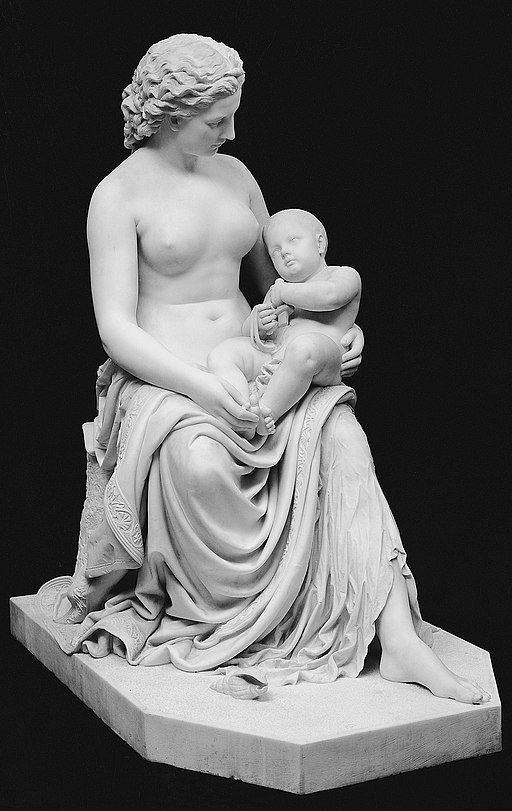
Monument of Achilles and Thetis
When presenting Thetis, Iliad readers tend to focus upon her role as the mother of Achilles.
But does Thetis have a larger role to play in the epic of the Trojan war?
What roles did she play and what influence did she have in evolving what would become a war that would destroy the entire City of Troy?
Like most women in Greek mythology, Thetis is often considered only for her role as a mother. The only connection of note she seems to have with the Trojan war is that the story of the Judgement of Paris begins at her wedding.
Eris threw her apple into the crowd of goddesses at Thetis' wedding, setting off the squabbling between the three goddesses, which would eventually lead to the start of the war.
As Achilles' Mom, she also acts as his champion and intercessor with the gods, including Zeus, and does all she can to protect him. For his part, Achilles seems determined to break free of his mother's efforts at protecting him.
He has been warned that a seer has predicted that his participation in the Trojan war will mean he leads a brief life that ends in glory. His avoidance will grant him a more prolonged, albeit peaceful, existence. He merely seems unable to accept the sound advice of his mother.
Thetis' role would seem to be the mother figure. Thetis, however, is more than just a nymph who happened to bring forth a heroic son. She once saved Zeus from an uprising; a fact alluded to by Achilles himself early in the Iliad:
"You alone of all the gods saved Zeus the Darkener of the Skies from an inglorious fate, when some of the other Olympians – Hera, Poseidon, and Pallas Athene – had plotted to throw him into chains … You, goddess, went and saved him from that indignity. You quickly summoned to high Olympus the monster of the hundred arms whom the gods call Briareus, but mankind Aegaeon, a giant more powerful even than his father. He squatted by the Son of Cronos with such a show of force that the blessed gods slunk off in terror, leaving Zeus free."
Thetis' role, it seems, is deeply involved in the affairs of both gods and men. Her interference is a desperate effort to save her son. A seer has predicted that he will die young after gaining for himself a great deal of glory if he enters the Trojan war. Despite Thetis' best efforts, Achilles is fated to die young.
Who Is Thetis in The Iliad?
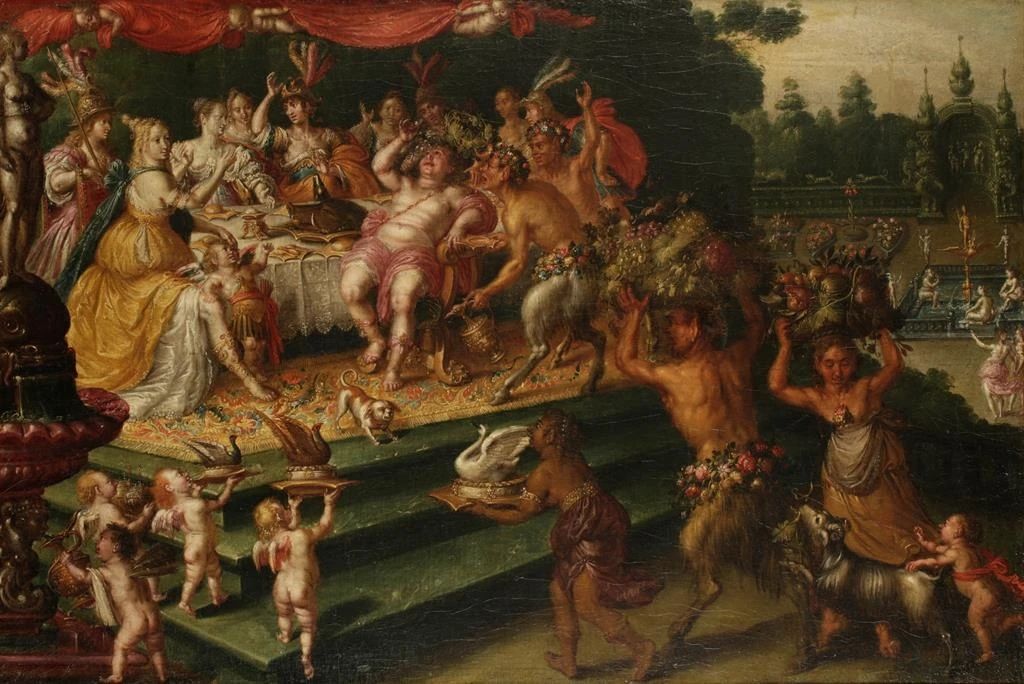
The Marriage of Peleus and Thetis
Though much of the study on Thetis in The Iliad evolves around her and Achilles, her background story is not that of a minor goddess. As a nymph, Thetis has 50 sisters.
There are conflicting stories about how she came to be married to Peleus, a mere mortal king. One story goes that two amorous gods, Zeus and Poseidon, pursued her. However, the gods were discouraged from their endeavors to marry or bed her when a seer revealed that she would give birth to a son who would "exceed his father."
Zeus, who had conquered his father to rule Olympus, had no interest in fathering a child greater than himself. Presumably, Poseidon, his brother, felt the same way.
Another version claims that Thetis rejected Zeus' advances out of simple respect for the marriage he already enjoyed with Hera. In a fit of temper, Zeus declared that she would never marry a god and doomed her to marry a mortal. Thetis ended up marrying Peleus, and together they brought forth her beloved son, Achilles.
Though Thetis and Zeus' relationship was complicated, her rejection of his advances was not an indication that she had no feelings for the god.
The leader of the 50 Nereides, Thetis was considered a minor goddess in her own right. Most of the gods and goddesses were of dubious loyalty and even looser morals. Not Thetis. Goddess Hera and Pallas Athene, and the god Poseidon rose to overthrow Zeus, but Thetis came to his rescue, calling on Briareus, one of the giants' races born of the Earth herself, to defend him.
Throughout the Iliad, Thetis shows similar desperation to defend Achilles. She seems willing to do nearly anything to protect her child. From the time he is an infant, she sought to grant him the immortality denied by his human heritage.
She fed him ambrosia, the food of the gods, and laid him in the fire every night to burn away his mortality. When that proved ineffective, she took the infant Achilles to the River Styx and dipped him in the waters, infusing him with immortality.
How Does Thetis' Try to Save Achilles?
Thetis tries several ways to defend her only child. She first tries to make him immortal, and then kept him out of the Trojan war. When those attempts fail, she gave him a unique set of armor made by the blacksmith to the gods, designed to defend him in battle.
Like any mother, Achilles' Mom will do all she can to protect her child. The birth of Achilles is an important event in Thetis' life. She was given to the mortal Peleus by Zeus, who advised the man to ambush her on the shore and not release her as she shape-shifted. Eventually, he overcame her, and she agreed to marry the mortal.
In Thetis, Greek mythology touches upon the words for creation, thesis, and nurse, tethe. Thetis is the maternal influence over Achilles. As Thetis' son, he is protected by her divine nature, but with his impulsive behaviors and choices, even his immortal mother can't defend him forever. Since Achilles is her only child, she is desperate to protect him, but her efforts are in vain.
Thetis' interventions begin early on. Before the war starts, she sends him to the court of Lycomedes, on the island of Skyros, to conceal him and prevent his entry into the war. Odysseus, the Greek warrior, however, is not fooled by his disguise and tricks Achilles into revealing himself.
When that ruse fails, Thetis goes to Hephaestus and engages him to craft a set of godly armor for Achilles, meant to protect him in the fighting. That armor later proves his downfall, as its use gives Patroclus an inflated sense of confidence that leads him to his doom.
When Patroclus is killed, Thetis goes to her son and comforts him, begging him to escape the war and accept his fate living a quiet but long life. Achilles refuses, telling her that Hector has killed Patroclus and won't rest until Hector dies by his blade. His pride, grief, and rage drive him, and nothing his mother can say will change his mind. She does all she can to defend Achilles, but in the end, even a mother's love can't defend a man from his own choices.
Thetis Intervention and the Return of Hector
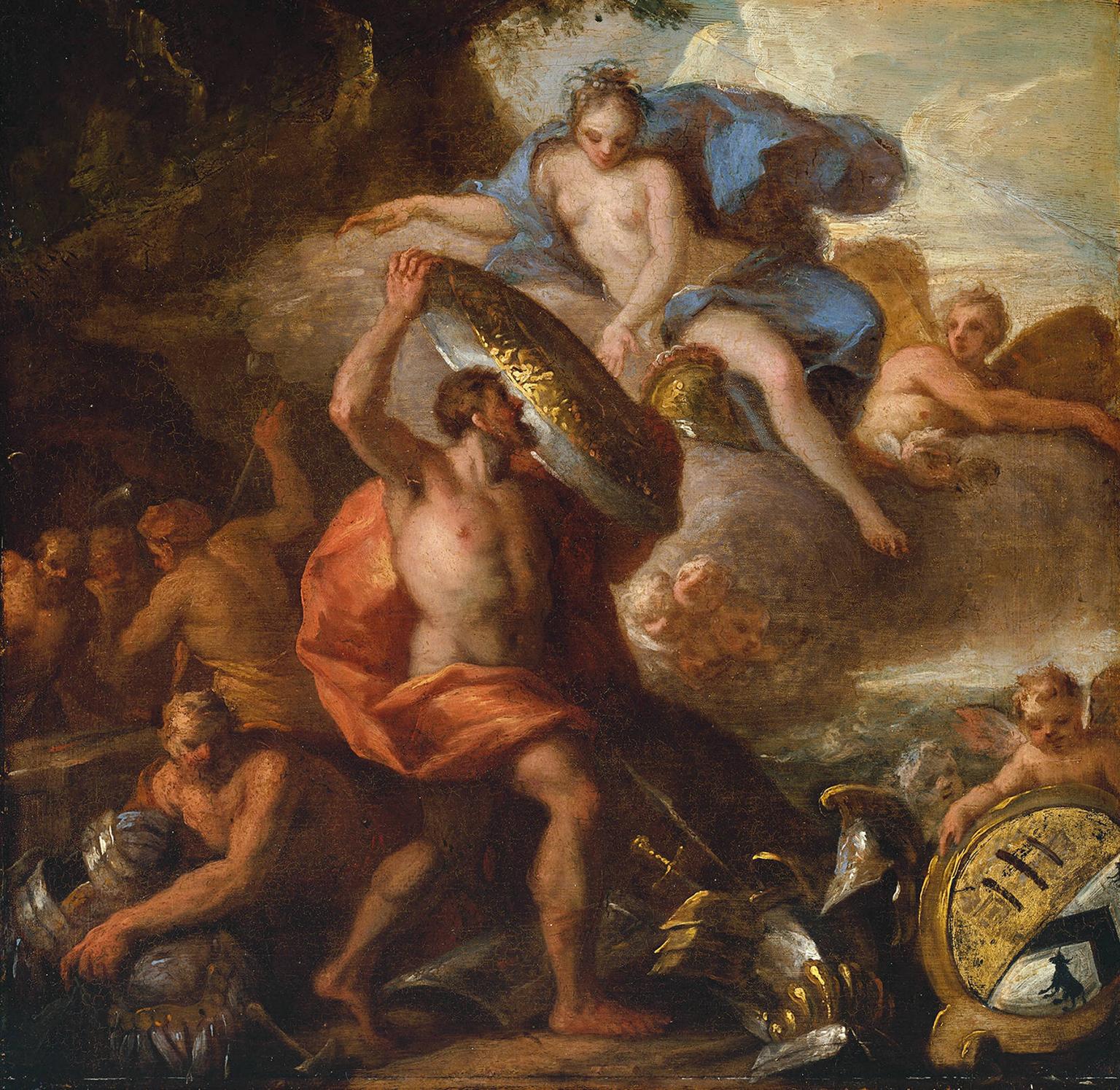
Thetis Accepting the Shield of Achilles from Vulcan
When Patroclus is killed by the Trojan prince Hector, Achilles vows revenge. He goes out from his camp, wearing the replacement armor Thetis has had crafted for him and lays waste to the Trojans. So great is Achilles' wrath and strength in battle that he angers a local river god by clogging the water with the slaughtered Trojans' bodies.
Achilles ends up battling with the river god itself, driving it back and continuing his vendetta. After he has pushed Hector back to the city gates, he chases him around the city three times before Hector turns to face him. Achilles, with some divine assistance, kills Hector.
Achilles has gained the revenge he sought on the Trojan prince for the death of Patroclus, but he is not satisfied by this victory. Furious, grieving, and his vengeance unsatisfied, he takes Hector's body and drags it behind his chariot. He goes on to abuse Hector's body for 10 days, dragging it around and refusing to release it to the Trojans for a proper burial.
Angered at Achilles' disregard for the usual rites of burial and the mores of death and respect for one's enemies, the gods insisted that Thetis speak to her wayward son.
Attempting to protect Achilles from his behavior, she goes to him and convinces him to return the body. Another of the gods leads Priam, the King of Troy, into the Greek camp to retrieve the body. Achilles meets with Priam, and for the first time, seems to consider his predicted mortality. The King's grief reminds him that his father, Peleus, will mourn for him one day when he falls, as is fated. Despite all of Thetis' efforts, Achilles is destined to a brief life covered in glory, rather than a long and quiet existence.
Throughout the Iliad, Thetis' efforts are centralized on one purpose—the defense of her son. She does everything she can to defend him. However, Achilles' arrogance, pride, and desire to prove himself is more substantial than her efforts.
From the time he leaves Skyros with Odysseus, he acts impulsively. His argument with Agamemnon was the indirect cause of Patroclus' going forth against the Trojans and falling to Hector. His mistreatment of Hector's body raises the wrath of the gods.
Over and over, Achilles defies his mother's efforts in his search for glory. His is the ultimate coming-of-age story, as he casts off the protection and guidance of a loving mother to find his way in the world.