Patroclus' Death in the Iliad
Patroclus – Death by Hubris
Patroclus' death was one of the most poignant and powerful scenes in the Iliad. It reveals the futility of mortals endeavoring to go against the gods and the price of reckless behavior. Recklessness and arrogance are recurring themes throughout the epic. Mortal men often show these failings while being conspired against by the gods, fate, and something Homer refers to often as "ruin."
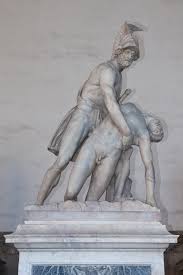
Patroclus - ancient Greek warrior
Achilles earned himself a brief life that will end in battle with his intemperate ways. He is hot-headed and passionate, often callous and impulsive. Patroclus, while wiser, is not much better. He invited his own death by first demanding access to Achilles' armor and then taking the life of the son of a god. Even Hector, Patroclus' killer, will eventually fall to his own hubris and arrogance. Although Zeus has decreed the Trojans' defeat, Patroclus will fall in the battle, luring Achilles back into battle fated to be his doom. Eventually, Hector will also pay with his life.
As a child, Patroclus is reported to have killed another child in anger over a game. To deflect the consequences of his crime and give him a chance to begin again elsewhere, his father, Menoetius, sent him to Achilles' father, Peleus. In the new household, Patroclus was named Achilles' squire. Achilles acted as a mentor and protector, as the older and wiser of the boys. The two grew up together, with Achilles looking after Patroclus. Even though Patroclus was considered a step above a servant, tending menial chores, Achilles mentored him.
Patroclus was the most trusted and loyal of Achilles' men. The exact relationship between the two men is a matter of some dispute. Some later authors depicted them as lovers, while some modern scholars present them as very close and loyal friends. Whatever the relationship between the two was, it is apparent that they depended upon and trusted one another. Achilles was much more empathetic and caring toward Patroclus than any of his other men. For Patroclus's sake alone, he might have made better choices.
Patroclus, for his part, was fiercely loyal and wanted to see Achilles succeed. When Achilles felt dishonored by Agamemnon, he vowed not to rejoin the war until his own ships were threatened. His refusal left the Greeks to fight on their own. Agamemnon had insisted upon taking a slave woman, Briseis, away from Achilles to replace his own concubine. Achilles had enslaved Briseis after invading Lyrnessus and slaughtering her parents and brothers. He considered it a personal insult to have his war prize taken from him, and he refused to aid the Greek leader, Agamemnon, in the battle.
The Trojans were pressing hard and came to the ships when Patroclus came to Achilles weeping. Achilles mocks him for crying, comparing him to a child "clinging to its mother's skirts." Patroclus informs him that he's grieving for the Greek soldiers and their losses. He begs permission to borrow Achilles' armor and go out against the Trojans in hopes of buying the soldiers some space. Achilles reluctantly agrees, not knowing that this battle will be the death of Patroclus.
Why Did Hector Kill Patroclus in the Iliad?
Patroclus' determination and bravery has earned him enemies among the Trojans. Having gained Achilles' armor, he rushes into the battle, driving the Trojans back. The gods are playing each of the sides against the other. Zeus has determined that Troy will fall, but not before the Greeks take heavy losses.
His own mortal son, Sarpedon, is among the Trojan soldiers as Patroclus drives them away from the ships. In a frenzy of glory and blood lust, Patroclus begins slaughtering every Trojan he meets in repayment for his fallen comrades. Sarpedon falls under his blade, enraging Zeus.
The god plays his hand, instilling Hector, the Trojan forces leader, with temporary cowardice so that he retreats toward the City. Encouraged, Patroclus pursues. He is defying Achilles' order only to drive the Trojans away from the ships.
Patroclus manages to kill Hector's chariot driver. In the ensuing chaos, god Apollo wounds Patroclus, and Hector is quick to finish him off, driving a spear through his belly. With his dying words, Patroclus foretells Hector's own impending doom.
Achilles reaction to Patroclus' death
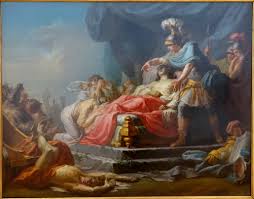
Patroclus and Hector in battle
When Achilles learns of Patroclus' death, he beats the ground, unleashing an unearthly cry that brought his mother, Thetis, from the sea to comfort him. Thetis finds Achilles lamenting the death of Patroclus, furious and grieving. She urges him to wait a single day to exact his revenge against Hector. The delay will give her time to have the divine blacksmith create his armor to replace that stolen and worn by Hector. Achilles agrees though he does go out to the battlefield, showing himself long enough to terrify the Trojans still battling over Patroclus' body to flee.
The Battle Turns
In truth, the war was won because of Patroclus' death. Iliad drama and history led up to the moment of his death and the vengeance it brought about. Achilles, furious and grieving his loss, return to the battle. While his goal is to route the Trojans, he now carries into battle a personal vendetta. He is determined to kill Hector.
Hector's own arrogance proves his downfall. His own advisor, Polydamas, tells him that it would be wise to retreat into the City walls against another Achaean attack. Polydamas has offered Hector wise counsel throughout the Iliad. Early on, he pointed out that Paris' pride and recklessness caused the war to begin and recommends that Helen be returned to the Greeks. While many of the soldiers quietly agree, Polydamas' advice is ignored. When he recommends retreat into the City walls, Hector once again refuses. He is determined to continue battling and win glory for himself and Troy. He would have been wiser to accept Polydamas' advice.
Achilles, mourning the death of Patroclus, prepares for battle. Thetis brings him the newly-forged armor. The armor and shield are described with great length in the poem, contrasting the ugliness of war with the beauty of art and of the greater world in which it takes place. As he prepares, Agamemnon comes to him and reconciles their disagreement. The captured slave, Briseis, is returned to Achilles, and their quarrel is laid aside. Thetis assures Achilles that she will watch over Patroclus's body and keep it preserved and safe until his return.
Who is Responsible for Patroclus' death in the Iliad?
Although Hector drove the spear home, it can be argued that Zeus, Achilles, or even Patroclus himself, was ultimately responsible for his death. Zeus determined Patroclus would fall to Hector after Patroclus killed his own son on the battlefield. The god orchestrated the events that brought Patroclus within range of Hector's spear.
Of course, Hector delivered the fatal blow in vengeance for both the Trojan soldiers Patroclus slaughtered and his own chariot driver.
Was it truly the fault of either of these that Patroclus died?
That is a matter of some debate. Patroclus defied Achilles' orders when he set off after the fleeing Trojans. Had he stopped attacking, as he promised Achilles he would, after the ships were rescued, he might have survived. Had he not fallen upon the retreating Trojans, killing them wantonly, he might not have fallen afoul of Zeus's wrath. His own arrogance and desire for glory proved his downfall.
Finally, if Achilles had joined the battle from the beginning, Patroclus might not have died. His quarrel with Agamemnon over the captured slave Briseis led him to sulk and refuse to participate in the war. Instead of going out to lead the soldiers, he allowed Patroclus to go in his stead, wear his armor, and pay the ultimate price.
Like most Greek epics, the Iliad displays the foolishness of glory-hunting and seeking violence over wisdom and strategy. Much of the slaughter and misery could have been prevented if those involved had listened to cooler heads and allowed wisdom and peace to prevail, but it was not to be. Following the death of Patroclus, Achilles steps out onto the battlefield, ready to take revenge on Hector. He pursues the Trojans and Hector with a vengeance.
Knowing that Achilles' rage will bring the Trojans down, Zeus lifts his decree against divine intervention in the battle, allowing the gods to interfere if they wish. As a body, they choose to instead take up places on the mountains lining the battlefield to see how the mortals fare independently.
It is time for Achilles to face his fate. He has always known that only death awaited him in Troy. From the Iliad's opening, he had the option of a long, if obscure, life in Phthia. Fighting in Troy would only lead to his demise. With the death of Patroclus, his mind is made up. Throughout the epic, Achilles makes little progress as a character or as a man. His passionate tempers and impulsiveness remain untempered as he rushes into the final battle. He begins slaughtering the Trojans, undeterred even by interference by the gods.
Even a god can't keep him from his ultimate goal. He continues the assault on the Trojan army, slaughtering so many that he enrages a river god, who attacks him and nearly kills him. Hera intervenes, setting the plains on fire and boiling the river until the god relents. Achilles returns, still pursuing his ultimate goal.
Returning to the City, Achilles drives all of the soldiers back until Hector remains on the battlefield. Ashamed of the defeat that his overconfidence has brought, Hector refuses to retreat into the City with the others. Seeing Achilles coming, and knowing himself lost, he runs, circling the City four times before turning to fight, aided, so he believes by his friend and ally, Deiphobus.
Unfortunately for Hector, the gods are playing tricks again. The false Deiphobus is actually Athena in guise. Once he has thrown a spear and missed Achilles, he asks Deiphobus for his lance, only to realize his friend is gone. He has been tricked.
Achilles knows every weak point of the stolen armor and uses that knowledge to stab Hector through the throat.
With his dying words, Hector begs that his body should be returned to his people, but Achilles refuses. He attaches the unfortunate Trojan to the back of his chariot and drags the body triumphantly through the dirt. Patroclus has been avenged, and Achilles will finally allow his body to be cremated so that his friend can be at peace.
The Final Burial
Achilles continues to abuse Hector's body, dragging it behind his chariot around Patroclus' tomb, for an additional twelve days. Finally, Zeus and Apollo intervene, sending Thetis to convince Achilles to accept a ransom for the body. Achilles is reluctantly convinced and allows the Trojans to retrieve Hector's corpse and return it for a proper funeral and burial. There is a respite from the fighting for twelve days as the Trojans mourn their fallen hero. Now Patroclus and Hector are both laid to rest.
Although the Iliad concludes before Troy's final fall and the death of Achilles, its anticlimactic ending is appropriate. The fall and death are fated and will come to be, but Achilles's change following Patroclus' death was less easy to predict. Beginning the epic as a proud, impulsive, and self-centered man, Achilles finally gains sympathy when Priam comes to him to negotiate the return of Hector's body.
Priam mentions Peleus, Achilles' own father. Achilles realizes that he has doomed his father Peleus to suffer the same fate as Priam. His father will mourn his loss when he does not return from Troy, just as Priam mourns Hector.
This sympathy and recognition of another's grief convinces him to release the body of his friend's murderer. In the end, Achilles changes from one who is driven by selfish rage to someone who has discovered his own personal honor.