Timeless Myths Logo

Explore myths and legends from cultures around the world

Featured

Classical Mythology
Classical Mythology Greek and Roman myths, gods, heroes, and epic tales
Norse Mythology
Norse Mythology Vikings, Asgard, Ragnarok, and the nine realms
Celtic Mythology
Celtic Mythology Irish, Welsh, and Gaelic legends and folklore
Ancient Literature
Ancient Literature Classical texts, translations, and literary analysis

All Mythologies

Arthurian Legends King Arthur, Camelot, the Round Table, and the Holy Grail Egyptian Mythology Pharaohs, pyramids, and ancient Nile deities Japanese Mythology Shinto gods, spirits, and legendary creatures Chinese Mythology Dragons, immortals, and celestial beings Aztec Mythology Mesoamerican gods, rituals, and creation myths

Discover gods and goddesses from every pantheon

Featured

Greek Gods
Greek Gods The Olympians, Titans, and primordial deities
Norse Gods
Norse Gods Odin, Thor, Loki, and the Aesir and Vanir
Egyptian Gods
Egyptian Gods Ra, Osiris, Isis, Anubis, and more
Japanese Gods
Japanese Gods Amaterasu, Susanoo, and Shinto kami

All Gods & Deities

Roman Gods Jupiter, Mars, Venus, and the Roman pantheon Celtic Gods The Tuatha Dé Danann and Celtic deities Aztec Gods Quetzalcoatl, Tezcatlipoca, and Aztec deities Chinese Gods Jade Emperor, Dragon Kings, and celestial beings View All 150+ Deities Browse the complete collection of mythological deities
View all gods & deities

Tales, legends, and character profiles from mythology

Featured

All Stories
All Stories Browse 800+ mythology and history stories
Characters
Characters Profiles of 67 mythological heroes, gods, and villains

All Stories

Mythology Stories Ancient myths and legends retold History Stories Historical tales from ancient civilizations Religion & Culture Religious traditions and cultural beliefs
View all stories

Tools, references, and site information

Featured

Name Generators
Name Generators Generate fantasy and mythology-inspired names
All Articles
All Articles Browse 1,800+ articles on mythology and history

All Resources

About Timeless Myths Learn about this mythology resource Bibliography Sources and references used on this site FAQ Frequently asked questions Contact Get in touch with us
Search
Classical Mythology Greek and Roman myths, gods, heroes, and epic tales Norse Mythology Vikings, Asgard, Ragnarok, and the nine realms Celtic Mythology Irish, Welsh, and Gaelic legends and folklore Arthurian Legends King Arthur, Camelot, the Round Table, and the Holy Grail Egyptian Mythology Pharaohs, pyramids, and ancient Nile deities Japanese Mythology Shinto gods, spirits, and legendary creatures Chinese Mythology Dragons, immortals, and celestial beings Aztec Mythology Mesoamerican gods, rituals, and creation myths Ancient Literature Classical texts, translations, and literary analysis
Greek Gods The Olympians, Titans, and primordial deities Roman Gods Jupiter, Mars, Venus, and the Roman pantheon Norse Gods Odin, Thor, Loki, and the Aesir and Vanir Egyptian Gods Ra, Osiris, Isis, Anubis, and more Celtic Gods The Tuatha Dé Danann and Celtic deities Aztec Gods Quetzalcoatl, Tezcatlipoca, and Aztec deities Japanese Gods Amaterasu, Susanoo, and Shinto kami Chinese Gods Jade Emperor, Dragon Kings, and celestial beings View All 150+ Deities Browse the complete collection of mythological deities View all gods & deities
All Stories Browse 800+ mythology and history stories Characters Profiles of 67 mythological heroes, gods, and villains Mythology Stories Ancient myths and legends retold History Stories Historical tales from ancient civilizations Religion & Culture Religious traditions and cultural beliefs View all stories
Name Generators Generate fantasy and mythology-inspired names All Articles Browse 1,800+ articles on mythology and history About Timeless Myths Learn about this mythology resource Bibliography Sources and references used on this site FAQ Frequently asked questions Contact Get in touch with us
Search Search the entire mythology archive

Nestor in the Iliad: The Mythology of the Legendary King of Pylos

greek-mythology
Nestor in the Iliad - Who was he

Nestor in the Iliad was the king of Pylos who was known for his wisdom and insight which helped several characters in the epic poem, though some of his counsel was controversial.

He was known to be motivating and an inspiring human who gave speeches and helped people. Keep reading this article to know all about him.

Who Was Nestor?

Nestor in the Iliad was the king of Pylos whose inspiring stories helped to drive the plot of Homer's epic poem. He was on the side of the Greeks against the Trojans but was too old to participate in the war so his contributions were his fables.

The Adventures of Nestor

When Nestor was young, the city of Pylos was destroyed, thus he was transported to the ancient town of Gerenia and that was how he got the name Nestor the Gerenian. During his youth, he was involved in some notable adventures such as hunting for the Calydonian Boar.

As an argonaut, he helped Jason in retrieving the Golden Fleece and fought the centaurs. Later, he was crowned the King of Pylos after the Greek hero Heracles decimated his father and siblings.

Due to the tragedy that befell his brothers and father, Apollo, the god of divine justice, granted him long life till his third generation. Though Nestor was old by the time the Trojan War came around, he and his sons participated in it; fighting on the side of the Acheans.

Nestor displayed some heroism despite his advanced age and was known for his oratory skills and advice. When Agamemnon and Achilles feuded over Briseis in the Iliad, Nestor advice played a crucial role in reconciling them.

In the Iliad, Nestor commanded his troops in battle by riding his chariot in front of the army. However, one of his horses was shot and killed by an arrow from the bow of Paris, son of Priam. He had a gold shield and was frequently referred to as the Gerenian horseman.

Nestor Counsels Patroclus

Since he was famous for his wisdom, Patroclus, the best friend of Achilleus came to seek counsel from him. Nestor told Patroclus of how the Achaean troops had suffered huge losses at the hands of the Trojans and advised him to either persuade Achilleus to return to the war or to disguise himself as Achilleus.

Patroclus went with the latter and disguised himself as Achilleus, an event that subsequently turned the tide in favor of the Greeks and helped to win the war. It was Nestor's speech that moved Ajax the Great to fight Hector and broker a temporary truce.

Nestor Advises Antilochus

During the funeral games for Patroclus, Nestor helped his son, Antilochus, devise a strategy to win the chariot race. Though the details of the strategy were unclear, Antilochus came in second ahead of Menelaus who accused the former of cheating. Some scholars believe that Antilochus ignored his father's advice which was why he came second, however, others maintain that it was Nestor's advice that helped Antilochus to second place despite his slow horses.

Nestor Recalls His Race in Bouprasion

At the end of the race, Achilleus rewarded Nestor in memory of Patroclus and Nestor gave a lengthy speech recounting when he competed in the chariot race during the funeral games for King Amarynkeus. According to him, he won all competitions except the chariot race which he lost to the twins known as Aktorione or Molione.

He narrated that the twins won the race simply because they were two and he was the only one. The strategy the twins adopted was simple; one of them held on tightly to the reins of the horses while the other spurred the beasts with a whip.

This strategy by the twins helped to maintain the equilibrium between the balance and the speed of the horses. Thus, they won without sacrificing one element for the other. This is in stark contrast to Eumelos (a competitor during the funeral games for Patroclus) who had the fastest horses but lost the race because his horses couldn't balance stability with speed.

Nestor's Contradictory Advice

However, not all Nestor's counsels ended in victory for his audience. For example, when Zeus tricked the Greeks by giving a false dream of hope to the King of Mycenae, Nestor fell for the trick and urged the Greeks to battle. However, the Greeks suffered heavy losses and tipped the balance in favor of the Trojans.

Also, in Book Four of the Iliad, Nestor told the Achaeans to use spear techniques in their battle with the Trojans. It was a piece of advice that proved disastrous as the Achaean troops suffered heavy casualties.

Who Is Nestor in the Odyssey and What is Nestor's Role in the Iliad?

He is the same as Nestor that appears in the Iliad and his role is to give an account of past events before the Trojan war. He also incites the warriors through his long-winded speeches of bravery and victory on the battlefield.

The Family of Nestor

The father of Nestor was King Neleus and his mother was Queen Chloris, who originally hailed from Minyae. According to other accounts, Nestor's mother was Polymede. The wife of Nestor varies depending on the myth; some say he married Eurydice, the princess of Pylos while others claim his wife was Anaxibia, the daughter of Cratieus.

Regardless of who he married, Nestor had nine children including Pisidice, Thrasymedes, Perseus, Peisistratus, Polycaste, and Aretus. The others were Echephron, Stratichus, and Antilochus with later accounts adding Epicaste, the mother of the poet Homer.

Conclusion

This article has covered the family and role of Nestor, a minor but key character in the epic poem the Iliad. Here is a recap of all that we have read so far:
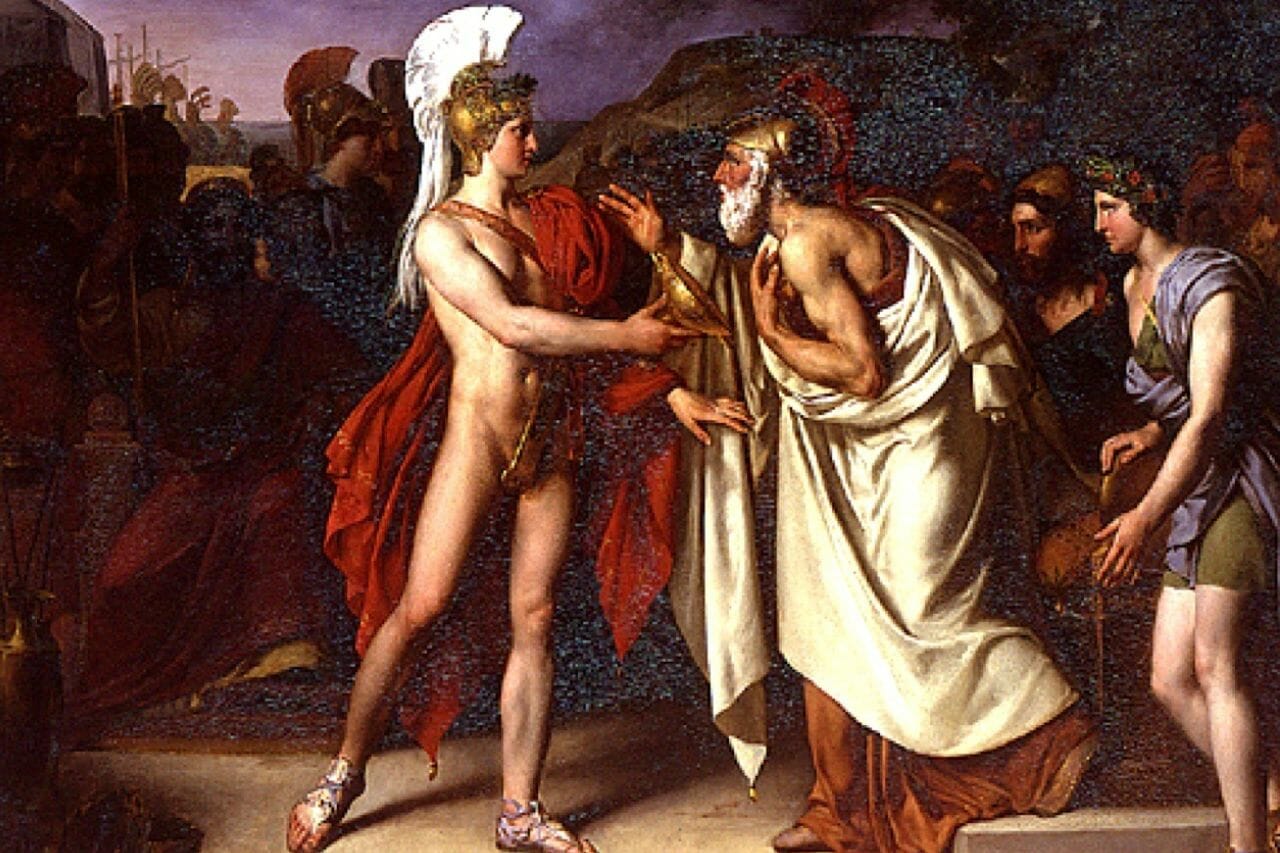
Nestor in the Iliad - What was his role

  • Nestor's father was King Neleus of Pylos and his mother was either Chloris of Minyae or Polymede, depending on the source of the myth.

  • He married either Eurydice of Pylos or Anaxibia, the daughter of Craetius and had nine children including Antilochus, Aretus, Perseus, Polycaste, Echephron and Stratichus.

  • He took part in the Trojan War alongside his sons and led the Pylians in his chariot but one of his horses was shot and killed by an arrow from Paris's bow.

  • Nestor's advice to Patroclus set in motion events that would eventually lead to the victory of the Greeks over the Trojans though it cost the life of Patroclus.

At the funeral games for Patroclus, Nestor's advice helped his son Antilochus come second and Nestor was rewarded for his old age and wisdom. Though he was garrulous and tended to tout his own achievements during his lengthy advice, his audience loved him and revered him greatly.

By Ancient Literature

Created: February 16th, 2024

Modified: January 19th, 2026

Nestor

Nestor

Nestor (Νέστωρ) was the youngest son of Neleus and Chloris, daughter of Amphion. He was the brother of Pero, Periclymenus, and ten other brothers. In his youth, Nestor took part in a cattle raid and the war against Elis. He killed or wounded a hun...

April 27th, 1999 • Jimmy Joe
Antenor: The Various Greek Mythologies of King Priam's Counselor

Antenor: The Various Greek Mythologies of King Priam's Counselor

Antenor of Troy was an aged and wise counselor who offered great services to Priam, the king of Troy, and his wife, Hecuba, before and during the Trojan War. He did not fight in the war due to his age but had his children fight in his stead. Depen...

February 15th, 2024 • Ancient Literature
Neleus

Neleus

Neleus (Νηλεύς) was the son of Tyro and Poseidon, and the twin brother of Pelias. When Pelias drove him from Iolcus, Neleus migrated south, where he was warmly welcomed by his cousin Aphareus. Neleus received most of the coastal land in Messenia f...

April 27th, 1999 • Jimmy Joe
Odysseus

Odysseus

King of Ithaca. The Romans identified Odysseus as Ulysses. Odysseus (Ὀδυσσεύς) was the hero of the epic poem called The Odyssey. Odysseus was the son of Laërtes (Laertes) and Anticleia, daughter of the thief Autolycus and Mestra. Other writers sai...

April 24th, 1999 • Jimmy Joe
Pylus

Pylus

Pylus or Pylos was founded by Pylas, exiled king of Megara. Pylas came to Messenia, and established a city on the southwest coast of the Peloponnesus. An Aeolid named Neleus drove Pylos out of his city, and became Pylus' second king. The city enjo...

August 8th, 1999 • Timeless Myths
Antilochus: The Greek Mythology of the Greatest Prince of Pylos

Antilochus: The Greek Mythology of the Greatest Prince of Pylos

Antilochus was a Greek warrior who sought the hand of Helen in marriage and thus had to join the Greek expedition to Troy after Paris kidnapped Helen. He killed some notable Trojan warriors while defending the honor of his father, Nestor. Antiloch...

February 15th, 2024 • Ancient Literature
What is the Role of Athena In The Iliad?

What is the Role of Athena In The Iliad?

Athena in the Trojan War acts as a mentor to Achilles, battling on the side of the Achaeans. Achilles is a hot-headed warrior, impulsively rushing into battle with little discipline. Athena tries to rein in his impulsivity and direct his strength ...

February 16th, 2024 • Ancient Literature
Peleus: The Greek Mythology of the King of the Myrmidons

Peleus: The Greek Mythology of the King of the Myrmidons

Peleus was an Argonaut who fled the city of Aegina after he and his half-brother, Telamon, murdered their sibling, Phocus. The two brothers landed in Phthia for the purification ceremony only for Peleus to later kill the King of Phthia albeit in a...

February 16th, 2024 • Ancient Literature
Achilles Greek Mythology: Discovering One of the Greatest Greek Heroes

Achilles Greek Mythology: Discovering One of the Greatest Greek Heroes

Achilles Greek mythology narrates the adventures of Achilles, the main character of the Iliad, before, during, and after the Trojan War. It tells of how he became invulnerable to attacks on the battlefield and how he died after his weakness was di...

February 15th, 2024 • Ancient Literature
What Roles Did the Gods in The Iliad Play?

What Roles Did the Gods in The Iliad Play?

The gods in the Iliad, as in most Greek mythology, heavily influenced events as they unfolded. While Zeus, the king of the gods, remained neutral, several lesser gods and goddesses chose sides, championing either Greek or Trojan causes. The entire...

February 16th, 2024 • Ancient Literature
Timeless Myths

Exploring mythology and legends from around the world.

Explore Myths

All Stories Characters All Articles Search Site Map

Mythologies

Norse Mythology Classical Mythology Celtic Mythology Arthurian Legends Mythology Gods Ancient Literature

About Us

Introduction About Jimmy Bibliography FAQs Retro Version

Resources

Timeless Myths All Stories All Articles Characters
© 1999-2026 Timeless Myths • Copyright • Privacy Policy • Cookie Policy • Contact
Follow us: