Timeless Myths Logo

Explore myths and legends from cultures around the world

Featured

Classical Mythology
Classical Mythology Greek and Roman myths, gods, heroes, and epic tales
Norse Mythology
Norse Mythology Vikings, Asgard, Ragnarok, and the nine realms
Celtic Mythology
Celtic Mythology Irish, Welsh, and Gaelic legends and folklore
Ancient Literature
Ancient Literature Classical texts, translations, and literary analysis

All Mythologies

Arthurian Legends King Arthur, Camelot, the Round Table, and the Holy Grail Egyptian Mythology Pharaohs, pyramids, and ancient Nile deities Japanese Mythology Shinto gods, spirits, and legendary creatures Chinese Mythology Dragons, immortals, and celestial beings Aztec Mythology Mesoamerican gods, rituals, and creation myths

Discover gods and goddesses from every pantheon

Featured

Greek Gods
Greek Gods The Olympians, Titans, and primordial deities
Norse Gods
Norse Gods Odin, Thor, Loki, and the Aesir and Vanir
Egyptian Gods
Egyptian Gods Ra, Osiris, Isis, Anubis, and more
Japanese Gods
Japanese Gods Amaterasu, Susanoo, and Shinto kami

All Gods & Deities

Roman Gods Jupiter, Mars, Venus, and the Roman pantheon Celtic Gods The Tuatha Dé Danann and Celtic deities Aztec Gods Quetzalcoatl, Tezcatlipoca, and Aztec deities Chinese Gods Jade Emperor, Dragon Kings, and celestial beings View All 150+ Deities Browse the complete collection of mythological deities
View all gods & deities

Tales, legends, and character profiles from mythology

Featured

All Stories
All Stories Browse 800+ mythology and history stories
Characters
Characters Profiles of 67 mythological heroes, gods, and villains

All Stories

Mythology Stories Ancient myths and legends retold History Stories Historical tales from ancient civilizations Religion & Culture Religious traditions and cultural beliefs
View all stories

Tools, references, and site information

Featured

Name Generators
Name Generators Generate fantasy and mythology-inspired names
All Articles
All Articles Browse 1,800+ articles on mythology and history

All Resources

About Timeless Myths Learn about this mythology resource Bibliography Sources and references used on this site FAQ Frequently asked questions Contact Get in touch with us
Search
Classical Mythology Greek and Roman myths, gods, heroes, and epic tales Norse Mythology Vikings, Asgard, Ragnarok, and the nine realms Celtic Mythology Irish, Welsh, and Gaelic legends and folklore Arthurian Legends King Arthur, Camelot, the Round Table, and the Holy Grail Egyptian Mythology Pharaohs, pyramids, and ancient Nile deities Japanese Mythology Shinto gods, spirits, and legendary creatures Chinese Mythology Dragons, immortals, and celestial beings Aztec Mythology Mesoamerican gods, rituals, and creation myths Ancient Literature Classical texts, translations, and literary analysis
Greek Gods The Olympians, Titans, and primordial deities Roman Gods Jupiter, Mars, Venus, and the Roman pantheon Norse Gods Odin, Thor, Loki, and the Aesir and Vanir Egyptian Gods Ra, Osiris, Isis, Anubis, and more Celtic Gods The Tuatha Dé Danann and Celtic deities Aztec Gods Quetzalcoatl, Tezcatlipoca, and Aztec deities Japanese Gods Amaterasu, Susanoo, and Shinto kami Chinese Gods Jade Emperor, Dragon Kings, and celestial beings View All 150+ Deities Browse the complete collection of mythological deities View all gods & deities
All Stories Browse 800+ mythology and history stories Characters Profiles of 67 mythological heroes, gods, and villains Mythology Stories Ancient myths and legends retold History Stories Historical tales from ancient civilizations Religion & Culture Religious traditions and cultural beliefs View all stories
Name Generators Generate fantasy and mythology-inspired names All Articles Browse 1,800+ articles on mythology and history About Timeless Myths Learn about this mythology resource Bibliography Sources and references used on this site FAQ Frequently asked questions Contact Get in touch with us
Search Search the entire mythology archive

Violence in the Aeneid: The Instances of Conflicts in the Epic Poem
literary-analysis
Violence in the Aeneid all you need to know

Violence in the Aeneid explores the subjects of conquest and defeat, glory and infamy, that characterized the establishment of the Roman Empire. The poem depicts the exploits of Aeneas whose heroic acts led to the founding of Rome, which later became an empire under Julius Caesar.

Though the poem is filled with violence, the brutality yields little to no results, a reflection of today's society. Discover violence in Virgil Aeneid and how it affected the people and civilizations.

What Is Violence in the Aeneid?

Violence in the Aeneid is the cause of war and destruction in the epic poem and the devastating losses that follow in its wake. It explores the frivolous reasons why wars began in the poem and how they affected the characters involved in the conflict.

The Violence in Aeneid: Book 1

Aeneas and his fleet were on a voyage to find a second home when violent winds sent by Aeolus attacked them. Before that, Aeolus had been bribed by Juno, who hated Aeneas and his fleet.

First, Aeneas was a Trojan, and Juno hated the Trojans because their prince, Paris, chose Aphrodite as the most beautiful among the goddesses. Secondly, it had prophesied that Aeneas would destroy her choicest city, Carthage.

As if that was not enough, Juno's daughter, Hebe, had been replaced as cupbearer to Jupiter by the Trojan prince, Ganymede. All these issues boiled up in Juno, and she conspired with Aeolus, the King of the Winds, to destroy Aeneas' fleet.

Aeolus blows his fiercest winds but Neptune, the god of the Sea, intervenes and calms the waters. Though Neptune doesn't like the Trojans, he interrupts the plans of Aeolus and Juno because he feels they are intruding in his territory.

Thus, right from the 1st Book or chapter, the poem records violence between the gods and man, Juno and Aeolus against Aeneas. Also, there is violence between the gods – Juno and Aeolus against Neptune.

However, the violence is pointless as Juno's efforts to destroy Aeneas and his ships are thwarted. Aeneas can brave the storm and take shelter off the coasts of Africa, where he encourages his men not to lose heart but continue to strive with him. They build another fleet of ships and set sail to continue their travels.

The Violence at the Beginning of the Poem

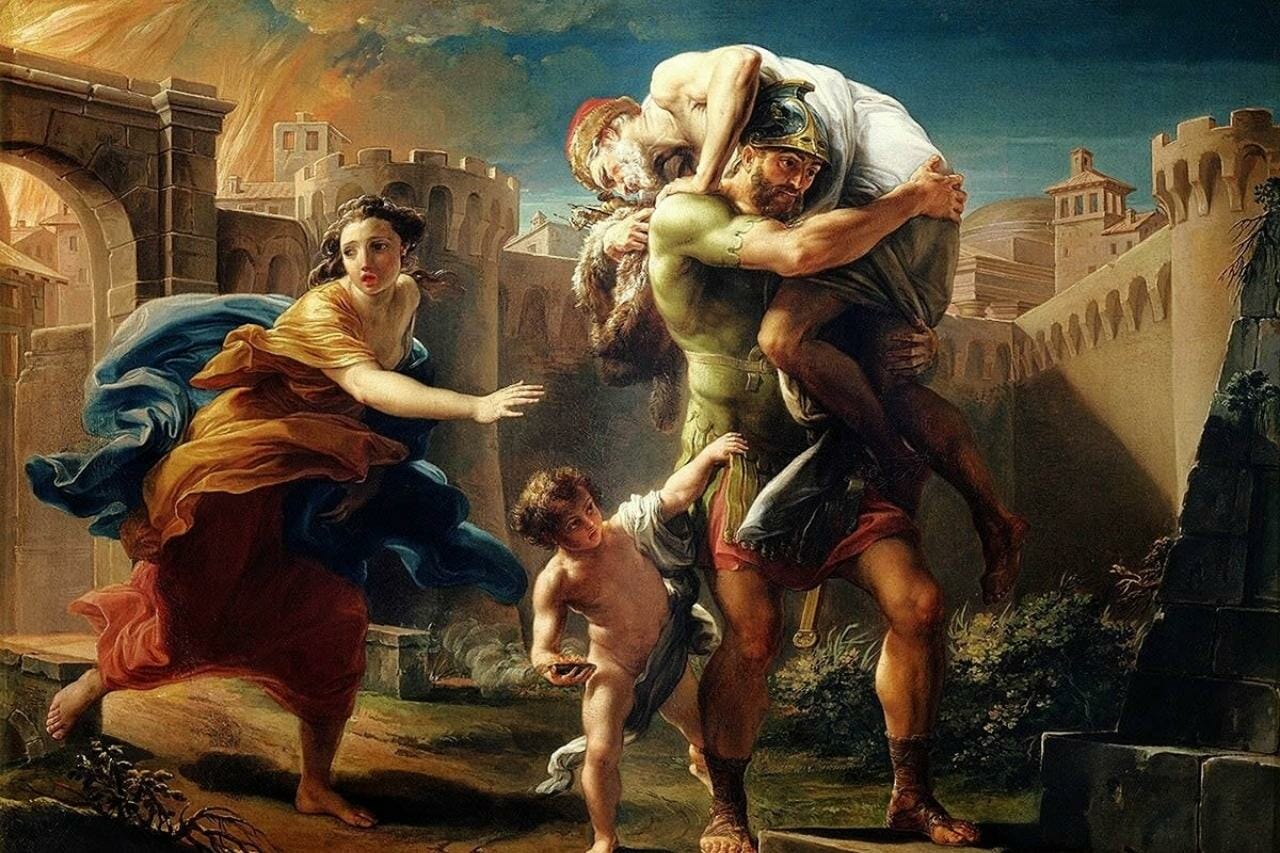
The Aeneid summary begins with the destruction of Troy by the Achaeans, and it depicts the epic hero, Aeneas, fleeing from the carnage and carrying his father, Anchises, with him. He later narrates how his fellow citizens fought valiantly, knowing they had already lost.

He recounts how the Greeks gifted a wooden horse to the Trojans but unknown to the Trojans; the Greeks had hidden their men in the horse. The Greeks then pretended to give up on the war and sail away.

However, a Trojan priest, Laocoon, saw through the ruse of the Greeks and warned the Trojans against bringing the wooden horse into the city. Unfortunately, his warnings fell on deaf ears, and to convince his people, and he threw a spear at the horse.

Sadly, the gods sent two giant sea serpents to kill Laocoon and his sons. Tragically, the people of Troy interpreted Laocoon's tragic death as a sign that he was lying. Thus they brought the wooden horse into the city.

Once night fell and the Trojans were sound asleep, the Greek warriors climbed out of the horse and opened the gates for their colleagues who had returned. The Greek warriors pillaged the city, killing the Trojans in droves and burning Troy to the ground.

Luckily, for Aeneas, Hector, who died in the battle, appeared to him in a dream and warned him to flee Troy with his family. On their way, he realized that he had left his wife behind, and he returned for her only to meet her ghost, indicating she was dead.

Effects of Violence in the Aeneid

The violence subsides as we read of Aeneas' numerous wanderings after his encounter on the seas. This chapter tells of the effects of the violence as Aeneas meets Andromache, his widowed wife of Hector. Andromache's story reminds everyone that though the war heroes may receive honor and glory, their relatives and descendants bear the brunt of their absence. Hector died defending the city of Troy and was honored as the greatest warrior in Trojan history.

However, his widow, Andromache, continued to feel his absence and mourn his death. Andromache also lost her son, Astyanax, during the war, and her sorrow could not be contained. She has lost her family through the conflict in Troy and nothing in this world could placate or replace the loss that she felt. Virgil conveys the idea that clashes are violent and have untold psychological, emotional, physical, and financial effects on their survivors.

Aeneas and his men also discover the dead body of Polydorus, a prince of Troy, and they are moved to sorrow. Polydorus' remains remind them of the Trojan warriors that lost their lives in defense of Troy. It also paints the horrid picture of the horror of war and why it should be avoided at all costs especially given the frivolous cause of the Trojan War. The effects of violence can be devastating even on the warriors that partake in it, as we encounter in Book 3 of the Aeneid.

The Fate of Dido and Other Violent Acts

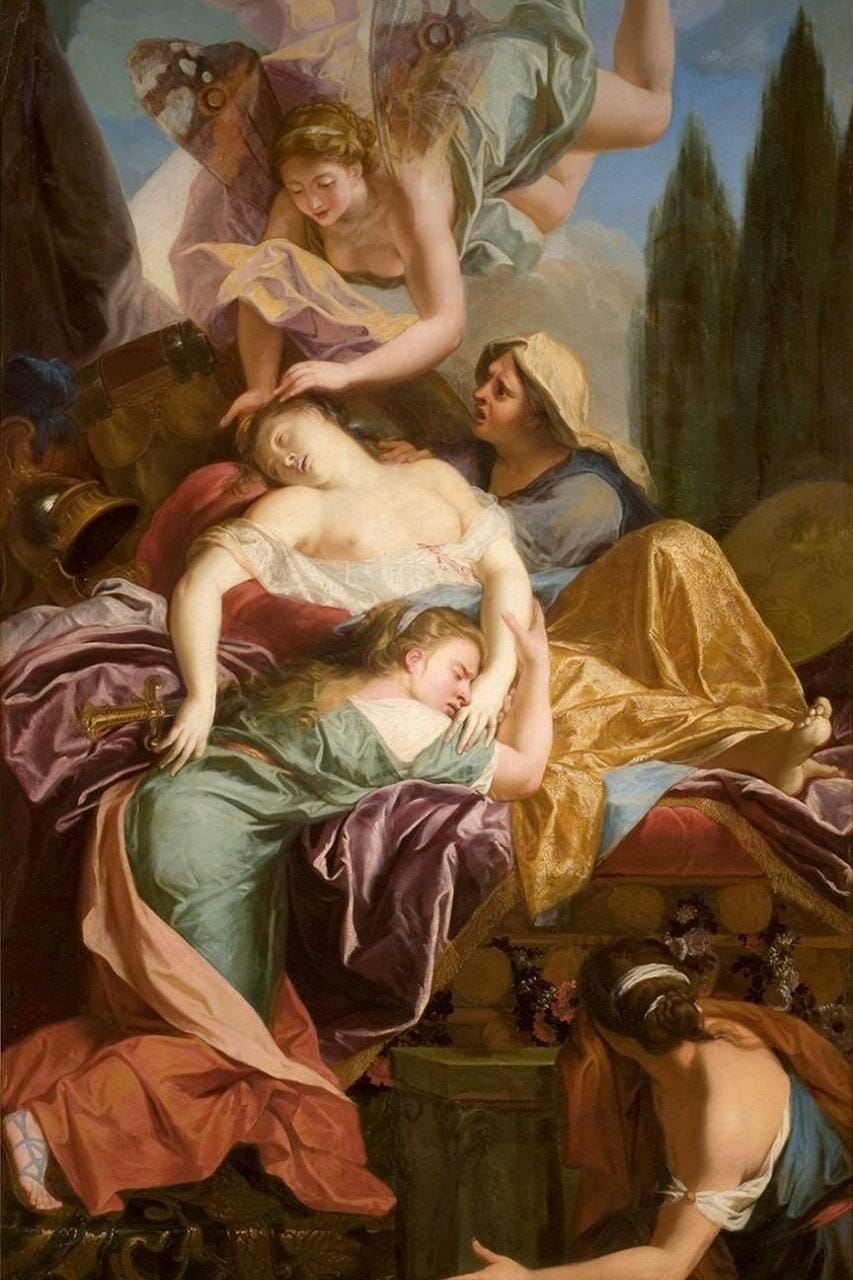
Dido, the Queen of Carthage, committed suicide by stabbing herself with the sword of Aeneas and dying on a funeral pyre. In this part, we witness a slight shift from the violence of wars and conflicts to violence perpetrated on oneself.

Dido killed herself because Aeneas couldn't reciprocate her sacrificial love for him. She gave her all in the relationship she built with the epic hero, but Aeneas put his mission of founding Rome above Dido.

Unknown to Dido, she was just a tool that Juno used to prevent Aeneas from fulfilling his destiny of founding Rome. However, Jupiter sends Mercury, the god of messages and communication, to remind Aeneas of his mission.

Nonetheless, Mercury then advises him to leave in the dead of night to avoid Dido's pleas and tears. Aeneas obliges and waits till everyone is asleep, and he creeps out of Carthage when Dido finds out the following day, that she had killed herself.

The Carnage at Latium

However, we return to the destructive acts of war when Aeneas arrives in Latium and marries Princess Lavinia. The princess had earlier been betrothed to the leader of the Rutuli people, Turnus, but her father, King Latinus, changed his mind and gave her to Aeneas.

On the other hand, Juno, who has always hated Aeneas, causes Alecto, one of the Furies, to incite Lavinia's mother to thwart the marriage. Lavinia's mother, Amata, hides her daughter in the woods and prompts the women of Latium to instigate a war between Aeneas and Turnus.

Alecto also causes Ascanius to wound the sacred deer of Sylvia, the daughter of Tyrrheus. This sparks another disastrous war that destroys several lives and property in Latium. The Aeneid ends with further violence as notable warriors like Pallas, Camilla, Arruns and Lausus lose their lives. Aeneas then faces off with Turnus as they agree that single combat should end all hostilities.

The gods also take sides and try to influence the duel's outcome, but Aeneas wins. Queen Amata also kills herself by hanging after learning that Aeneas killed Turnus in the duel. Once again, we encounter the destructive effects of war as the people of Rutulli lose their revered champion, and King Latium loses his beloved wife.

Conclusion

So far, we've discussed the various instances of conflicts in the Aeneid and their catastrophic effects on the warriors and their relatives. Here is a summary points of all that this article has covered:
Violence in the Aeneid what to expect

  • The Aeneid is an epic poem filled with various forms of violence, including suicide, from the beginning to the end.

  • Aeneas narrates how Troy fell at the hands of the Greeks and how he had to escape with his family from the city only to realize that he had left his wife behind.

  • He encounters the widow Andromache, the wife of Hector, who is still mourning the loss of her family, and we learn how war affects the relatives of the warriors.

  • Aeneas' encounter with Dido introduces us to another form of violence, suicide, which Dido commits after she learns that her husband, Aeneas, has abandoned her.

  • The Aeneid ends in a war when the epic hero and Turnus face off in a duel after princess Lavinia's hand is given in marriage to Aeneas instead of Turnus as promised.

Though violence in the epic poem is a means of conquering and surviving, its damages the spirit of both the victor and the vanquished as they both suffer terrible losses.

By Ancient Literature

Created: February 16th, 2024

Modified: January 11th, 2025

Conflicts in The Odyssey: A Character's Struggle

Conflicts in The Odyssey: A Character's Struggle

In Odysseus's journey home, he faces significant conflicts in The Odyssey. The various challenges Odysseus faces are essentially the center of Homer's classic, but what are these antagonisms he encounters? To understand this, we will go over the p...

February 16th, 2024 • Ancient Literature
Themes in the Aeneid: Exploring the Ideas in the Latin Epic Poem

Themes in the Aeneid: Exploring the Ideas in the Latin Epic Poem

The Aeneid's themes are plenty; each gives an idea of what shaped the lives of the ancient Romans. A theme such as fate tells of how the ancient Romans struggled with the concept, while the idea of divine intervention reveals their religiosity. Th...

February 16th, 2024 • Ancient Literature
Mezentius in the Aeneid: The Myth of the Savage King of the Etruscans

Mezentius in the Aeneid: The Myth of the Savage King of the Etruscans

Mezentius in the Aeneid was a King who antagonized the Trojans as they settled in Latium. The Romans referred to him as "Despiser of the gods" due to his perceived disregard for the divine. He had a son Lausus who he loved more than his life but u...

February 16th, 2024 • Ancient Literature
Fate in the Aeneid: Exploring the Theme of Predestination in the Poem

Fate in the Aeneid: Exploring the Theme of Predestination in the Poem

Fate in the Aeneid is a major theme that explores how the ancient Romans viewed the concept of predestination. The entirety of the poem hinges on Aeneas's destiny which is to set the foundations for the establishment of the Roman Empire. We learn ...

February 16th, 2024 • Ancient Literature
The Aeneid

The Aeneid

(Epic Poem, Latin/Roman, 19 BCE, 9,996 lines)Introduction - Who wrote Aeneid "The Aeneid" (Lat: "Aeneis") is an epic poem by Vergil (Virgil), the pre-eminent poet of the Roman Empire. It was his final work and the twelve books of the poem occupied...

October 25th, 2024 • Timeless Myths
Omens in the Aeneid: How Virgil Used Signs to Predict the Future

Omens in the Aeneid: How Virgil Used Signs to Predict the Future

Omens in the Aeneid are signs that foreshadow future events while giving assurances of what is to come. Several times throughout the poem, the gods use omens to communicate to the characters. The signs then empower, encourage, or strengthen the re...

February 16th, 2024 • Ancient Literature
Aeneid

Aeneid

The Aeneid was written by a Rome's greatest poet named Virgil or Vergil (full name was Publius Vergilius Maro) and lived in 70-19 BC. Although Virgil wrote a couple of other works, it was the Aeneid which brought him fame after his death, during t...

March 31st, 2004 • Jimmy Joe
Fate in the Iliad: Analyzing the Role of Fate in Homer's Epic Poem

Fate in the Iliad: Analyzing the Role of Fate in Homer's Epic Poem

What Is Fate in the Iliad? Fate in the Iliad is "how the gods determine the destiny of characters" in the epic poem and how the action of the characters drive them towards their fated ends. The Iliad itself is thought of as already fated as it is ...

February 16th, 2024 • Ancient Literature
Hubris in the Iliad: The Characters That Displayed Immoderated Pride

Hubris in the Iliad: The Characters That Displayed Immoderated Pride

Hubris in the Iliad is an exposition of some characters in the poem who was excessively arrogant and the price they paid for their insolence. This extreme pride, also known as hamartia, is akin to challenging the authority and decrees of the deiti...

February 16th, 2024 • Ancient Literature
Aeneas

Aeneas

A Dardanian hero. He was the son of Anchises and the goddess Aphrodite. Hesiod says that Aphrodite gave birth to Aeneas (Αἰνείας) at the peaks of Ida. Aeneas was of the Trojan royal line of Dardania. Aeneas was brought up on Mount Ida by nymphs wh...

April 24th, 1999 • Jimmy Joe
Timeless Myths

Exploring mythology and legends from around the world.

Explore Myths

All Stories Characters All Articles Search Site Map

Mythologies

Norse Mythology Classical Mythology Celtic Mythology Arthurian Legends Mythology Gods Ancient Literature

About Us

Introduction About Jimmy Bibliography FAQs Retro Version

Resources

Timeless Myths All Stories All Articles Characters
© 1999-2026 Timeless Myths • Copyright • Privacy Policy • Cookie Policy • Contact
Follow us: