Why Is Odysseus An Archetype? – Homer's Hero
In the discussion of archetypes (ark-uh-types), it is necessary to begin at the beginning.
What is an archetype?
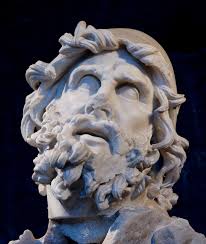
Odysseus statue
The definitions, and types, vary. Psychologist Carl Jung first raised the idea of archetypes in mythology and literature. Building upon Freud's work, he theorized that the human experience is universal in many ways. Grief, love, the pursuit of meaning and purpose are all things experienced by all human beings.
Jung produced a list of archetypes that don't look much like what we know in literature today. Jung referred to "the shadow, the wise old man, the child, the mother … and her counterpart, the maiden, and lastly the anima in man and the animus in a woman."
Those basic types have evolved in Joseph Campbell's writings, author of The Hero with A Thousand Faces and renowned mythologist. He distilled Jung's writing with others to develop 8 basic character types–Hero, Mentor, Ally, Herald, Trickster, Shapeshifter, Guardian, and Shadow.
Each of these archetypes serves a specific purpose. Definitions shift and, in some cases, overlap, but these basic types each have distinct traits that make the character types identifiable in literature. Odysseus is a classic Hero archetype. Other characters serve other purposes, like Athena, who appears as the mentor archetype in the Odyssey.
Odysseus the Hero
Odysseus fits the epic Hero mold almost seamlessly. A Hero is defined as having some trait that makes them unique or special. Most commonly, this trait is conveyed by being royalty or having royal bloodlines. It can also be possessing a unique or special ability, or even unusual courage or cleverness. Odysseus is of royal background and possesses a great deal of courage and determination, and is known for his cleverness.
Heroes are not infallible.
Their weaknesses and occasional self-awareness make them even more Heroic, as such flaws provide them additional challenges to overcome. The Hero must journey and face their greatest challenges and worst fears, overcoming all to reach their ultimate goal.
A Hero's Journey- How is the Odyssey an Archetype?
Every archetypal character needs a foundation upon which his or her story may be built. Not only is Odysseus an archetype, but the very tale itself also fits a mold.
There are many basic story structures, but they may each be boiled down to a few general storylines:
Man vs. Nature (or gods)
Rags to Riches
The Quest
Voyage and Return
Comedy (Overcoming adversity)
Tragedy
Rebirth
What Type of Epic is the Odyssey?
The Odyssey, as its title suggests, is a quest. Odysseus is on a long journey, through which he must overcome many obstacles to find his way home following the nostos concept. The antagonist in the Odyssey, in truth, is Odysseus himself. He must overcome his own hubris and humble himself to ask for help before he can return to Ithaca. Once he returns, he must complete the journey with a pilgrimage inland to sacrifice to the god Poseidon.
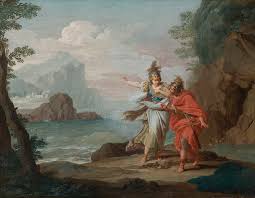
Athena appearing to Odysseus
Odysseus, as the Hero, faces many challenges along the way. There are many minor villains, such as the cyclops Polyphemus, and those who are antagonistic against him, such as the witch Circe, but who ultimately assist him along his way. Throughout the challenges, Odysseus gained wisdom and self-knowledge. At the first challenge, entering the land of the Cicones, he raided and mercilessly ransacked the land. His crew amplified his arrogance by refusing to leave when Odysseus urged them to, staying to enjoy the spoils of their raid. They are set upon by the inland people and driven off, suffering a hard loss.
As they move on to the next stop, they come to the land of the Lotus Eaters, where they fall to another deadly temptation, sloth. The crew would stay forever, eating the food offered by the people, and lazing away their lives, if Odysseus did not force them to leave.
They then face the cyclops, and Odysseus wins a victory, blinding the cyclops, but his pride brings down Poseidon's curse upon him. By the time Odysseus reaches the isle where Aiolos gives him a bag of the winds, the reader might be wondering what type of story is the Odyssey.
The Odyssey is, in fact, a chronicle of a Hero's journey. As Odysseus travels, he learns about himself and those around him and by the time he returns to Ithaca, he has gained the one thing he needed most- humility.
What Type of Literature is the Odyssey?
The Odyssey is considered an epic poem, a piece of such length and depth that it withstands the tests of time and criticism. Odysseus is a complex character, beginning as an arrogant adventurer setting out on a journey and returning as a true King, ready to take his place.
What type of poem is the Odyssey?
It is a Quest, a journey that takes the archetype Hero character through a series of challenges that contribute to his growth and change. While providing the reader with an exciting read, each challenge also affects the character in some way.
As Odysseus faces each new challenge, he uses the knowledge and wisdom he has gained. By the time he reaches Ithaca, he comes not with a large crew and ships, but alone and bereft. Upon his arrival, rather than striding proudly in to reclaim his wife and his throne, he comes cautiously and warily. He allows himself to be sheltered in a humble slave's hut until the time comes for him to reclaim his place. He enters the palace in guise as if he is just another suitor and allows the others the honor of going first in the contest. When his turn comes, he steps up to show his strength and draws the bow, which of course, is his own.
At the end of his journey, Odysseus' new strength of character is shown in his humility and strength. Penelope challenges him to move their bed from the bridal chamber. Rather than replying with rash anger or pride, he explains why it can not be moved, proving his identity. At the end of his journey, Odysseus has won the prize and completed his quest.