Achilles Greek Mythology: Discovering One of the Greatest Greek Heroes
Achilles Greek mythology narrates the adventures of Achilles, the main character of the Iliad, before, during, and after the Trojan War. It tells of how he became invulnerable to attacks on the battlefield and how he died after his weakness was discovered. The story follows all his duels as well as his conquests during his lifetime. To discover his character, strengths, weaknesses, and exploits, keep reading this article to uncover it all.
Who Is Achilles Greek Mythology?
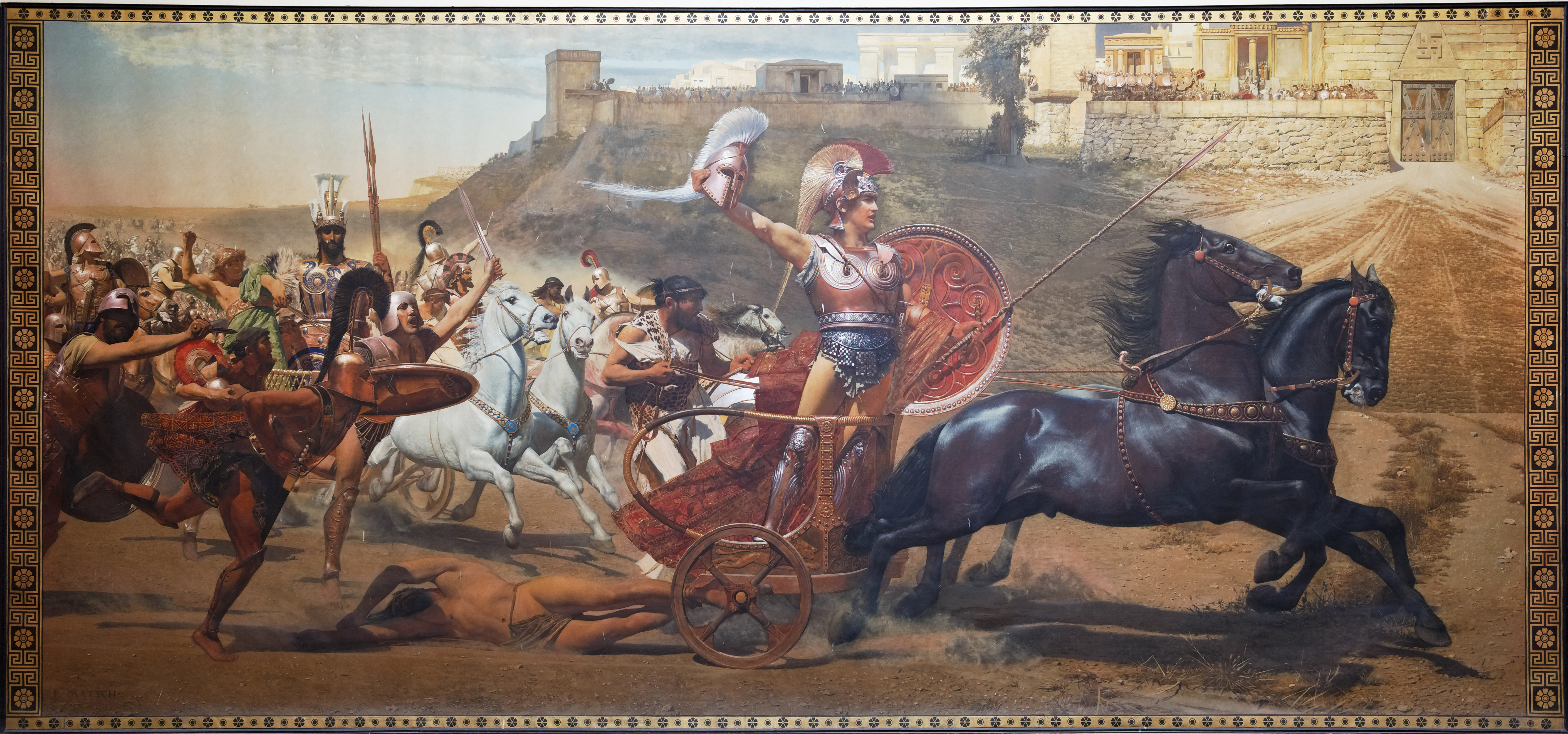
Achilles Greek mythology follows the life of one of the greatest Greek heroes from his birth to death. It explores how he rose from being a lowly Greek citizen to being the most feared warrior in the whole of Greece and Troy.
The Physical Description
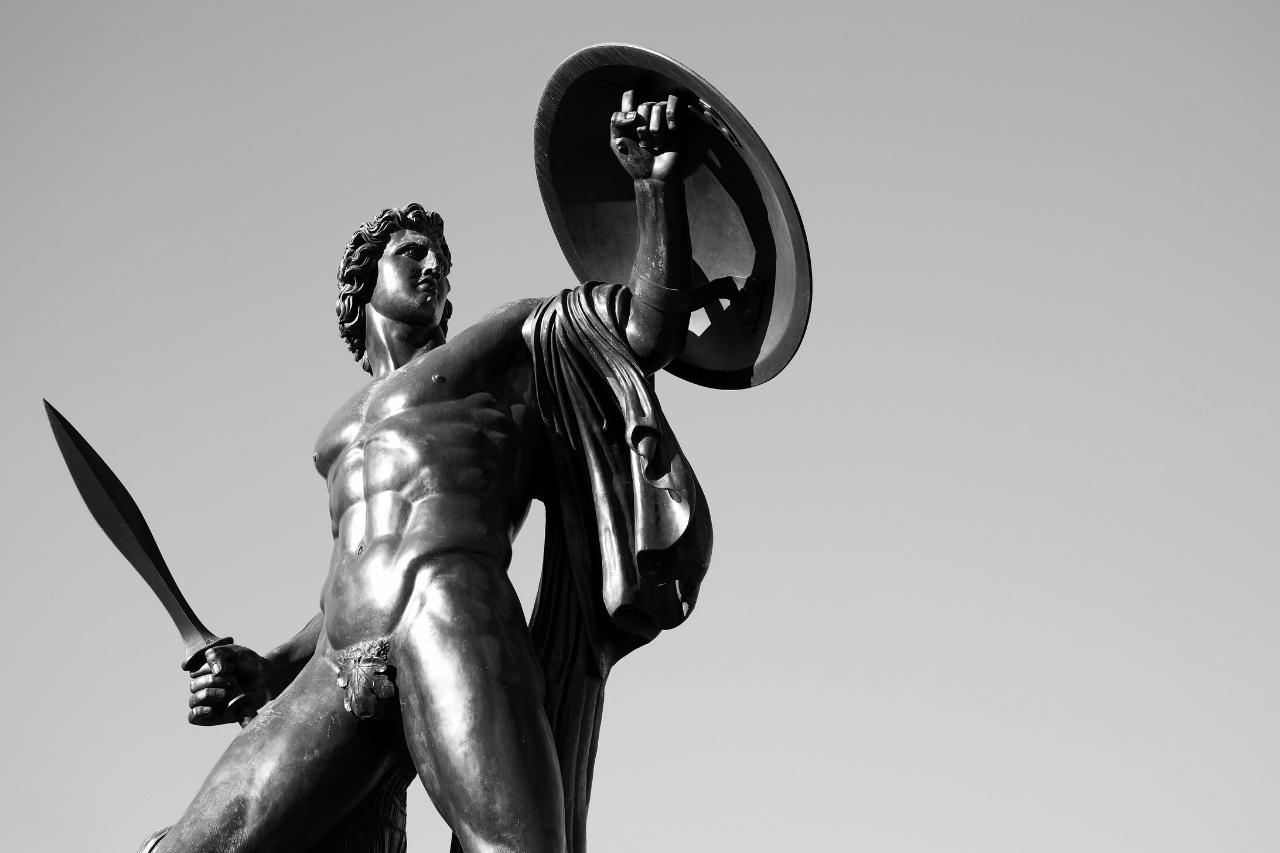
According to the author, Daris Phrygius, Achilles was a well-built man with a broad chest, beautiful lips, muscular arms, and legs. His hair was long and wavy and its bright chestnut color added to his radiance. This hero was gentle and mild-mannered but all that disappeared once he donned his battle garb and headed to war. On the other hand, his smile indicated a man of wealth and substance.
The Story and Life
Achilles was born by King Peleus of the Myrmidons, a fierce and strong tribe, and the Nereid, Thetis. Before his birth, Zeus and Poseidon expressed interest in marrying Thetis but withdrew when they learned of a prophecy that Achilles would become greater than his father. Thus, Peleus wedded Thetis, and true to the prophecy, Achilles became greater than Peleus.
However, another version of Achilles' birth account narrates that Zeus tried wooing the beautiful nymph, Thetis, but she kept eluding his advances. This was because Thetis was raised by Hera and thus, loyalty towards her, the queen, and mother of the gods who was strong. This infuriated Zeus who decreed that no deity would marry Thetis and that was how she ended up with the mortal, King Peleus.
How He Became Invulnerable
When Achilles was born, his mother Thetis decided to make him invulnerable to prolong his life. The accounts vary on how she went about it; some say she dipped baby Achilles head first into the infernal river, Styx, while holding his left heel. The part that Thetis held while dipping the boy in the Styx became the Achilles' weakness as it didn't get dipped into the Styx.
On the other hand, others narrate that she anointed his body when he was a baby with Ambrosia, the drink of the gods, and held him over a fire till all his mortality burnt away. During the process, Achilles' father, Peleus, chanced on Thetis and the Nereid abandoned the boy. Though she succeeded in burning most of the boy's mortality, she couldn't burn the Ambrosia around his left heel, thus his heel became his only vulnerable spot.
Some accounts also combine both methods by which Achilles became invulnerable. However, one event that runs through all accounts is that Achilles' whole body was invincible except his left heel. This led to the phrase "Achilles' heel" which we'll come to later in this article. When the boy was nine years, his mother received a prophecy that he was going to die in battle. Thus, she sent him to the island of Skyros to hide among the daughters of King Lycomedes.
On the Island of Skyros
Achilles was then disguised as a girl and placed among the daughters of the king, even without the girls noticing that he was a male. He was given the name Pyrrha, which meant "red hair", and he was thought to behave like a female. Some versions of the myth indicate that Thetis sent the disguised Achilles to Lycomedes under the pretense of training her to behave like a lady. Achilles got closer to the girls and fell in love with one of them known as Deidamia.
Deidamia also took a liking to Achilles but was unaware that he was a disguised male. One day Deidamia went with him to a festival and there he, who couldn't control his lust anymore, raped her. Thus, she discovered his secret but he convinced her to keep it for the sake of their love. Eventually, Deidamia had two sons for him: Neoptolemus and Oneiros.
Meanwhile, Odysseus, the King of Ithaca, learned through prophecy that the Greeks won't be able to defeat the Trojans without him in their ranks. Odysseus made his way to Skyros and told King Lycomedes to arraign all the girls so he could be identified. When he couldn't identify him, he resorted to trickery by pretending to leave the court only to blow the war horn once he was out of sight. When he heard the sound of the war horn he sprung into action thinking Lycomedes' court was under attack, thus revealing his identity.
Achilles at Mysia
Achilles went to Peleus, his father's kingdom, and organized fifty ships full of the best warriors in all of Myrmidon. They joined the other Greek forces and headed for Troy but mistakingly stopped at Mysia, thinking it was Troy.
They attacked the city, ruled by King Telephus, by him inflicting a wound on King Telephus. The king tried to heal the wound but all his efforts proved futile until he contacted an oracle who told him to seek help from the same Achilles.
Telephus found him at Argos and begged him to heal his wounds which he did. Other accounts claim Telephus kidnapped Orestes, the son of Agamemnon, and wouldn't let him go until Achilles healed him. He responded that he was only a warrior and knew nothing about healing battle wounds. Odysseus intervened and explained that since it was Achilles' spear that inflicted the wound, that same spear could heal it.
Therefore, pieces of Achilles' spear were placed on the wound, and immediately Telephus' wound healed.
Killing Troilus
The Greeks decided to go back home after Mysia but Achilles advised them against it. To inspire confidence and boost the morale of the troops, he sacked the cities of Pedasus and Lynerssus. They then captured the Queen of Lynerssus, Briseis, and killed Troilus, the son of King Priam of Troy, in Apollo's sanctuary. According to a prophecy, Troilus was linked to the fate of Troy; if he died Troy would be destroyed, thus his death spelled doom for Troy.
However, another rendition of the myth states that Achilles fell in love with Troilus but the young handsome prince refused the advances of Achilles. Therefore, he accidentally killed Troilus in the sanctuary of Apollo which was a sacrilege. For his punishment, he was cursed to die at the tail end of the Trojan war and it came to pass. Later, he took Briseis as his slave and later became his lover.
The Story of the Iliad
Agamemnon took Achilles' prized asset, his slave girl Briseis, and this angered him so much that he withdrew from the ongoing War. Earlier on, Agamemnon had captured Chryseis, the daughter of Chryses, a priest of Apollo, and made her his slave.
However, Chryses pleaded with Agamemnon to return his daughter but his pleas fell on deaf ears. Now, this caused Apollo to send a plague into the Greek camp causing sickness and death.
However, the Greeks were at a loss as to the cause of the plague until the seer Calchas spoke up and claimed that he knew the source of the sicknesses. Before he revealed the cause he asked Achilles to protect him from the repercussions of his revelations and he agreed.
Calchas revealed that until Agamemnon returned Chryseis, the sickness would remain in the camp. Reluctantly, Agamemnon returned Chryseis but took Achilles' slave girl, Briseis, as her replacement drawing anger Achilles.
Achilles was hurt that his prized slave and glory was taken from him, therefore, he withdrew from the war. His mother, who also knew of the prophecy that Achilles would die as a hero during the war at Troy, urged him to leave the battlefield.
Achilles could not also go up against Agamemnon because he was the king and commander of the Greek troops. Achilles then prayed to Zeus to give the Trojans an upper hand in the war so that his services would be missed.
The Effects of His Withdrawal From the Trojan War
Once the Trojans heard that the greatest Greek champion, Achilles, had deserted the battlefield, they became enamored and inflicted heavy losses on the Greeks. The losses affected the spirits of the Greek warriors, therefore, Nestor, the King of Pylos, urged Agamemnon to ask Achilles to return. Agamemnon agreed and sent a delegation consisting of Odysseus, Ajax and Phoenix to plead with Achilles and convince him to return to aid the Greeks.
They met up with Achilles and brought him gifts with assurances that Agamemnon was ready to return Achilles wife, Briseis. Achilles refused to return and encouraged the Greeks to abandon the war and follow him as he returned home. The Greeks headed back to their camps disappointed, meanwhile, Hector, the Trojan champion, led an assault on the Greeks leading to devastating losses. Hector's onslaught continued till the Greek army was almost defeated when Patroclus, the best friend of Achilles, decided to intervene.
Patroclus' Intervention
Patroclus went to convince his best friend, Achilles, to swallow his pride and return to the war but once again the pleas fell on deaf ears. Patroclus then asked him for his armor so that he would disguise himself as the Greek champion hoping that that would strike fear among the Trojan ranks.
Nonetheless, he reluctantly released his armor to Patroclus on one condition that he would not pursue the Greeks to the camp. Patroclus agreed, took the armor, and headed rallied the remainder of the Greek troops.
The Death of Patroclus
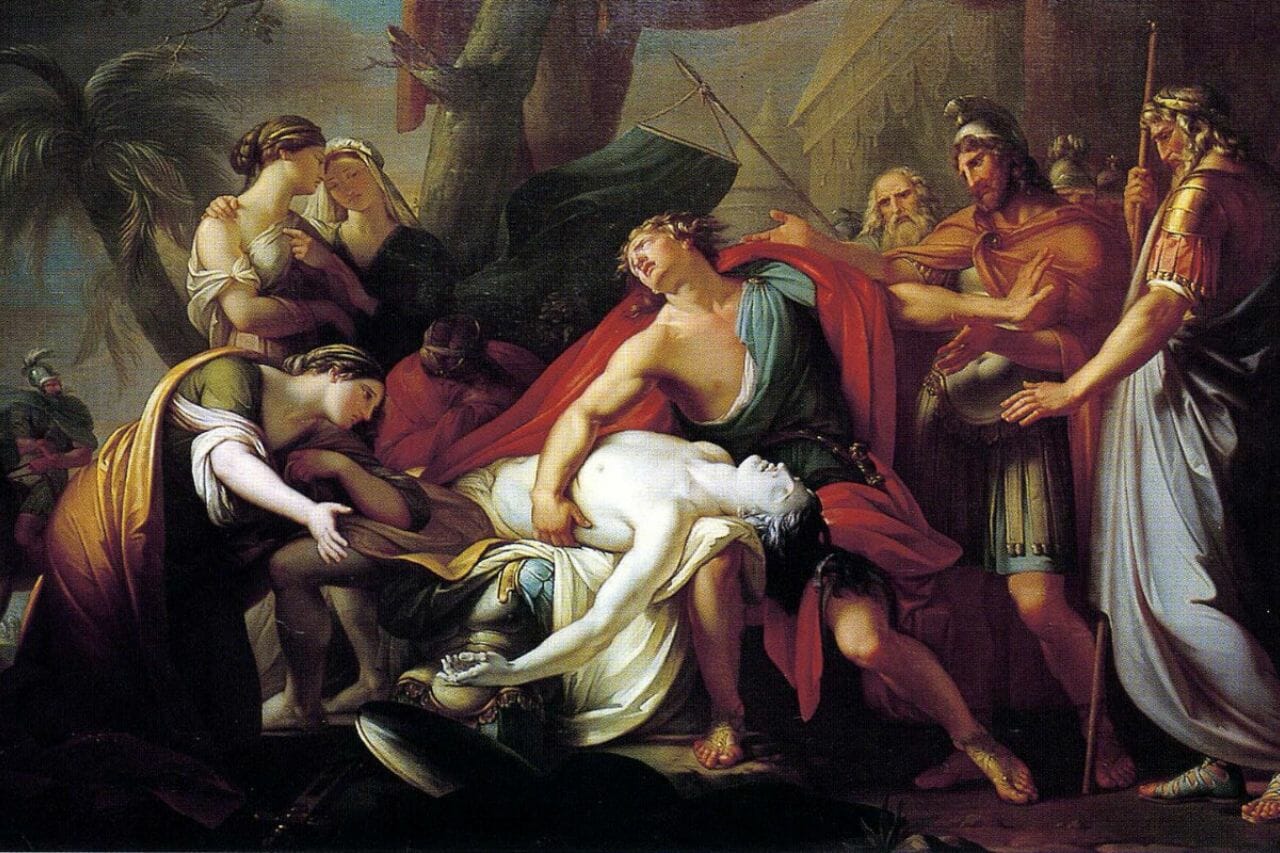
When Patroclus arrived on the battlefield in Achilles' armor, the Trojans lost courage because they thought it was he, himself who had returned. With their newfound morale, the Greeks beat back the Trojans from their ships to the gates of the city of Troy. In his excitement, Patroclus forgot about the warning and he chased the Trojans to their gates. He killed many of the Trojan warriors including Sarpedon, the prince of Lycia.
At the gates of Troy, Apollo untied the armor of Patroclus and Euphorbus threw a spear at Patroclus which struck him to the ground. Thinking it was Achilles, Hector took out his spear and pinned Patroclus to the ground, killing him.
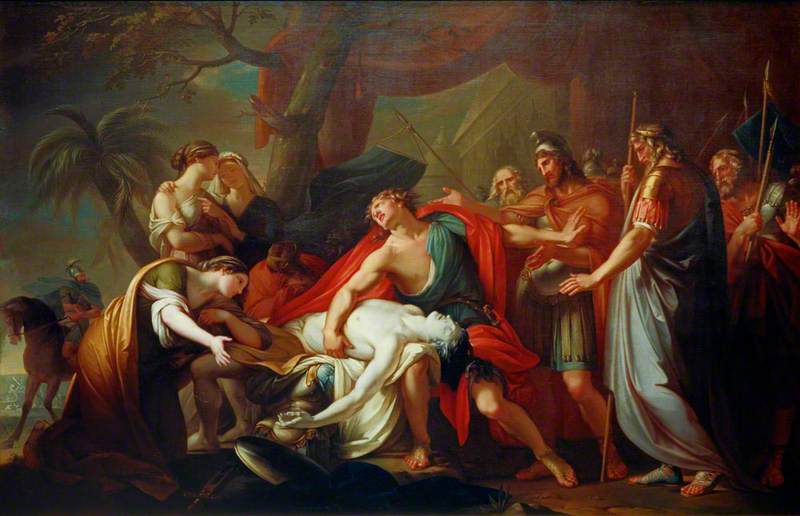
However, after removing the armor Hector realized that he had killed an impostor, therefore, he decided to keep the armor. When he heard the tragic and sadening news about the death of his friend, he was stricken with grief and went to retrieve the body.
He refused to bury Patroclus until his ghost appeared and urged him to give it a befitting burial. Thetis came to comfort him and asked Hephaestus, the god of iron, to fashion a new armor for her son. Hephaestus also included the famous Shield which he used for the rest of the Trojan War.
The Return to the War
Patroclus' death enraged Achilles and he yearned to avenge his death, thus he rescinded his decision not to fight and re-entered the war. Fueled by rage and revenge, the Greek champion slaughtered many Trojan warriors while searching for Hector. As much as he had killed so many men, their bodies choked the river Scamander and this angered the god of the river. Thus, he tried submerging him under the waters but Hera and Hephaestus came to give him a helping hand.
Fearing that his wrath may destroy Troy before its allotted time, Zeus sent the gods to stop him. This was an indication that the wrath of Achilles was potent enough to defy fate, thus Zeus had to intervene. This was when he kept looking for Hector and he slashed his way through the warriors of Troy in search of him; meanwhile, Hector was waiting for him at the city gates ready to defend his city, Troy.
The Duels With Hector
Finally, the two champions of their respective sides face off at the city gates of Troy. On seeing him, Hector took to his heels partly because he knew that he was destined to die at the hands of the Greek champion.
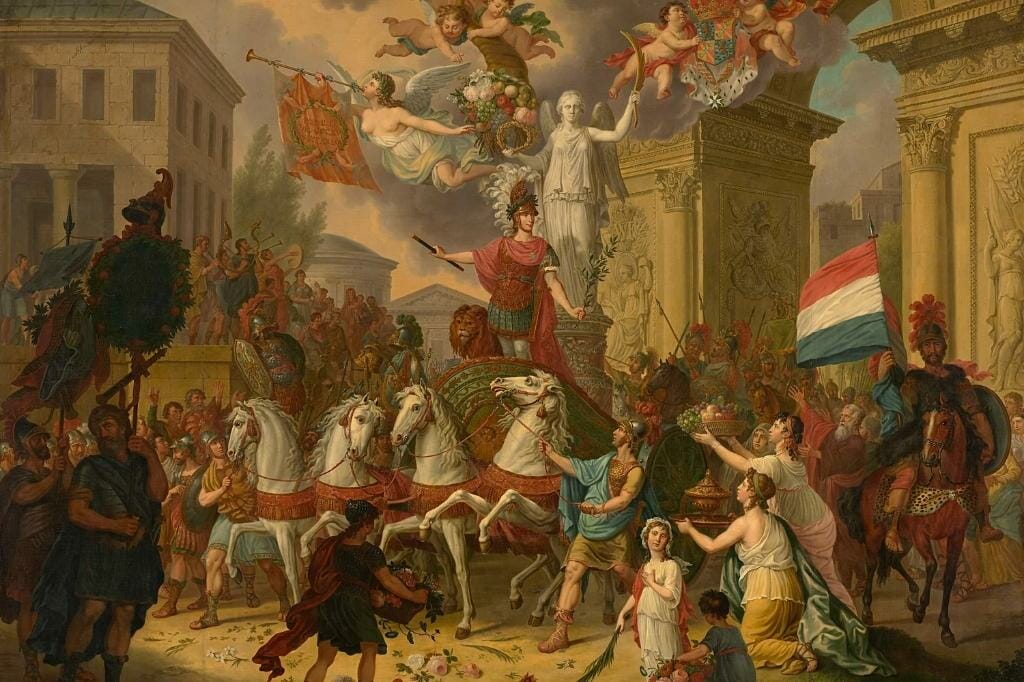
Driven by revenge, Achilles chased Hector thrice around the city of Troy until Athena, disguising herself, and Deiphobus, Hector's brother, urged him to stop running, and he mustered courage and decided to face Achilles damning the consequences of his decision.
Before the duel, Hector requested that the body of the one who loses should be returned to their respective cities for a proper burial but he refused. Achilles started the duel by hurling a spear at him which he dodges but the disguised Athena returned the spear to Achilles on Hector's blindside.
Afterwhich, Hector returns the favor by throwing his spear at him which hits the shield of the Greek champion. He stretched his hand for a spear from his supposed brother, Deiphobus, but he didn't find anyone – that was when he knew he was doomed.
Athena, disguised as Deiphobus, took Hector's thrown spears and handed them over to him. Since Hector was still wearing the armor of Achilles, which he stole from Patroclus, note that he was familiar with the armor's weakness. Thus, he aimed his spear at the collarbone, the only area of his body the armor failed to protect and he struck him down. Though he was mortally wounded, he managed to beg Achilles to give him a proper burial but of course, the request was a motion that was denied.
The Death of Hector
He promised to deliver Hector's body to dogs and vultures to devour and soon Hector died but not without prophesying the death of Achilles. When Hector died, he tied his corpse to his chariot and dragged it to his camp.
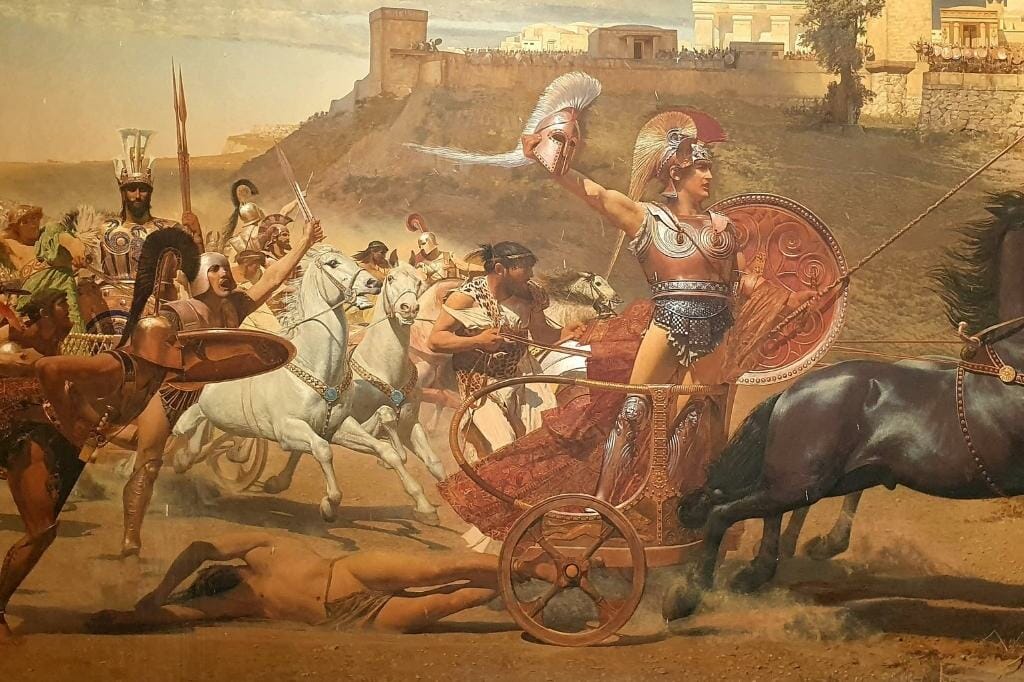
There he desecrated Hector's corpse for 12 days, however, this was when the god Apollo preserved the body from further damage. Finally, the gods had had enough of the desecration and they sent Iris, the messenger of the gods, and Thetis, Achilles' mother to intervene.
He finally released Hector's corpse after much persuasion from Hector's father, King Priam, who was heavily assisted by the god Hermes. Achilles then calls for a truce as the Trojans mourned their greatest hero for nine days. However, on the 10th day, Hector was buried and the Iliad ends with a vivid description of Hector's burial while foretelling the doom of Troy and Achilles.
Achilles in the Aethiopis and Posthomerica
The Aethiopis and the Posthomerica are epic poems, that, together with the Iliad, tell the full story of the war between Troy and Greece. They contain various aspects of the war that were not captured in the Iliad. For instance, Achilles had to fight the Queen of the Amazons known as Penthesilea who had come to the aid of the Trojans. At the beginning of the duel, Achilles got distracted by the beauty of the queen so he fought with less ferocity than he was used to.
This gave the Amazon queen an upper hand and she almost killed Achilles. Realizing that the distraction was endangering his life, he refocused and killed the Amazonian queen.
Achilles Duel With Memnon
Another ally that came to the aid of the Trojans was Memnon, the son of the King of Ethiopia and the goddess of the dawn, Eos. Due to his parentage, Memnon was a demigod just like him and was almost even equal to him in terms of strength. If there was anyone who could match Achilles on the battlefield, it was Memnon. Thus, when he arrived in Troy, king Priam was overjoyed for he knew that his savior had come.
When Patroclus died, Antilochus, the son of Nestor, became the closest friend of Achilles but was slain when he faced Memnon. Once again, moved with anger and revenge, Achilles sought out Memon and the two came face to face. Memnon and Achilles fought an epic battle but Achilles ultimately became the victor, killing Memnon in the process. This grieved Memnon's mother, Eos, and she prevented the sun from rising until Zeus intervened.
The Death
As with diverse Greek myths, the death of Achilles varies from one account to the other. The most popular account narrates that while fighting at the city gates of Troy, he was pierced and hurt by an arrow from the bow that Paris shot, and this is known as Paris Greek mythology.
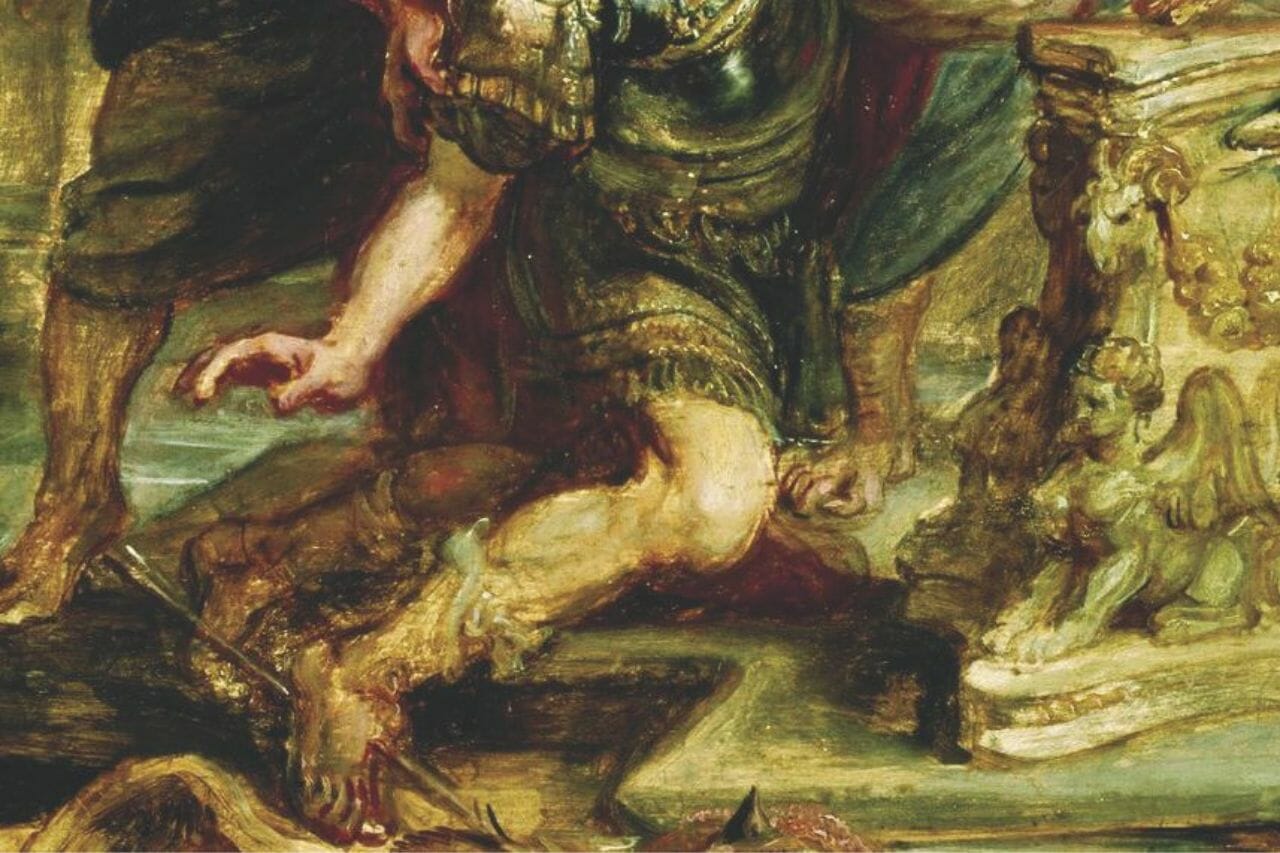
Paris was the sibling of Hector who, according to Helen Greek mythology, captured Helen and brought her to Troy. The god Apollo was said to have guided Paris' arrow to hit the heel of Achilles which was his weak spot.
Thus, he died as was prophecied by Hector and this scene serves as a backdrop to the popular phrase 'Achilles' heel' which means the weak spot in an invulnerable system, and to this day this phrase is used.
In Aeneas Greek mythology, after Achilles and the Greeks sacked Troy, Aeneas and his family survived and founded a new city that eventually blossomed into the Roman Empire. Achilles perished in Troy and was laid to rest there. A great tomb called tumulus was erected to house his ashes after his body was burned on a funeral pyre. Achilles' tomb was in Achilleion an ancient Greek city in Anatolia.
Some people still ask how old was Achilles when he died, nonetheless, some scholars speculate that he was 33 years at the time of his death if you're thinking was Achilles real? He might have been a Thessalian warrior whose origins and attributes may have been greatly exaggerated by Greek poets.
Conclusion
This article has covered the mythology of Achilles from his birth to his death. Here is a summary of all that we've read so far:
He was born by the mortal, Peleus, and the nymph Thetis after Zeus, thus he was a demigod, as his heel was a weak point in his body, it was mortal.
His mother decided to make him immortal due to a prophecy that he will die a hero in battle, though the stories of how she did it differ from one version of the myth.
However, his mother failed to make his left heel invulnerable and that remained the only weak spot on his body and eventually facilitated his death.
He was hidden on the island of Skyros until he was discovered by Odysseus and asked to join the Greek ranks due to the prophecy that defeating Troy would be impossible without him.
He, however, withdrew from the war after his slave girl Briseis was taken and only rejoined when his friend Patroclus was killed.
He fought and killed various Greek heroes during the war including Hector and the demigod Memnon. However, he was killed by Paris with the help of Apollo and was buried in Troy.