Apollo in The Odyssey: Patron of All Bow Wielding Warriors
Apollo in The Odyssey is a recurring character that didn't appear often and was most usually invoked in the Homerian classic. The Greek god of archery and sunlight played a meager but important role in Odysseus' journey home as a stalwart guide and protector to the hero alongside Athena, the goddess of wisdom.
Our article will offer you a deeper look into.
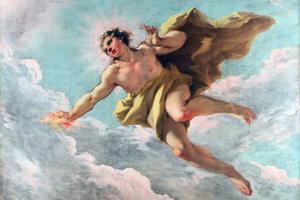
What Did Apollo Do in The Odyssey?
Unlike his violent depiction in the Iliad, Apollo's role in Odyssey is less grandiose and more incorporeal. He served as Odysseus' guide and voice of reason alongside Athena. As he was the patron to all archers, Apollo was often portrayed as a divine figure armed with a golden bow and a quiver of silver arrows.
In different scholastic accounts, it is often argued that it is also the same bow Odysseus used to defeat the suitors harassing Penelope on the final parts of his journey. He is also responsible for safeguarding him against the wrath of Poseidon during his travels at sea.
In The Odyssey's precursor, the Iliad, Apollo played a more vital role in the tale as a fierce Olympian warrior who sided with the Trojans. Despite being on opposing sides, Odysseus approached the Trojan camp to return Chriseis, the daughter of an Apollonian priest. In his wake, he also presented many offerings to Apollo, which pleased the Olympian god. As he was also the patron to sailors, a duty he shared with the Earthquake god Poseidon, he then assured Odysseus' safety on his journey back to Ithaca.
Apollo in The Odyssey: Significance of Archery in Greek Mythology
In Greek mythology, archery held a deeper symbolic meaning; it was more than just a weapon of war. At the time, it was man's tool enabling him to get food and clothing from the animals he hunted, and it was also his protection against the dangers of the world. Several Greek deities were known through the weapons that they used, such as the Apollo bow and arrow, along with his sister Artemis the Huntress, and Eros the god of love.
Mortals and Archery
There were mortals portrayed as heroes who also wield the bow and arrow such as Paris, the Trojan prince, and Odysseus, the celebrated hero in The Odyssey. And just as there are many who wield the weapon, there are also several figures slain by the usage of archery in battle.
The mighty hunter Orion, known for his skill in hunting any animal, was struck down by the very same bow of Artemis. Perhaps the most famous example is the death of Achilles, who took an arrow to the heel by Paris, who was guided by Apollo himself.
Archery As a Dishonorable Fighting-Style
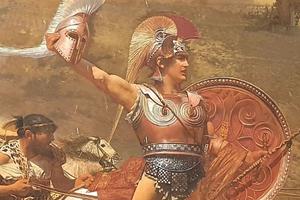
Archery had a long withstanding appearance in the chronicle of Olympian gods and mortals, and yet it held an infamous metaphor in Greek mythology. For the Greeks, the ideal warrior was not one who shot arrows, but one who struck spears: the hoplite. A hoplite was a fighter donned in heavy armor, sword or spear, and shield in hand.
Their style of fighting involved close physical combat and required much training and courage of heart, ideals that the Greeks often emphasized and regarded as important. The Greeks regarded the style of archery-based fighting as dishonorable and, in some cases, dishonest. That is because the archer had to throw the arrow from a distance and so the opponent couldn't see them. This has also taken effect on how the characters who wield the bow and arrow in Greek mythology are perceived.
Apollo and Archery in The Trojan War
In the Iliad, it was the Trojan prince Paris who chose to elope with the beautiful Queen Helen of Sparta, which became one of the reasons that sparked the Trojan war. His proficiency with the bow netted the lives of many unfortunate souls, including that of the famed hero Achilles. Notably, Paris met the same end by the hand of Philoctetes, another accomplished archer.
It is not surprising then, that Apollo, the patron of the archers, chose to side with the Trojans while Athena, goddess of wisdom and emblem of the hoplite, sided with the Greeks, who then went on to win the war.
Apollo and Odysseus
In The Odyssey, Homer made Odysseus an archer as well, despite his excellent capabilities of fighting in heavy armor. The hero Odysseus was known to be a wise and sharp-witted man, who was not only skilled in combat but in diplomacy as well.
Apollo and Odysseus in The Iliad
Even as far back in the Iliad, Odysseus presented his shrewdness in more ways than his combat prowess, which did not just aid the Greeks but also profited him in the future. One such event was when Agamemnon insulted and dishonored Apollo's priest, Chryses, which then resulted in the sun god's anger and him releasing a plague upon the Greek army camp.
To placate his ire and free the camp from the plague, Odysseus proposed returning the priest's daughter, Chriseis, to her father, as well as preparing a grand offering of a hecatomb to appease the sun god at his altar. Satisfied with these offerings, Apollo ensured Odysseus and his company's safety as they traveled back to their camp after finishing their worship.
Apollo and Odysseus in the Odyssey
Despite being on different sides of the war, Apollo was impressed by Odysseus' mastery of negotiation and valor and offered his aid numerous times throughout the hero's journey in The Odyssey.
It is later in the tale that the god was mentioned assisting the hero, although even before Odysseus' return to Ithaca, his name and association was often invoked to compare something so beautiful, to pray for his guidance, and even to request courage in times of danger. An example of this was when Odysseus first met Nausicaa on the island kingdom of the Phaeacians.
After having woken up from his slumber, the hero likened Nausicaa's beauty and appearance to that of a palm tree in Delos, beside Apollo's altar. King Alcinous, Nausicaa's father and ruler of the Phaeacians, cited his name along with Zeus' and Athena's, to bear witness to Odysseus' greatness should he marry his daughter and live on the island if he wanted to.
Odysseus Invoking Apollo in The Odyssey
It was only during the last legs of his journey that the hero chose to invoke Apollo's name, the patron of all archers, to end the conflict between himself and his wife, Penelope's, suitors. Upon his arrival on Ithaca, Odysseus concealed his identity and met with Eumaeus, who didn't even recognize his own master. Eumaeus recounted what had happened in Ithaca in Odysseus' absence, including the fate of his wife Penelope who was being harassed by ill-gotten suitors.
He also met up with his son, Telemachus, who was overjoyed to see the return of his father. The two then launch a plan to attack the suitors in the palace. Odysseus would continue wearing his beggar disguise, while Telemachus would hide the palace's weapons to hinder the suitors.
Meanwhile, in the palace, Penelope had enough with the suitors and openly declared that Apollo would kill the most savage of them, Antinous. Odysseus, discarding his beggar disguise, obliged her wish pretending to be Apollo, and shot Antinous with his bow and arrow, all the while invoking Apollo's name for luck.
He succeeded in killing Antinous and revealed himself to the rest of the suitors in anger and a bloody battle ensued. Afterward, he and Telemachus finally got rid of the suitors, and then reunited with Penelope.
Conclusion
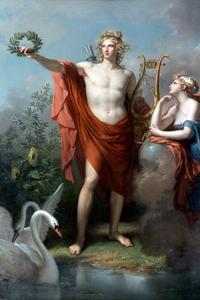
Now that we've discussed the heroic and intelligent deeds of Odysseus done in Apollo's name, the continuing appearance of archery and its allegorical meaning into the tales of major Greek mythologies, and Apollo's role in The Odyssey, let us go over the critical points of this article:
Apollo is the ancient Greek god of Archery, a patron to all archers and soldiers, and the god of sunlight
He played a major role in the Iliad in contrast to his very minor role in The Odyssey, in which he was only mentioned in passing
Apollo was in favor of the hero Odysseus who, with his wits and courage, managed to appease the god's anger after Agamemnon insulted his priest
In Greek mythology, archery was mentioned multiple times yet it was thought to be a precursor of trickery and deceit. For instance, Paris and Odysseus were scorned for using arrows and a bow to fight, as opposed to those who fought with heavy armor and shield.
Homer likened Apollo to Odysseus, who was not only proficient in combat but a shrewd diplomat and negotiator.
Odysseus invoked Apollo's name as he shot an arrow into Antinous, one of Penelope's suitor, and killed him.
In conclusion, the god of archery and sunlight is depicted as violent and vicious in the Iliad, to match the narrative's overall premise of a bloody and mighty war of gods and mortals. Whereas, in The Odyssey, he serves as the hero Odysseus' guide and voice of reason throughout his difficult journey.