Zeus Children: A Glance at the Most Popular Sons and Daughters of Zeus
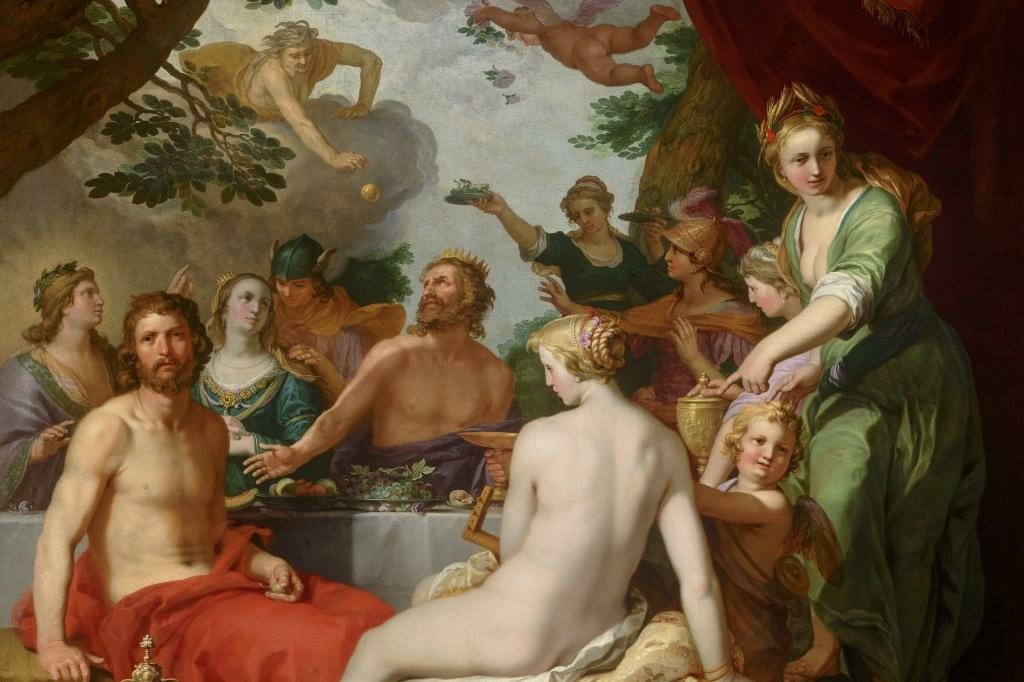
Zeus children
Zeus children, depending on the source, could be between 50 to 100 or even more because of his numerous affairs with a big number of women. It was told that no woman under the sun or even in the heavens could resist his advances.
Some of his children became gods like himself and ruled with him on the Mountain of Olympus while others became mortals. Covering all of Zeus' offspring in this article would be impossible, thus we would focus on the most famous ones.
– Athena, the Favorite of Zeus' Children
Athena is among the first deities to be born by Zeus with some versions saying that he gave birth to her by himself. According to these versions of Greek mythology, Athena burst forth out of Zeus' head and became the goddess of war.
However, other versions also indicate that Zeus swallowed Athena's mother, Metis, the Greek goddess of wise counsel, while she was pregnant with Athena. The reason Zeus ate Metis varies but some versions state that Zeus was trying to kill Metis to prevent a prophecy from being fulfilled.
According to the prophecy, Zeus' second-born would become more powerful than him (a similar prophecy was told to Zeus' father when Zeus was a baby) and to prevent that, he swallowed Metis by convincing her to turn into a fly.
However, Metis grew up in Zeus' head and gave birth to Athena. She made armor and weapons for her daughter while they were both in the head of Zeus. Metis gradually faded into thought while Athena blossomed into a full-grown woman.
Athena then gave her father constant and severe migraine by frequently clashing her weapons. Zeus, not knowing the cause of his headache called on his son Hephaestus to cut it open and diagnose the problem. As soon as he opened Zeus' head, Athena jumped out fully clothed in war gear and ready for action. That was how, the Greek goddess of war, wisdom, and handicraft was born.
– Hephaestus, the Ugliest of Zeus Children
In the Zeus family tree, Hephaestus came after Athena as a result of Hera's, Zeus's wife, anger against Zeus for giving birth to Athena without her. Most versions state that Hera gave birth to Hephaestus by herself, without male involvement.
Therefore, that makes Zeus a step-father to Hephaestus, the Greek god of fire, blacksmithing, and artisans. Hephaestus was not only ugly but physically deformed so much that either his parents or Hera had to cast him down from Mt Olympus.
The reason for his physical deformity was attributed to the poisonous nature of bronze-age smithing using arsenic. The Greeks knew the dangers associated with using the poisonous chemical, therefore, they envisioned the deity responsible for metalworks as deformed.
Others also believe that while protecting his mother Hera from Zeus' advances, Zeus cast him from Mt Olympus and his fall rendered him lame. Hephaestus was famous for fashioning all the weapons of the Greek gods.
Furthermore, some sources also narrate that Hephaestus was born lame and his mother, Hera, cast him from the heavens. To exact his revenge on his mother, Hephaestus fashioned a bronze throne as a gift for her but when she sat on it, she got stuck. The other Greek deities pleaded with him to free his mother from the throne and he only agreed to do that if they allowed him to marry Aphrodite. Hera agreed and gave Aphrodite's hand in marriage to Hephaestus albeit against her will.
– Aphrodite, the Goddess of Love and Beauty
The people of ancient Greece had two origins of Aphrodite, the goddess of love, beauty, and procreation. In Homer's Iliad, Aphrodite was the daughter of Zeus and the earth goddess Dione.
Aphrodite was described as having no childhood and was forever young and desirable. As already mentioned, Aphrodite was matched with the ugly god of metallurgy, Hephaestus but she cheated on Hephaestus with Ares the god of war.
It was believed that she was the goddess of prostitution and she oversaw 'sacred sex' as part of fertility rites in her temples. One of her major temples was on the Acrocorinth in the city of Corinth which was popular for its heitarai (high-class prostitutes).
However, Aphrodite was regarded as the goddess of seafarers and the goddess of war in cities such as Cyprus and Thebes. According to Greek mythology, Aphrodite had many lovers including mortal shepherds Anchises and Adonis who died at the hands of a boar.
With Ares, Aphrodite bore the goddess Harmonia who was responsible for harmony and unity in ancient Greece. The couple also gave birth to Eros, the god of desire and lust or carnal love. She was closely related to the Graces, goddesses of fertility, and the Horae, goddesses of the seasons. The symbols of Aphrodite were a swan, dove, myrtle, and pomegranate.
– Apollo, the Most Revered Child of Zeus
Apollo was birthed by Zeus and the Titan goddess Leto much to the anger and envy of Zeus' wife Hera. When Apollo and his twin sister Artemis were in the womb, Hera decided to exact revenge on their mother, Leto, by preventing her from delivering on any land of the earth.
Fortunately for Leto, she came across a floating island that wasn't attached to the seafloor. There she delivered the twins Apollo, the god of light and music, and Artemis, the goddess of vegetation and childbirth.
However, Hera continued searching for both Apollo and her mother to kill, thus his mother hid him and fed him on nectar and ambrosia. Within a day, Apollo had grown into a full-blown deity and began his exploits by slaying the dragon sent by Hera to kill him, his mother, and his sister.
Later, he became the Delphi oracle and assumed the role of giving prophecies. According to Greek mythology, the Delphi oracle became renowned for its accurate prophecies which attracted people from far and wide to have their future divined.
In the Iliad, god Apollo took the side of the Trojans during the Trojan War and fought valiantly for them. At one point he shot his arrows into the camp of the Greeks inflicting on them diseases that slowed them down.
Most importantly, Apollo had a hand in Achilles' death by guiding the arrow shot by Paris to hit Achilles' heel. Apollo was also known as the 'preventer of evil' due to his penchant for protecting people from evil and was a healer as well.
– Artemis, The Virgin Daughter of Zeus
As we've already discovered, Artemis was the twin brother of Apollo and was the first to be delivered by her mother, Leto. Artemis then helped her mother to deliver Apollo who was then fed with nectar and ambrosia.
Artemis was worshipped as a goddess of hunting and wildlife as well as the protector of children, especially young girls. Artemis swore an oath to never get married, thus she was regarded as one of the virgin goddesses.
According to one popular Greek legend, Actaeon, son of Aristaeus and Autonoe, once went on a hunting expedition and saw the naked Artemis as she was taking her bath. Immediately, Actaeon turned into a deer and his own dog which he came hunting with gave him a hot chase.
When they caught up with him, they tore into his flesh and killed him because they could no longer recognize their master. In another myth, Callisto, the daughter of King Lycaon of Arcadia, slept with Zeus thereby breaking the oath of virginity she swore to Artemis and gave birth to a son.
In anger, Artemis sacked Callisto from her group and either turned her into a bear or Hera did. Callisto, in the form of a bear, encountered her son Arcas and the latter tried to hunt her down. Zeus intervened and sent her to the heavens to reside with the stars where she became known as the Great Bear.
In the end, Artemis became a member of the Twelve Olympians who were members of the Greek pantheon. Her worship was widespread and every major city and town had a temple dedicated to her.
– Ares, the Bloodthirsty Offspring of Zeus
Ares was the son of Zeus and Hera and the god of war who represented bravery and violence. The ancient Thebans credit Ares as playing a significant role in the founding of their city-state. According to the myth, Cadmus, the founder of Thebes slew Draco, the water dragon, and sowed his teeth. Out of the teeth rose the Spartoi, a group of people who later became part of Theban nobility.
However, Draco originated from Ares, and to prevent the vengeance of the god, Cadmus decided to serve him for eight years. He also married Harmonia, Ares' daughter, to further appease the god and founded the city of Thebes.
One dominating theme in the myth of Ares was his frequent amorous affairs with Aphrodite, the wife of Hephaestus. It was narrated in Homer's Odyssey, that Ares and Aphrodite were once caught by Helios, the sun god, who quickly went to inform Hephaestus.
Therefore, Hephaestus decided to set a trap that will catch the two illicit lovers in the act and make a spectacle of them. His trap was a well-hidden finely-knitted net that was difficult to detect and it sprung up and caught Ares and Aphrodite in during one of their escapades.
Hephaestus then called the other gods to come and witness the nakedness of both lovers. The goddesses declined while the male deities made mocked the disgraced gods for their indiscretion.
– Persephone, the Only Child Among Zeus' Children With A Conflicting Nature
Persephone was the goddess of vegetation and fertility and doubled as the Queen of the Underworld ruled by Hades. It was narrated in Homer's hymn that Persephone was kidnapped by Hades (one of Zeus' brothers) as she was collecting flowers in the valley Nysa and sent to the Underworld.
Her mother, Demeter, who was the goddess of fruitfulness, mourned the loss of her daughter causing widespread famine. Zeus pitied his wife, Demeter, and commanded Hades to release Persephone to her.
However, Persephone had already tasted a pomegranate seed which meant that she had to spend some time with Hades in the Underworld. It was agreed that she would spend one-third of the year with Hades while the remaining two-thirds would be with her mother, Demeter.
This Greek myth was to account for the annual barrenness that ravaged Greece before autumn rains. As the wife of Hades, she was greatly dreaded and many shuddered from mentioning her name out of fear.
As the goddess of vegetation and fertility, she was greatly loved and many couldn't wait for refreshing seasons. Persephone was widely worshipped as an agricultural deity throughout Greece and beyond.
She was mostly worshipped alongside her mother, Demeter, as both deities were responsible for the fruitfulness of the land. The children of Persephone include Melinoe the nymph, Dionysius the god of revelry, and Erinyes the deities of vengeance.
– Hermes, the Trickster Among the Children of Zeus
Hermes was known as the messenger of the gods due to his ability to move swiftly between the realm of the mortals and immortals. He was born through the union of Zeus and Maia – one of the seven daughters of the Titan Atlas and the nymph Pleione.
Maia gave birth to Hermes in a cave embedded in Mount Cyllene in the south of Greece. Having exerted a lot of energy in delivering Hermes, Maia fell asleep and the young boy was nursed by Cyllene the Nymph.
As soon as he was born, the precocious Hermes went in search of adventure in Pieria in Northern Greece. He chanced on the cattle of the god Apollo and decided to steal them.
First, he removed the hooves of the cattle and fixed them back but this time he turned the hooves backward. Then he led the herd to a cave after he had worn his sandals backward. The idea was to fool anyone who would try to track him.
Apollo, the god of prophecy discovered what Hermes had done and took him to Mount Olympus for judgment. Zeus refused to punish the boy after he found his story amusing and instructed him to return the cattle to Apollo.
As an act of penance, Hermes offered his lyre that he had fashioned out of the shell of a tortoise as a gift to Apollo. Moved by the kind gesture, Apollo gave Hermes a golden staff with which to drive the cattle.
– Dionysus, the Child of Zeus Who Was Born Twice
Dionysus' birth was described as "twice-born" and this was because of its peculiarity in ancient Greek mythology. According to the myth, Zeus fell in love with Semele, the Princess of Thebes and daughter of King Cadmus.
Enchanted by her beauty, Semele implored Zeus to reveal his 'real' self to her because she was tired of the disguises. She died when Zeus gave in to her request by revealing his true form which sent thunderbolts toward her burning her to death.
At the time, she was pregnant with Dionysus thus to save the baby from dying, Zeus took him and sewed him into his thigh. Zeus then gave birth to Dionysus with two horns on both sides of his head in the shape of a crescent moon.
The Horae, deities of the seasons, made a crown of ivy and flowers and placed it on his head and then wrapped his horns with horned snakes. After his birth, Dionysus was taken to live with one of Zeus' siblings, Ino, the Queen of Boeotia in Greece to hide him from the jealous Hera.
However, Hera discovered his whereabouts therefore Zeus sent Hermes to take Dionysus to the island of Nysa where he was raised by nymphs. Dionysus became the god of wine and revelry and was widely worshipped in Greece with a lot of females among his followers.
Many festivals were held throughout the year in his honor including the Haloa, Lenaian, Ascolia and Dionysia festivals. The Greeks also named him Bacchus which was later adopted by the Romans.
– Heracles, the Greatest of Greek Heroes
Heracles was born to Zeus and Alcmene, the Queen of Tiryns and Mycenae who was known as a tall beautiful woman with dark eyes that matched that of Aphrodite. Zeus was so enchanted by the beauty of Alcmene that he found a way to seduce and sleep with her.
While her husband, Amphitryon, was away fighting the Taphians and Teleboans, Zeus disguised himself as Amphitryon and slept with her. Thus, Heracles was born but not without much drama depending on the version of the myth of Heracles' birth.
Heracles became a subject of Hera's revenge as she targeted him due to Zeus' infidelity. As a child, Athena protected Heracles and tricked Hera into breastfeeding him which gave him supernatural powers.
When Heracles was eight months, Hera sent two snakes to kill him but he grabbed the snakes and squeezed them to death. When he got married to Megara, daughter of Creon, Hera caused him to go into a fit of rage which caused him to kill Megara and his children. To make up for his crime, the Delphic oracle, under the direction of Hera, told Heracles to undergo Ten Labors, however, Eurystheus added two more making it Twelve.
However, other versions also state that Zeus ordered Heracles to perform the Twelve Labors to appease the anger of Hera and place his madness at a later date. The reward for successfully executing the Twelve Labors was immortality which he does. Heracles was famous for his extraordinary strength, bravery, and intelligence.
– Perseus, the Child of Zeus Who Killed Medusa
The greatest of Zeus' children before Heracles was Perseus the founder of Mycenae and slayer of dragons. He was born to Danae, the daughter of the Argive King Acrisius, and Zeus.
According to the myth of Perseus, King Acrisius had no male heir so he went to the Oracle at Delphi for answers. The oracle prophesied that he won't have a male child but his grandson, born to his daughter Danae, would kill him.
To prevent the prophecy from materializing, Acrisius constructed a prison under the court of his palace with no doors or windows except for an open roof. The open roof served as the only source of light and air and Acrisius intended to let his daughter die in the prison.
Zeus, attracted by the beauty of Danae, transformed into a golden shower and slept with her. Danae gave birth to Perseus much to the anger of Acrisius who cast mother and son into the open sea inside a chest.
Danae and Perseus landed on the island of Seriphos and were rescued by a fisherman named Dictys, brother of the King of Seriphos, Polydectes. There, Perseus grew up into a man who later slew the only mortal Gorgon, Medusa, to satisfy King Polydectes who wanted to marry his mother, Danae.
Later, Perseus rescued the Princess of Aethiopia, Andromeda, from Cetus the sea monster sent by Poseidon. The couple gave birth to nine children including Perses, Alcaeus, Heleus, Mestor, Electryon, Gorgophone, and Sthenelus.
Summary
Children of Zeus
We've been looking at some of the most popular children of Zeus, the circumstances surrounding their births, and their roles in the mythology of Greece. Here is a summary of what we've discovered about the Zeus' offspring:
Zeus was a promiscuous deity that resulted in the birth of several children both divine and mortal much to the anger and jealousy of his wife, Hera.
His favorite child was believed to be Athena, the goddess of war, who was born out of the head of Zeus after he swallowed her pregnant mother, Metis.
Zeus also had a set of twins, Apollo and Artemis, who were born on a floating island after Hera had prevented their mother, Leto from delivering on any land attached to the seafloor.
Heracles and Perseus were mortals or demigods who became great Greek heroes of extraordinary intelligence and strength and slew countless monsters.
Other popular children of Zeus include Persephone, Ares, Dionysus and Hermes who stole the cattle of Apollo and became known as the god of tricksters and thieves.
Zeus had other prominent children such as Panda, Minos and Agdistis, a hermaphrodite deity who was dreaded by the other gods for a dual nature. The children inherited some of Zeus powers like Heracles who had superhuman strength and Apollo the god of prophecy.