Zeus Family Tree: The Vast Family of Olympus
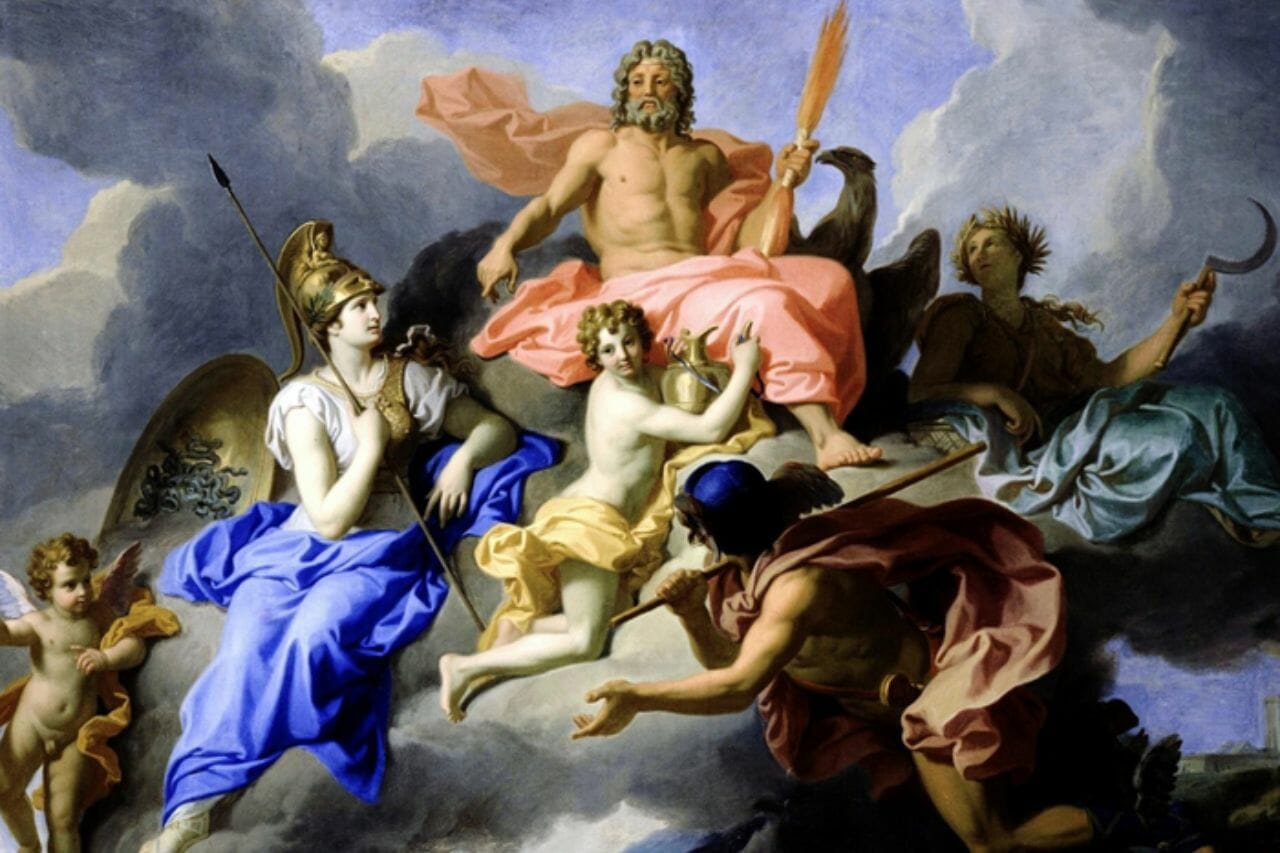
Zeus was the king of the Olympian gods in Greek Mythology. He is A very complex character, both loved and loathed among the followers of this ancient Greek religion. Zeus' character was considered to be the driving force of Greek mythology. Without Zeus, the classic story would not be as compelling as it is. Read to know more about the family tree of this legendary Greek god and this Greek god family that portrays crucial roles in the story of Greek mythology.
Who Was Zeus?
Zeus, the god of thunder, was the mightiest among the Greek gods and goddesses of Mount Olympus. He was made as the king of the Gods in Greek mythology and has played so many different roles in his lifetime that it is challenging to encapsulate his identity into a short expository.
Zeus' Symbol
Zeus is usually represented as a bearded man who carries with him his bolt of lightning as his scepter. Zeus symbol was either of the following: a thunderbolt, an oak tree, an eagle, or a bull.
Zeus' Parents
The Greek god Zeus was one of the children of the magnificent Titan couple Cronus and Rhea. Cronus was the son of Ouranos, a powerful sky deity, while Rhea was the daughter of Gaia, the primordial goddess of mother Earth. Cronus usurped the throne of his father, Ouranos as the king of the sky. Afraid that he would have the same fate, Cronus ate his children: daughters Hestia, Demeter, and Hera, and sons Poseidon and Hades.
Wary of her husband, Rhea saved her sixth-born, Zeus, by deceiving Cronus. Instead of a baby, she gave a bundled stone to her husband; Cronus ate it, thinking it was his son, baby Zeus.
True to his destiny, Cronus's throne was taken over by his son Zeus when he was an adult. Later in the story, all of Zeus' siblings were spewed out by his father after consuming poisoned nectar. This event thus completed the original god family tree.
One could say that Zeus parents and all the branches in his family tree, primarily the actions of his father, had greatly influenced how he evolved as a character and contributed to his undertakings in Greek mythology.
Zeus and His Siblings
After his father spewed out zeus siblings, Zeus led and won a revolt against Cronus and became the king of Olympus. Mount Olympus is the pantheon where the Greek gods of the Ancient Greeks lived. As king, Zeus gave the Underworld to Hades and the seas to Poseidon, while he ruled the Heavens.
Demeter became the goddess of agriculture. While Hestia was in charge of the families and the homes of the Ancient Greek mortals. Hera married Zeus, thus becoming an alter ego of the Greek god.
Together, these Greek gods ruled the world.
Ancient Greece was polytheistic; they believed in many gods. Marriage between and among siblings was just a natural phenomenon. It ensures that the power stays within the family. No wonder that throughout Greek mythology, marriages among brothers, sisters, and family members are commonly portrayed.
Zeus' Many Wives
Zeus is notorious for his amorous relationships with many women: titans, nymphs, goddesses, and humans. This is a not-so-godly trait that causes constant disarray in this Greek god family. His involvement with women happened before and even after he got married.
As the king god, often, women were attracted to Zeus' incredible charm and appeal. Other times, he used his power to lure women into him. Many times, Zeus was mentioned to change forms, becoming a bull, satyr, swan, or a golden shower, just to have his wayward ways toward them.
Among the women who got involved with the Greek god were Metis, Themis, Leto, Mnemosyne, Hera, Io, Leda, Europa, Danae, Ganymede, Alkmene, Semele, Maia, and Demeter, not to mention those who are left unknown.
As Zeus wife, some accounts said that Hera married Zeus because she got ashamed of unknowingly sleeping with her brother. A sick little bird she had taken in her arms to give some warmth and care later on transformed into a human –her brother Zeus. No wonder almost throughout the story, Hera is seen as a nagging, abused, and unhappy wife to her husband.
Zeus' Sons and Daughters
Zeus' offspring were so numerous that even he could not seem to recall all of them. Yet, when you have the king of the gods as your father, it is expected that some kind of a gift or favor would be freely given to you, which was enjoyed (or perhaps not) by his sons and daughters.
Zeus' wife was Hera, his sister, with whom he had four children: Ares, the god of war; Hephaestus, the god of fire; Hebe; and Eileithyia. On the other hand, it was said that even before marrying Hera, Zeus fell in love with a Titan named Metis.
Afraid of a prophecy that his throne will be taken away from him, he swallowed the pregnant Metis on her sixth month of pregnancy. After suffering from a severe headache, out of his forehead came Athena, the goddess of wisdom and justice, fully grown and fully clothed. She became his favorite child.
Other notable Zeus children were the twins, Apollo and Artemis (Leto); Dionysos (Semele); Hermes (Maia); Perseus (Danae); Hercules (Alkmene); the Fates, the Hours, the Horae, Eunomia, Dike, and Eirene (Themis); Polydeuces, Helen, and Dioscuri (Leda); Minos, Sarpedon, and Rhadamanthys (Europa); Epaphos (Io); the Nine Muses (Mnemosyne); Arcas (Callisto); and Iacchus and Persephone (Demeter). These children of Zeus have made Greek mythology more interesting, with their intertwining of interests and conflicts within their vastly branched family trees.
Greek mythology recounted the different endeavors undergone by Zeus' children who were under the constant challenges of the different gods and goddesses, especially his wife Hera. Often, Zeus was there to offer his support and power for his children to succeed in every challenge.
Zeus might not be an ideal husband, but his portrayal as a father is to be reckoned with.
FAQ
How Did Zeus Die?
As a god, Zeus is an immortal. He does not die. The immense scope of Greek mythology hasn't mentioned how the Greek god died in any of its writings.
However, modern TV shows and films depicted that Zeus died in his homeland, Crete. This trope has been often attributed to the writings of Callimachus (310 to 240 B.C.), who, as early as the fourth century, wrote that there was indeed a tomb for the god-king Zeus on the island of Crete. Accordingly, the island of Crete has served a great purpose in the life of Zeus, for it was here where he was taken care of as a young child up to adulthood, without the knowledge of his father.
The death of Zeus was never literal but rather an allusion to his dethronement. In the first place, he's a god; thus, he's eternal.
Several attempts to overthrow Zeus from power were made. Most notable were the attempts made by the titans, particularly Gaia (his titan grandmother) to avenge her sons (one was Cronus), who suffered from Zeus' might and power. She tried to send Typhon to destroy Zeus and Olympus but to no avail because the Greek god-king was able to destroy it.
Another coup was attempted by Hera herself, the bitter wife of Zeus who has also been under tremendous pressure to perform her gargantuan tasks as the wife of the god-king. Together with other Olympians Gods, Poseidon, Athena, and Apollo, who also wanted the throne for themselves, Hera drugged Zeus to sleep and chained him to his bed.
The gods started fighting among themselves on who was fit to take the throne, but nobody could decide. This went on until such time that helped Zeus to arrive. A longtime friend and ally to Zeus, Hecatoncheires, destroyed the chains that bound Zeus, freeing him from bondage.
With the failure of the coup, the gods once again kneeled and acknowledged Zeus as their king. Zeus may have been left to oblivion in this modern era. However, for the Greeks, he is still the god-king of Mount Olympus, together with all the members of his family tree.
Conclusion
It could be said that Greek mythology has been widely read because of its compelling narratives and characters. Among the best feelings was Zeus, who kept the dynamics of the story flowing through his different actions and antics. Overall, check what we covered in this article:
His mother saved Zeus from being swallowed by his father Cronus, thus continuing their strong lineage.
He assumed the throne and became king of the Greek gods on Mount Olympus.
Together with his siblings, he ruled the world.
He was involved with many women, both mortals, and immortals, in relationships that may be consensual or not.
His relationship with many women resulted in numerous children, which caused a frenzy in his family tree.
Zeus' character can be viewed through many lenses; he was loved by some while hated by others because of his complexities. However, his womanizing and the widely networked family tree made Zeus an infamous character. Nevertheless, one thing that cannot be disputed is his immense power as the one and only king of the gods of Olympus.