Was Andragathius the Real King Arthur?

Some theories about King Arthur focus on explaining the legendary European conquest rather than the tradition of Arthur fighting the Saxons in Britain. These theories propose that Arthur was actually a composite figure. One theory is that, entirely separate from the Anglo-Saxon war in Britain, the figure behind Arthur’s legendary conquest of Europe was a historical commander named Andragathius. This also proposes that he was identical to the figure who appears in medieval Welsh records as ‘Anthun’ son of Magnus Maximus. What is the evidence for this theory?
Who Was Andragathius?
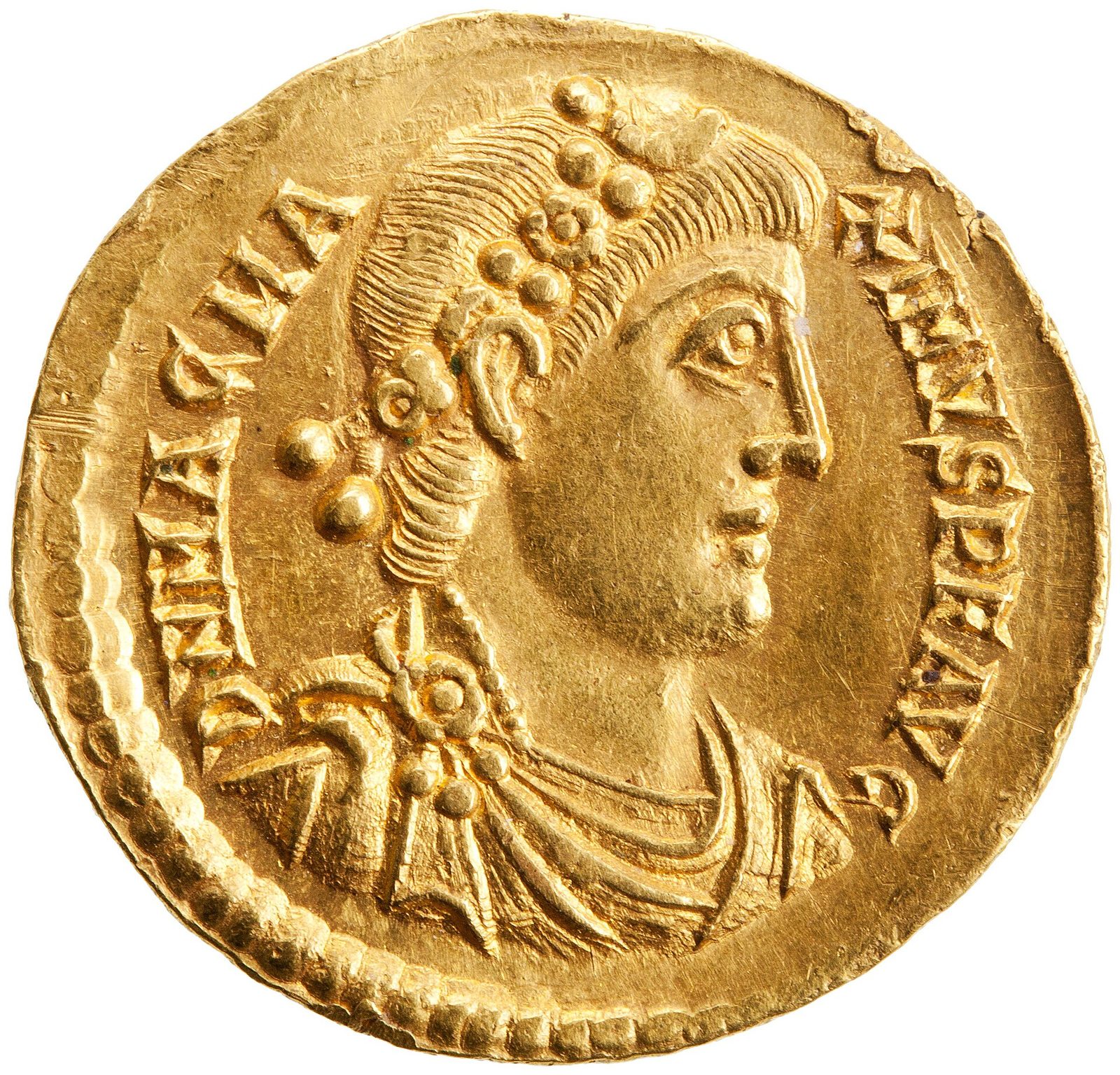
Andragathius lived in the fourth century CE, long before the traditional Arthurian period. He was a magister equitum, the commander of the cavalry. He served in this function for Magnus Maximus during his usurpation of the Western Roman Empire.
Initial Conquest
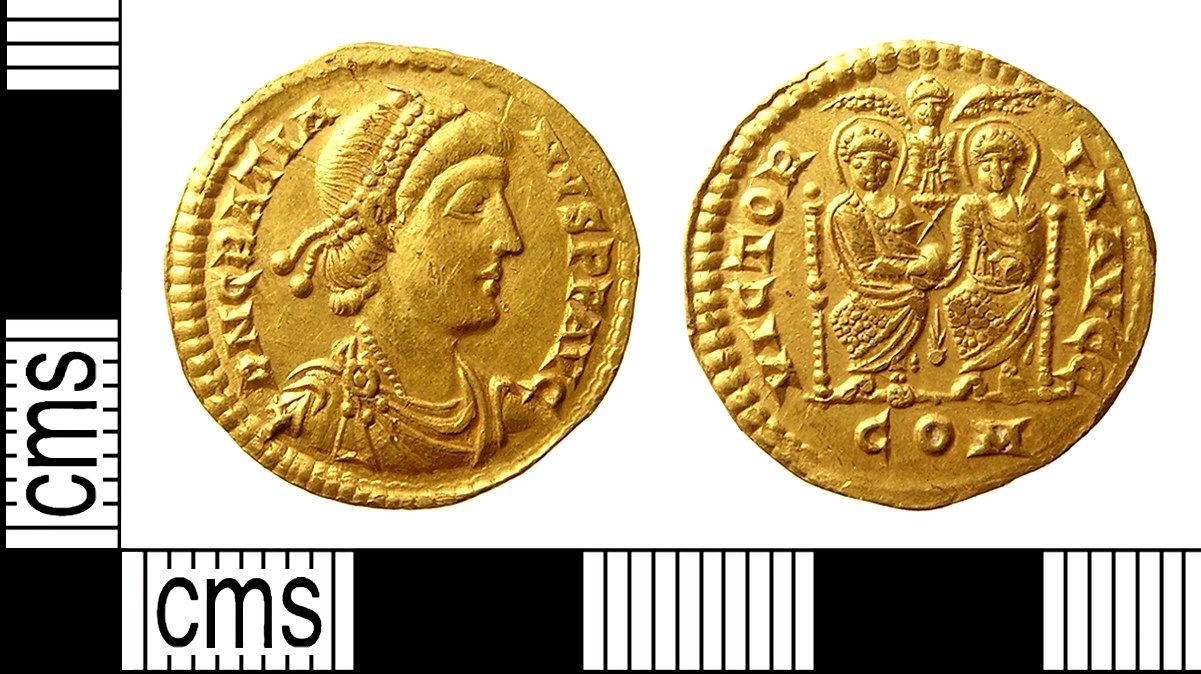
In 383, Magnus Maximus (possibly the governor of Britain at the time) was proclaimed emperor by his soldiers. He then led his army to Gaul to engage in battle against Gratian, the recognised Western Emperor. According to the Roman historian Orosius, Maximus gave Andragathius “the general direction of the war.”
Therefore, although these events are normally described in relation to Maximus, they can also properly be attributed to Andragathius.
The conflict with Gratian was not very momentous. There were some skirmishes over a few days, but then most of Gratian’s forces switched sides, joining Maximus and Andragathius. Gratian then fled. Maximus sent Andragathius in pursuit of him.
Eventually, Andragathius caught up to Gratian at the city of Lyon. By sending a false report, Andragathius gained access to Gratian and then slew him.
Final Battles
For several years, Magnus Maximus enjoyed a delicate peace with Valentinian II and Theodosius I. Theodosius was the Emperor of the East, while Valentinian was the Emperor of the West along with Maximus.
In the year 387, Maximus engaged in war against Valentinian, hoping to take complete control of the Western Roman Empire. His armies, presumably led by Andragathius, attacked Italy, where Valentinian was based. Valentinian then fled to Theodosius in the East.
With this, Andragathius had won the entire Western Roman Empire for Maximus. However, Theodosius raised an enormous army to defeat Maximus. This army was composed not just of Roman armies, but of various foreign troops too.
Andragathius took his men and stationed them at various strategic locations among the Julian Alps. Roman historians noted that his placement of men was excellent, displaying impressive competence as a general.
The ensuing battle, however, did not go well for Andragathius. Actually, Andragathius had stayed behind the rest of his army with a body of troops. As for the majority of his men, the ones stationed at Siscia, they were defeated by the army of Theodosius.
Subsequently, Magnus Maximus was captured and executed. Reportedly, when Andragathius heard news of this, he committed suicide by jumping from his ship into the Adriatic Sea.
Evidence That Andragathius Was the Real King Arthur
With this overview of Andragathius’ career in mind, what is the basis for identifying him as the real King Arthur? Firstly, it should be remembered that this theory does not propose that Andragathius alone was the foundation of the legend of Arthur. Rather, it proposes that he formed part of a composite Arthur figure. Stories of his life were combined with stories of a later figure, the military leader who really did fight the Saxons in sixth century Britain.
The Sequence of Events
One key argument used by proponents of this theory is that the sequence of events involved in Andragathius’ career on the continent closely matches the sequence of events in the legend about King Arthur conquering Europe. Consider the following comparison:
Initial Encounter with the Roman Ruler of Gaul
The legend of King Arthur conquering parts of Europe is found in full for the first time in Geoffrey of Monmouth’s Historia Regum Britanniae, written in c. 1137. In this account, Arthur arrives in Gaul with a massive army and encounters the Roman leader of Gaul, a tribune named Frollo.
There is no dramatic battle at this point. Instead, Geoffrey describes how most of the Gallic army switched sides, joining Arthur. As a result, Frollo fled.
It is worth noting how similar this legendary account is to what really happened with Andragathius. In both cases, the invading army came from Britain. After landing in Gaul, they were confronted by the leader of Gaul along with his army. The only difference is that Gratian, unlike Frollo, was actually the ruler of the entire Western Roman Empire, not just Gaul. It is worth noting, though, that Geoffrey does not rule out the possibility that Frollo ruled more than just Gaul too.
In any case, the description of most of Frollo’s army switching sides matches exactly what really happened with Gratian. And just like with Gratian, Frollo responded by fleeing with his remaining few troops.
The Two Elens
Further support for concluding that the historical event of 383 led to this legend of Arthur’s invasion of Gaul comes from the Welsh Triads. These are a medieval collection of triads covering a large number of legendary events. They often provide helpful extra insight.
One triad speaks of the ‘Three Elens who went from Ynys Prydain’ (that is, from the Island of Britain). One of these Elens is a sister of Arthur, otherwise unrecorded in Welsh tradition. It specifically says that she went with Arthur when he went to fight Frollo and did not return.
This is fascinating, because Welsh tradition also speaks of an Elen who was active in the time of Andragathius. In fact, she is made the wife of Magnus Maximus. One of the triads describes her and her brother Cynan as leading one of the ‘Three Levies that departed from this island, and none of them came back.’
Another triad refers to this same event, although instead of mentioning her brother, it describes her as accompanying Maximus. Again, it says that she left the island and did not return.
It is significant that Welsh tradition reports the same thing concerning Elen the sister of Arthur in connection with the war against Frollo and Elen the wife of Maximus in connection with the war against Gratian. This supports the idea that both events were actually the same.
Killing Frollo
The legend as recounted by Geoffrey of Monmouth explains that Arthur pursued Frollo as he fled. Frollo took up shelter in the city of Paris, and Arthur laid siege to it. After some time, Arthur and Frollo agreed to settle the matter by personal combat inside the city. During this fight, Arthur successfully killed his enemy.
Again, there is an interesting connection to the historical events surrounding Andragathius and Gratian. Just like Arthur, Andragathius pursued his enemy and caught up with him in a city. Although the city itself is not the same in this case, there are various examples in the Historia Regum Britanniae of mistakes in geography.
It is also true that Andragathius did not lay siege to Lyon, the city which Gratian reached. Yet this, again, is an example of something which was sometimes invented in the Historia Regum Britanniae. There are at least two examples of sieges described as occurring in the Roman era in that book which did not really occur.
Nevertheless, the key parts of the legend match the historical events of 383. Andragathius caught up with Gratian at a city and slew him in a one-on-one setting, exactly like Arthur did to Frollo in the legend. The surrounding details are easily explained as embellishments, the likes of which are seen elsewhere in Geoffrey’s book.
Conquering Through Battles
The Historia Regum Britanniae goes on to describe how Arthur spent several years conquering the rest of Gaul. This appears to be a major diversion from what historically happened with Andragathius. By killing Gratian, Andragathius won that entire region for Maximus, who was recognised as emperor by Theodosius and Valentinian almost immediately thereafter.
In reality though, this is in line with the Welsh tradition about Maximus’ conquest of the Western Roman Empire. In the Historia Regum Britanniae itself, we find an account of this conquest, attributed directly to Maximus. Notice the following description:
“But he himself, with the rest of his follow soldiers marched into the further part of Gaul, which, after many bloody battles, he subdued, as he did also all Germany, being everywhere victorious.”
Contrary to the historical reality, we see that Maximus was remembered for successively conquering all of Gaul. There is every reason to presume that any legends that built up around Andragathius, the one who was actually in charge of the general direction of Maximus’ war, would have evolved similarly.
Several Years of Peace
After this, the Historia Regum Britanniae reveals that there were several years of peace. It does this by means of a later passage, in which the Romans send Arthur a letter demanding tribute because of his conquest of their territory.
In response, one of Arthur’s men gives a suggestion regarding what they should do. He remarks that ‘almost five years have passed’ since they last fought (their last fighting having occurred in Gaul as far as the account indicates).
The idea that there were four years between the initial conquest of Gaul and the return to battle against the Romans is, again, plausibly understood as deriving from the historical activities of Andragathius. After the initial defeat of Gratian, Andragathius is not described as leading Maximus’ armies in battle anywhere until 387.
In that year, Maximus decided that he wanted to oust the young Valentinian II from his half of the Roman Empire and take the entire West for himself. He sent an army to attack Valentinian in Italy. This marked the resumption of military conflicts between Maximus’ army and the other emperors.
Just like in the legend of Arthur, the two conflicts were separated by four years.
Conflict with Petreius the Senator
In the legendary account found in the Historia Regum Britanniae, Arthur’s army arrives on the continent once more and heads towards Rome. This can be related to the historical activities of Maximus’s army, which headed towards Italy to attack Valentinian.
During the first stage of this event, Arthur’s men are described as having a conflict with the Romans. This was not a conflict with the entire Roman army, but just one division which was led by a senator and commander named Petreius Cotta. Interestingly, a Welsh version of the Historia Regum Britanniae, which contains extra details taken from others pieces of Welsh tradition, specifically calls him the senator of Rome.
Historically, one of the opponents of Maximus (and thus Andragathius) was Sextus Claudius Petronius Probus. He was a senator and the guardian of the young Valentinian, based in Italy. As such, he could effectively be called the senator of the capital of the Western Roman Empire.
Although the capital at this time was actually Milan, not Rome, the false belief that Valentinian was based in Rome can be found at least as early as De Excidio, a sixth-century document from Britain.
Therefore, it makes a lot of sense to identify Petreius Cotta, whom Welsh tradition remembered as the senator of Rome, as Petronius, the historical opponent of Maximus, the senator who served as the guardian of Valentinian in the capital.
While ‘Petreius’ is clearly a corruption of ‘Petronius’, the ‘Cotta’ part of his name is more obscure. However, it is likely a corruption of ‘Claudius’. In medieval Welsh documents, there are a number of examples of either the first or second consonant being dropped when there are two consonants at the beginning of a name. Furthermore, it was normal for ‘au’ to be reduced to ‘o’, and the letter ‘d’ was regularly exchanged for ‘t’ (and vice versa).
Therefore, the clash with Petreius Cotta as Arthur’s men marched towards Rome can be associated with the historical clash between Claudius Petronius in Italy as Andragathius’ men marched towards the capital.
The Battle of Siesia
Arthur’s army and the Romans’ army continued marching towards each other. Eventually, they met at a valley called Siesia. Proponents of this theory argue that this matches the historical battle of Siscia, which location was also a valley.
Where Did the Battle Take Place?
One key divergence from the historical reality of 388 is that the Historia Regum Britanniae actually places this battle in some location nearer to Britain than Rome. In fact, the description of the aftermath of the battle explicitly shows that it was in the territory of the Allobroges, which was in southeast France, with the Alps between it and Italy.
However, this is contradicted by some Welsh tradition found in the Welsh Triads. One of the triads describes this final battle between Arthur and the Romans, and it explains that it took place ‘beyond the mountain of Mynneu’.
The ‘mountain of Mynneu’ is a medieval Welsh term for the Alps. Thus, Welsh tradition placed this battle further away than the Alps, which would not fit the location given to it in Geoffrey’s Historia Regum Britanniae.
Generally speaking, Welsh tradition is to be favoured over Geoffrey’s account, which includes numerous mistranslations and geographical mistakes.
The battle between Andragathius’ army and the army of the eastern Romans took place at Siscia in Croatia, a location which could certainly be described as being beyond the Alps.
The Division of Troops
Recall that Andragathius’ division of his troops among the Julian Alps in the vicinity of Siscia was notable to Roman historians for being so impressive. With this is mind, it is significant that Geoffrey’s account in the Historia Regum Britanniae describes Arthur as dividing his men into various bodies of troops.
In isolation, this would not be very significant, since this is a fairly standard procedure. However, the account devotes an unusually large passage to describing Arthur dividing his troops, which suggests that it was something significant.
Furthermore, just like Andragathius, Arthur positioned himself behind the rest of his army.
The Dragon Standard
Another interesting connection between the account of King Arthur and Magnus Maximus’ usurpation is the fact that Arthur is described here as bearing a dragon standard. While it is true that Arthur is associated with the symbol of a dragon in Britain, this is the only time in Geoffrey’s account of Arthur’s career that a dragon standard is mentioned.
This is potentially significant, because Magnus Maximus is specifically recorded as bearing a dragon standard during his usurpation of the Western Roman Empire.
The Enemy at This Battle
What about the enemy at this battle? Naturally, the army was principally composed of Romans. However, Geoffrey explains in his account that the Romans requested help from numerous other nations. At one point, Arthur refers to them as the ‘Eastern nations’. In the Welsh version of the Historia Regum Britanniae, they are referred to as the ‘kings of the east’.
This appears to match the fact that, historically, the Roman army which went up against Andragathius and Magnus Maximus was aided by the Goths, the Huns, and the Alans. All of those non-Roman nations were from the east.
Andragathius’ Defeat and Arthur’s Victory
The one major difference between Andragathius’ career on the continent and Arthur’s is that Arthur is described as ultimately being victorious in this battle at Siesia. In contrast, Andragathius’ army was defeated at Siscia.
However, this would not be the only example of a defeat being turned into a victory in the Historia Regum Britanniae, so this does not disprove the theory. Proponents of this theory also point out that Geoffrey’s account of this battle described it as being very bloody on both sides, including Arthur’s.
In fact, more of Arthur’s men are described as dying at Siesia than at Camlann, his final, crushing, Pyrrhic victory which ended his reign.
Furthermore, the Welsh Triads describe Arthur’s army as being ‘routed’ at this battle. This strongly supports the conclusion that this may have been a historical defeat which was turned into a legendary victory.
Evidence from Culhwch and Olwen
As well as the sequence of events found in Geoffrey’s Historia Regum Britanniae, proponents of this theory also point to the evidence seen from Culhwch and Olwen. This is a Welsh tale which dates to about 1100. It is independent of Geoffrey of Monmouth, which makes it a valuable source.
In this story, there is an exchange of dialogue in which one of Arthur’s men refers to all the places he has been in Arthur’s service. He states:
“I was there in the battle of the Two Ynyrs when twelve hostages were led from Llychlyn, I was there in Europe and in Africa and the islands of Corsica. And in the Caer of Brythwch and Brytach and Nerthach, I was there when you killed the host of Gleis son of Merin and when you killed Mil Du son of Dugum. I was there when you conquered Greece as far as the East.”
Here, we have a reference to some grand war in which Arthur participated, which involved Europe and Africa. The fact that Arthur is described as conquering ‘Greece as far as the East’ strongly suggests that this conquest did not go any further east than that.
The fact that this really is the same European conquest as that described by Geoffrey of Monmouth is indicated by the fact, just before mentioning Europe, the place name Llychlyn is mentioned. This is the medieval Welsh word for Scandinavia. In Geoffrey’s account, Arthur fights in Scandinavia before going to Gaul.
At the same time, this is clearly a very different manifestation of the legend than that which is found in the Historia Regum Britanniae. A historical basis which adequately explains both versions would be very compelling.
How This Matches Andragathius’ Career
There is no evidence that Andragathius actually fought in Africa or the islands of Corsica. Yet, by defeating Gratian, he could be described as conquering the Western Roman Empire for Maximus. This, according to proponents of this theory, adequately serves as the historical basis for this claim in Culhwch and Olwen.
What about the statement that Arthur conquered Greece? Andragathius did not conquer that far. Yet, he did conquer as far as Croatia. In doing so, he managed to conquer a large part of the Prefecture of Illyricum. This encompassed almost the entire Balkan Peninsula, including Greece.
During Magnus Maximus’ usurpation, the capital of the Prefecture of Illyricum was in Greece. Therefore, it may be that the medieval Welsh, who display no knowledge whatsoever in their tradition of the Illyrians or any other relatively obscure nation in that region, simply referred to this region as ‘Greece’.
Andragathius’ Name
This theory also addresses the issue of how Andragathius’ activities could have become combined with a later Arthur’s activities by examining the name of this commander. There are many examples in medieval Welsh documents of the letter ‘d’ being exchanged for ‘t’ or even ‘th’, and vice versa.
For example, in the Latin Book of Llandaff, there is a reference to a certain ‘Guruodu’. Yet, in Culhwch and Olwen, this same name appears as ‘Gwrbothu’. This makes it plausible that Andragathius’ name could have been spelt with a ‘th’ instead of a ‘d’. The first part of the name would thus be ‘Anthr’, which is tantalisingly close to ‘Arthur’.
As it happens, there is evidence that the name of a female Welsh figure named ‘Arddun’ was mistakenly spelt ‘Arthur’ in at least one medieval record from Wales. Notice that this requires both the change from ‘d’ to ‘th’ and also the corruption of the ‘n’ into an ‘r’.
With these attested corruptions in mind, it would not be surprising if the first part of Andragathius’ name, ‘Andr’, could have been corrupted into ‘Arthur’. And in support of the idea of someone coming to be known by just the first part of their name, there are a number of examples of this as well, in addition to examples of someone coming to be known by just the final part of their name.
Evidence from Welsh Genealogies
As well as evidence that this corruption could have happened, proponents of this theory also point to evidence that something like it actually did happen.
In the medieval Welsh genealogies, Magnus Maximus appears at the head of a number of dynasties. The earliest example is seen from the Harleian MS 3859, which is a tenth century genealogical record.
Here, we find that Maximus is given a son named Anthun. Maximus is not described in contemporary Roman histories as having a son by that name. Interestingly, there are a variety of other Welsh records in which Anthun appears. One example is the Jesus College MS 20. In this and other records, Anthun is described as the ‘king of Greece’.
The Identity of Anthun
Historically, we know that Magnus Maximus engaged in a conquest of much of the Western Roman Empire. Therefore, the fact that his supposed son, Anthun, is described as the king of Greece is surely most logically understood in terms of having something to do with that historical conquest, which reached as far as the Balkans.
The only person in Maximus’ retinue who is could plausibly be credited with such a conquest and who had a name which could plausibly have evolved into ‘Anthun’ is Andragathius.
There is no record of anyone else associated with Magnus Maximus who did anything which could have led to the idea that they conquered Greece. On this basis, proponents of this theory argue that Anthun can only be the historical Andragathius.
This being the case, this demonstrates that Andragathius really did come to be known by just the first part of his name, and that this initial part did evolve into something very similar to ‘Arthur’.
Potentially, ‘Andr’ could have evolved into ‘Anthun’ and then been corrupted further into ‘Arthur’. The attested corruption of ‘Arddun’ to ‘Arthur’ would be comparable to this. Alternatively, both ‘Anthun’ and ‘Arthur’ could be independent evolutions of the name through independent lines of transmission.
Evidence from His Descendants
Supporting the conclusion that the Anthun of the genealogies should be identified with Andragathius are the names of his descendants. In the Jesus College MS 20, for example, we find the following sequence of names after Anthun:
Tathal
Teithrin
Teithfallt
The first two are plausibly understood as Brythonic names. However, ‘Teithfallt’ appears to be a form of the Germanic ‘Theodbald’ or ‘Theodebald’. This was the name of a king of the Franks in the sixth century. ‘Tewdrig’ is the Welsh form of ‘Theodoric’, which was another Germanic name of this era. For example, Theodoric the Great was the king of the Ostrogoths in the sixth century.
One scholar also suggested that ‘Teithrin’, rather than having a Brythonic origin, can be understood as an evolution of the Germanic ‘Theodhere’.
In any case, it is clear that this sequence of names following Anthun has a strong Germanic component within it. More specifically than just Germanics, many researchers associate these individuals with the Goths in particular, although there is debate as to how Goths would have come to rule in Wales.
Significantly, Andragathius has been identified as a Goth on the basis of his name. Therefore, the fact that Anthun’s descendants for several generations had Gothic names strongly supports identifying Anthun as Andragathius, a Goth.
Evidence from Andragathius’ Associates
This theory proposes that legends surrounding Andragathius and his conquests in Europe came to be misattributed to Arthur, a military commander in the sixth century who fought against the Saxons. As well as being recorded with a similar name, the confusion between Andragathius and the sixth century King Arthur could also have been encouraged by the fact that they had some associates with similar names.
Victor and Gwythyr
One example of this is the fact that Arthur was said to have had a father-in-law named Gwythyr. He appears to have been a historical ruler in Brittany, recorded as Withur in the ninth-century Life of St Paul Aurelian.
In the case of Andragathius, his master Magnus Maximus had a son named Victor. The Welsh form of this name is Gwythyr. He was given the position of Augustus by Maximus, meaning that Andragathius, too, had a kinsman named Gwythyr ruling in Gaul.
The Two Owains
In addition, both men were associated with someone named Owain. This would have added to the confusion in accounts of both of them.
In the case of the sixth century Arthur, this was Owain the son of Urien Rheged. In the case of Andragathius, Maximus is recorded as having a son named Owain.
Constantine the Successor
Another interesting coincidence is that King Arthur was, according to legendary accounts such as the Historia Regum Britanniae, succeeded by a ruler named Constantine.
As it happens, the next commander to go forth out of Britain and conquer part of the Western Roman Emperor was Constantine III, who was proclaimed emperor by his troops in 407.
Objections to This Theory
The key objection to this theory is that Andragathius lived long before the traditional Arthurian period. He was active in the late fourth century, whereas the records about Arthur clearly place him in the sixth century.
However, as already stated, this theory does not propose that Andragathius was the key figure behind the legends of Arthur. Rather, it proposes that legends about his activities became attached to the later, sixth-century Arthur as the Arthurian tradition evolved.
Conclusion
In conclusion, this theory argues that the legend of King Arthur conquering Europe comes from accounts of the historical activities of Andragathius, the cavalry commander of Magnus Maximus. He led the general direction of the war and thus conquered much of the Western Roman Empire for Maximus. The general sequence of events involved in his career on the continent strikingly matches the sequence of events provided by the earliest account of Arthur’s European conquest, found in the Historia Regum Britanniae. The evidence that Andragathius should be identified as the legendary Anthun from the genealogies supports the idea that Andragathius’ name could and did evolve into something very similar to ‘Arthur’.
Sources
Howells, Caleb, King Arthur: The Man Who Conquered Europe, 2019
Bartrum, Peter, A Welsh Classical Dictionary, 1993
https://www.britannica.com/biography/Gratian-Roman-emperor
https://www.maryjones.us/ctexts/jesus20gen.html
https://www.maryjones.us/ctexts/genealogies.html
https://www.maryjones.us/ctexts/tysillo.html
https://www.maryjones.us/ctexts/gildas01.html
https://en.wikisource.org/wiki/Six_Old_English_Chronicles/Geoffrey%27s_British_History/Book_10