Was Owain Danwyn the Real King Arthur?

While most theories that attempt to identify the real King Arthur assume that ‘Arthur’ was simply that man’s real name, some theories argue that this was actually a title, allowing them to identify Arthur with someone whose name is recorded as being completely different. One such theory has been proposed by two popular authors. They argue that the real King Arthur can be identified with a figure called Owain Danwyn. What is the evidence for this theory?
Who Was Owain Danwyn?
First of all, who was Owain Danwyn? Outside of this theory about King Arthur, he is not a well known figure at all. He is quite obscure, featuring primarily in medieval genealogical lists.
The theorists who identify him with Arthur tend to use the spelling ‘Ddantgwyn’ for his epithet, which is one old spelling seen in some manuscripts. Nonetheless, the modernised spelling ‘Danwyn’ is favoured by virtually all other authorities, so it will be used here.
It is assumed that Owain was a king, since his son was definitely a king and there is no reason to assume any differently about Owain.
Owain’s Family
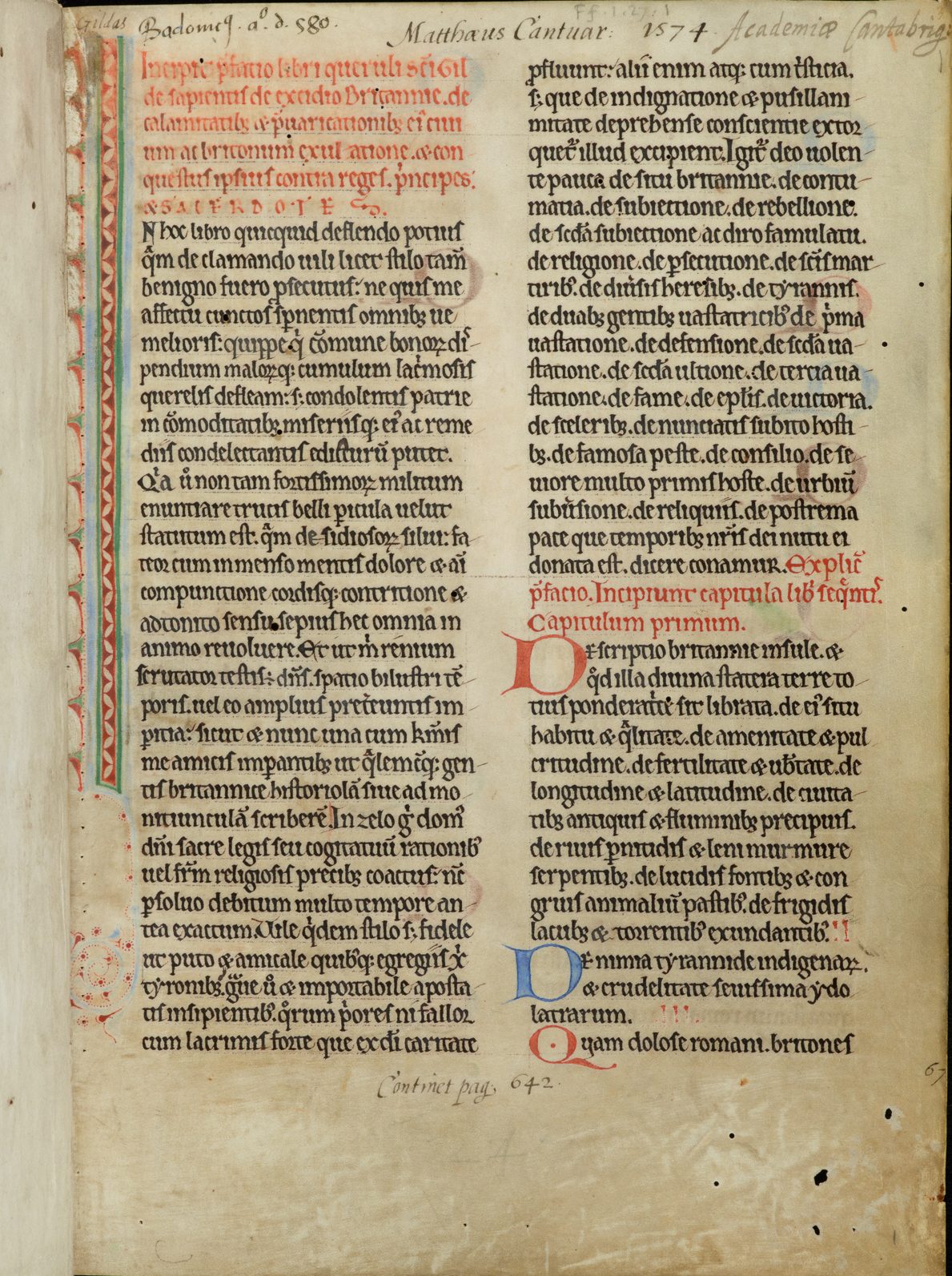
Owain appears in the medieval genealogical lists as the father of a figure named Cynlas. This Cynlas is almost universally accepted as King Cuneglasus, one of the five living monarchs to whom Gildas, a sixth century writer, directed some scathing comments in his De Excidio.
Cynlas was not Owain’s only son. He is also recorded as being the father of a figure named Einion Frenin, as well as Seiriol and Meirion, all of whom were known for being saints.
Owain’s father was also called Einion. This elder Einion had the epithet ‘Yrth’. ‘Einion’ was evidently a family name, since Owain is also recorded as having a brother called by that name.
The identity of Owain’s mother is not known, but his father Einion Yrth is recorded as marrying two daughters of a king called Didlet, king of the Picts in Powys, East Wales. In the absence of any reason to believe otherwise, Owain was likely the son of one of these two women.
Owain’s Kingdom
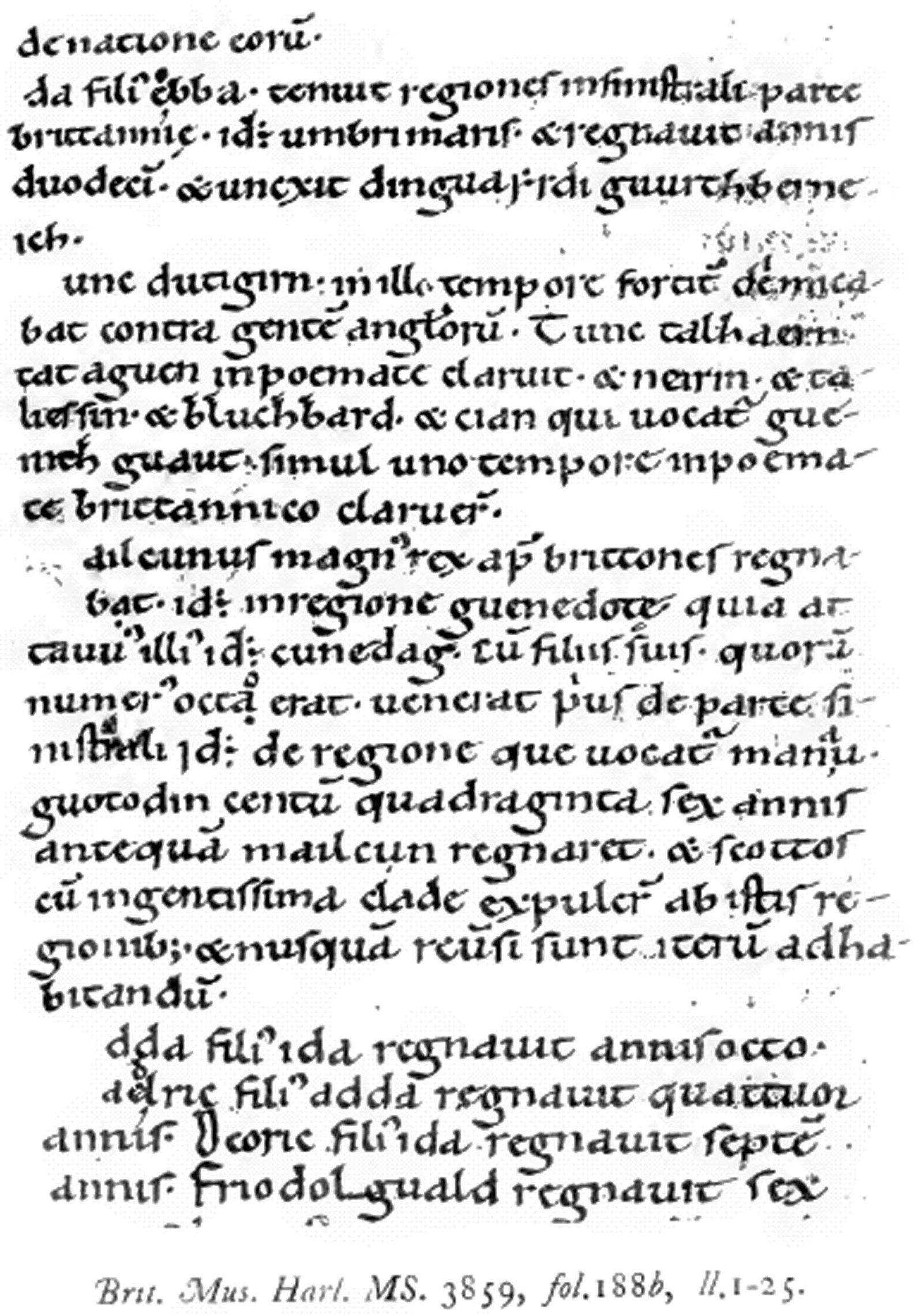
An important question is where Owain ruled. Among academics, there is not really any controversy regarding this. In the Harleian MS 3859, the earliest surviving record concerning the kings of medieval Wales, Owain and his dynasty are clearly identified as the kings of Rhos, which is a region within Gwynedd in North Wales.
This would suggest that Owain’s family were prominent subkings within the Kingdom of Gwynedd, which was ruled by kings descended from a different one of Einion Yrth’s sons.
Today, the former kingdom of Rhos roughly corresponds to Conwy County Borough, or part thereof, in North Wales.
When Did Owain Danwyn Live?
Another critical issue is establishing when Owain Danwyn really lived. To a large degree, this is dependent on when Gildas wrote. After all, Gildas referred to Cuneglasus, the son of Owain, describing him as a king who was still alive and active when Gildas wrote.
Therefore, establishing when Gildas wrote would logically reveal when Cuneglasus lived, thus, by extension, helping us to determine approximately when Owain lived.
The problem is that the date of Gildas’ writing is rather controversial, since he did not provide any specific dates in his work that help us. In fact, ironically, he is primarily dated by means of later medieval material concerning the five contemporary kings to whom he directs his comments.
The Date of Maelgwn Gwynedd
Of those five kings, the one about whom we know the most is Maelgwn Gwynedd. His death has traditionally been placed in 547 (during a plague) on the basis of the Annales Cambriae. However, an earlier chronological reference appears in the Historia Brittonum, which places the start of his reign 146 years after his ancestor Cunedda came down to Wales.
Based on this, respected scholar Rachel Bromwich highlighted that this may well indicate that Maelgwn actually reigned in the late sixth century rather than the early sixth century, and that the date of 547 in the Annales Cambriae may be a mistake due to confusion with an earlier plague.
This being the case, it would mean that Gildas would have been writing in the latter part of the sixth century. That would mean that Owain, the father of one of Gildas’ contemporary kings, would likely have been active in the early to mid sixth century.
Relative to Badon
Another important acknowledgement is the fact that Gildas places the Battle of Badon forty-three years before the time of his writing. This battle was, according to the Arthurian legends, King Arthur’s climactic victory against the Anglo-Saxons, establishing a long period of peace.
Of course, we do not know how old Cuneglasus was when Gildas was writing. However, as long as he was upwards of forty years of age, his father Owain would have easily been old enough to have led the armies at Badon.
Note that this is the case regardless of the absolute dates of Gildas or Badon.

Evidence That Owain Danwyn Was the Real King Arthur
So far, we have seen that Owain was a king of Rhos who was active in the early to mid sixth century. With these basic facts out of the way, what evidence is there to actively believe that he could plausibly have been the real King Arthur?
Evidence From Gildas
The main piece of evidence comes from what Gildas wrote in his De Excidio. Really, this is the foundation of the theory, the piece of evidence which gave birth to it in the first place.
While directing his comments to King Cuneglasus, Gildas wrote the following:
“thou bear, thou rider and ruler of many, and guider of the chariot which is the receptacle of the bear.”
Notice the reference to Cuneglasus as the ‘guider of the chariot which is the receptacle of the bear’. Other translations render this as: ‘driver of a chariot belonging to a bear’s den’. Another one renders it as: ‘charioteer of the bear’s stronghold’. Notice, furthermore, that Gildas refers to Cuneglasus himself as a ‘bear’.
Based on this description, some researchers have argued that ‘bear’ was a title used by Cuneglasus. Yet, note the fact that he is described as being the rider of a chariot which was, itself, associated with a bear. Due to this, these researchers theorise that ‘bear’ was a title which was not only used by Cuneglasus, but also by his father Owain.
The Importance of the Bear
Why is this so important? The reason is that the Welsh word for ‘bear’ is ‘arth’. Therefore, if Cuneglasus and his father were known as the Bear as a matter of course, this would mean that they were known as Arth. This, in turn, may have been expanded into the name Arthur.
Therefore, this comment directed at Cuneglasus by Gildas serves as the fundamental basis for the idea that Owain might have been the real King Arthur. However, the evidence goes further than just that.
The Power of Owain’s Dynasty
The Arthurian legends are very clear that Arthur was the most powerful king in Britain in his time. Even as far back as the Historia Brittonum, the earliest surviving record describing Arthur’s career, we see the description of Arthur leading an alliance of kings. Therefore, if Owain was the real King Arthur, this must be supported by evidence that his dynasty was a particularly powerful one.
As it happens, Gildas also provides some evidence for this. One of the other kings to whom he directed some comments was also a descendant of Einion Yrth. This is the Maelgwn mentioned earlier. According to the available genealogies, he was the son of Cadwallon, son of Einion Yrth, thus meaning that Maelgwn was the nephew of Owain Danwyn.
In his comments to Maelgwn, Gildas refers to him as the ‘dragon of the island’. This clearly refers to his preeminent position in the political sphere. Gildas goes on to describe him as:
“exceeding many in power… [God] hath made thee as well in kingdom as in stature of body higher than almost all the other chiefs of Britain.”
Therefore, this contemporary evidence makes it clear that Maelgwn was one of the most powerful kings of Britain in the sixth century.
Since Owain Danwyn was from the same family as Maelgwn, being the brother of Maelgwn’s father, it is not unreasonable to suggest that Owain may have been a notably powerful king.
Powerful Viroconium
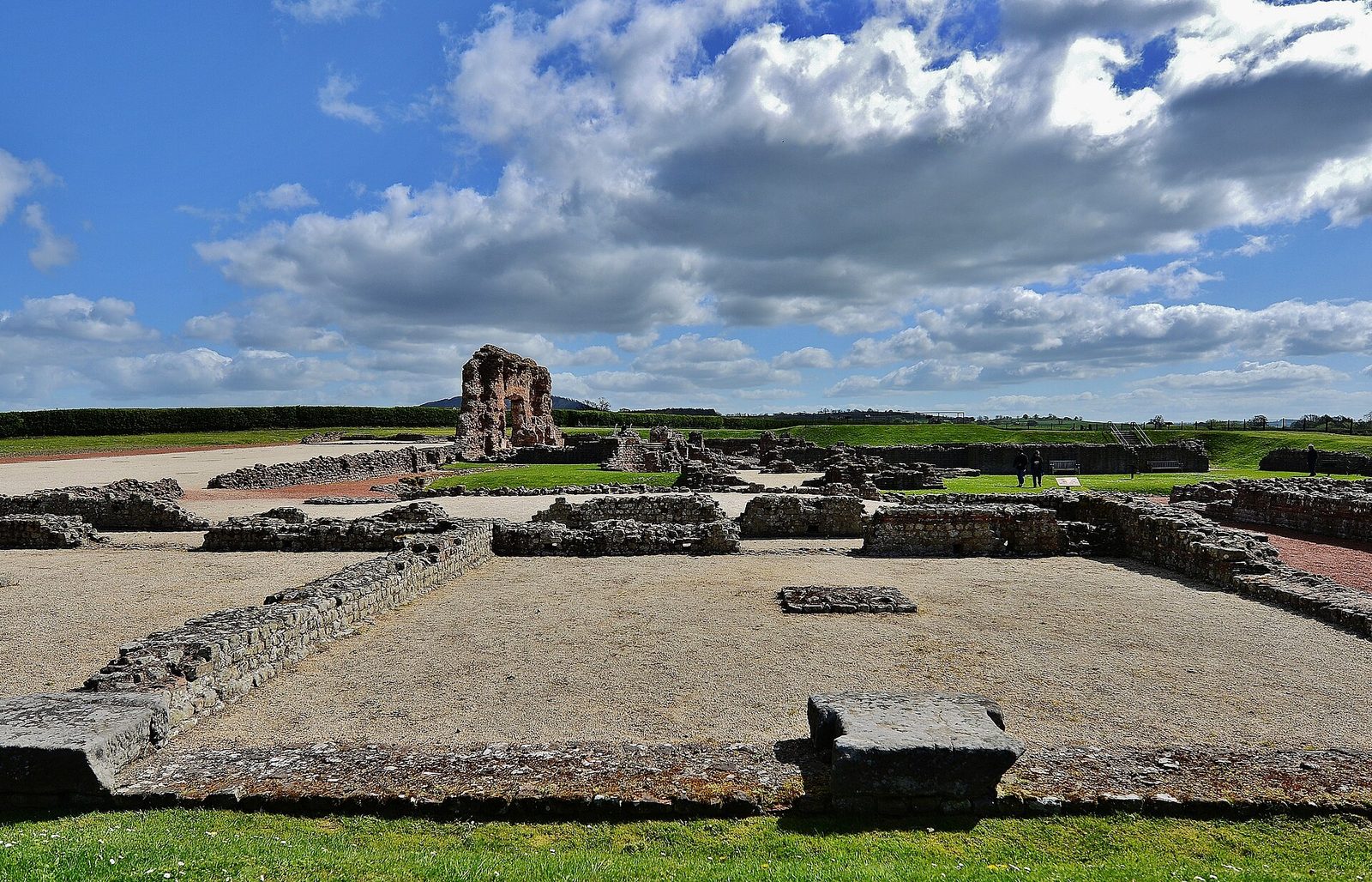
Another argument in favour of Owain being an exceptionally powerful king is related to the city of Viroconium. This was a Roman city at the present-day site of Wroxeter in Shropshire, just outside the eastern border of Wales. It is believed to have continued to be inhabited until the early sixth century. It was formerly part of the Welsh kingdom of Powys.
According to proponents of this theory, Owain’s dynasty was based in Powys. Since Viroconium was the largest city in that kingdom, it stands to reason that this was Owain’s capital city. Notably, there is evidence that Viroconium was an exceptionally powerful city in the Arthurian period.
The proponents of this theory argue that Viroconium was actually the most powerful and important city in Britain in the time of the fifth-century tyrant Vortigern and his successors. Thus, the fact that it was Owain’s capital city means that Owain must have been one of the most powerful and important kings in Britain.
King of Powys?
As the reader may note, this theory makes Owain the king of Powys rather than the king of Rhos. What is the justification for this deviation from the academic consensus?
The basis appears to be the discovery of an inscribed stone in the ruins of Viroconium. This stone inscription, usually known as the Cunorix Stone, records the presence of a person (evidently of some importance) named Cunorix.
According to proponents of this theory, the first part, ‘Cuno’, refers to Cunedda Wledig, the ancestor of Owain. The second part, ‘rix’, means ‘king’. Thus, the etymology of this name indicates that the one who possessed it was a king from the family of Cunedda.
Since Owain was from the family of Cunedda, this is used as supporting evidence for the theory that he ruled in Powys, and from Viroconium in particular, where this inscribed stone was discovered.
Connection with the Kings of Powys
In line with Owain Danwyn being a ruler of Powys, proponents of this theory have pointed to a medieval poem which appears to identify the kings of Powys as descendants of King Arthur. It is a poem called Marwnad Cynddylan, or The Death Song of Cynddylan. The titular Cynddylan was a king or prince of Powys.
In one part of the poem, the poet declares:
“I used to have brothers. It was better when they were
the young whelps of great Arthur, the mighty fortress.”
This has been used to imply that the princes of Powys were descended from Arthur. If Owain was the king of Powys, this would provide strong support for the theory that Owain really was the real King Arthur.
Overthrown by a Nephew
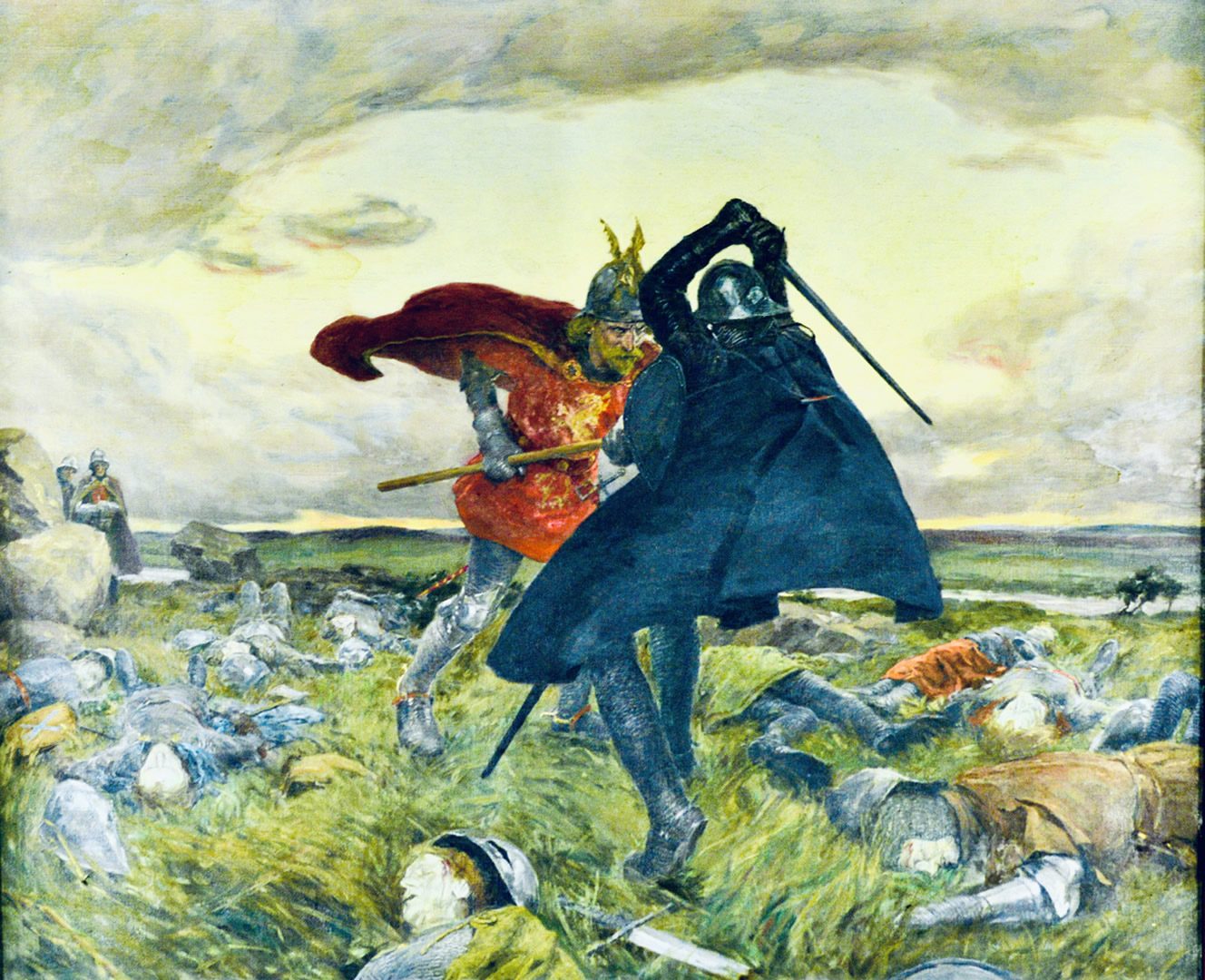
A famous part of the Arthurian legends is that King Arthur was betrayed by his nephew, Mordred. This nephew started a civil war which culminated in the Battle of Camlann. At this battle, according to the common interpretation of the earliest source (the Annales Cambriae), Arthur died.
Interestingly, there is yet more evidence from Gildas which has been used to support this theory connecting Owain to Arthur. As we have already seen, Maelgwn was the nephew of Owain. With that in mind, notice what Gildas wrote about Maelgwn:
“Didst not thou, in the very beginning of thy youth, terribly oppress with sword, spear, and fire, the king thine uncle, together with his courageous bands of soldiers?”
According to this statement, Maelgwn ‘terribly oppressed’ with weapons his uncle the king. In fact, the remark about doing this to the king’s ‘courageous band of soldiers’ suggests that this was not a mere coup, but was an actual war.
Based on this evidence, this theory suggests that Maelgwn is actually identical to Mordred, and that the uncle whom he overthrew was Owain, thus identifying Owain as the real King Arthur.
The Battle of Camlann
Hand in hand with the above line of reasoning is the evidence concerning the location of Camlann. There is much debate regarding the location of this battle site, but the weight of evidence places it somewhere in North Wales, in the south of Gwynedd.
There are actually three locations called Camlan or Gamlan within close proximity of each other in the region of Dolgellau. It is very likely that these locations preserve the name of one wider area (or perhaps just one spot of particular prominence) in that vicinity.
Since the Battle of Camlann was supposedly fought between Arthur and his nephew, it is notable that the most likely site for the real Camlann is near the border between the ancient kingdoms of Powys (ruled by Owain according to this theory) and Gwynedd (ruled by Owain’s nephew).
The fact that we find the name ‘Camlan’ in a strategically likely location for the clash between Maelgwn and his uncle Owain ostensibly supports the idea that Owain was Arthur.
Uthyr Pendragon
Another argument used to support this theory is based, yet again, on Gildas’ words. First, let us note that the Arthurian legends describe Arthur’s father as being a figure named Uthyr Pendragon. The name ‘Uthyr’ is usually taken to be a personal name, while ‘Pendragon’ is entirely a title.
This title is composed of two elements. The first, ‘pen’, means ‘head’. It can mean this in both a literal sense and also a figurative sense, such as ‘chief’ or ‘supreme’. The second element, ‘dragon’, also has both a literal and a figurative meaning. Figuratively, it is used to mean a warrior or chieftain. Therefore, the Pendragon is the chief warrior or leader.
With this in mind, consider once again the fact that Gildas described Maelgwn Gwynedd as the ‘dragon of the island’. This has often been taken to be a reference to the title of Pendragon. In any case, it clearly conveys essentially the same meaning.
Based on this fact, the argument goes that Einion Yrth was a Pendragon, since he was the head of both Maelgwn’s dynasty of Gwynedd and Owain’s dynasty of Powys. If Maelgwn had this title, then logically Einion Yrth would have had it too.
The Origin of ‘Uthyr’
If Einion was the Pendragon who fathered Arthur – that is, his son Owain Danwyn – then how did he come to be known as ‘Uthyr’? One option is that this, too, is part of a title. The word ‘uthr’ in Archaic Welsh means ‘fearsome’, which works very well as an addition to a title meaning ‘chief warrior’.
If this is the correct interpretation, then it means that Uthyr Pendragon’s real, personal name could have been anything else, even something completely different from ‘Uthyr’.
On the other hand, one version of this theory argues that the name ‘Uthyr’ comes from Einion’s epithet, Yrth. Immediately, we can see that ‘Uthyr’ and ‘Yrth’ are quite similar. However, there is an attested corruption that would make them even closer.
There are a number of examples in the medieval Welsh manuscripts of the metathesis of the letters ‘r’ and ‘th’. One instance is seen in the case of Arthwys ap Mar, recorded in a later manuscript as Athrwys ap Mar. The opposite switch is seen in the case of an epithet seen in Welsh literature as ‘Urddawl’, which is likely to be a corruption of ‘Uthrawl’.
If this attested corruption was applied in the case of Einion Yrth, it would mean that his epithet could have plausibly been corrupted into ‘Ythr’, virtually identical to the name of Arthur’s legendary father.
Objection to This Theory
Now that we have seen the primary pieces of evidence used in support of this theory, does this theory stand up to scrutiny? Let us examine each of these arguments and see what the evidence really shows.
Was Owain Really the ‘Bear’?
The primary foundation of this theory is the description that Gildas gives to Cuneglasus, which ostensibly provides evidence that his father Owain was known as ‘the bear’. There are a few issues with this argument.
Firstly, when Gildas refers to Cuneglasus as a bear, there is no reason to believe that this necessarily had anything to do with any official title used by the king. Scholars have observed that Gildas refers to five of his contemporary kings as beasts evoked in the Bible book of Revelation.
For instance, as well as the bear, Gildas also mentions the dragon (in the case of Maelgwn), the lion (in the case of Constantine and Aurelius Caninus), and the leopard (in the case of Vortiporius). For this reason, many scholars understand Gildas’ description of Cuneglasus as a bear to simply be part of this symbolic, Biblical imagery, without any basis in an actual title used by Cuneglasus.
Therefore, there is no evidence that ‘the bear’, or ‘Arth’, was a dynastic title used by Owain Danwyn’s family.
Charioteer of the Bear’s Stronghold
What about the description of Cuneglasus as the ‘charioteer of the bear’s stronghold’? Does this not indicate that Cuneglasus’ father was known as the bear, with Cuneglasus leading his father’s armies? There is no reason why it should.
The ‘bear’s stronghold’ may simply be a reference to a prominent stronghold within Cuneglasus’ kingdom. As it happens, one such prominent Dark Age fortress in the medieval kingdom of Rhos was at a site known as Dinerth, whose name does indeed mean ‘Stronghold of the Bear’.
Gildas likely made reference to this fortress because it dovetailed well with his use of Biblical imagery and him calling Cuneglasus a bear. There is simply no evidence, however, that Gildas’ reference to a bear has anything to do with Cuneglasus’ father.
Was Owain the Powerful King of Powys?
As we saw before, Owain must have been a powerful king for him to have been the real King Arthur. While it is true that Gwynedd was evidently a very powerful kingdom, there is limited evidence for this power prior to the time of Maelgwn. Furthermore, this evidence only applies to Gwynedd, not to Maelgwn’s more distant family.
As we have seen, this theory argues that Owain simply must have been powerful because the powerful city of Viroconium was his capital city. Yet, there is simply no evidence whatsoever for associating Owain with Powys.
The medieval Welsh documents, such as the Harleian MS 3859, unambiguously associate Owain’s dynasty with Rhos, which was a much smaller kingdom than Gwynedd and much less significant.
In the Historia Regum Britanniae, written by Geoffrey of Monmouth in c. 1137, there is an interesting description of King Arthur’s special coronation. His coronation is attended by many kings, and at the start, we read of the five most prominent kings of Britain who attended the coronation. One of these was Cadwallon, the King of Gwynedd and father of Maelgwn.
This account thus places Arthur above the king of Gwynedd. Yet, there is no evidence that the kings of the small kingdom of Rhos ever had power over the dynasty of Gwynedd. Rather, if anything, the reverse was the case.
Weak Evidence from Cunorix
What about the evidence from the Cunorix Stone which supposedly shows that Owain Danwyn ruled in Powys? This is based on nothing more than the similarity between the names ‘Cunedda’ and ‘Cunorix’. However, there is no basis for assuming that ‘Cunorix’ indicates that the individual was from Cunedda’s family.
In reality, the name ‘Cunorix’ is simply a name. It has no particular connection to Cunedda. The only connection is that they do both start with the same element, but this is an element which appears in countless other names. It has nothing to do with showing which dynasty someone belonged to. For instance, it appears in Welsh literature as Cynyr, and the figures with this name are not just members of Cunedda’s family.
Furthermore, even if that were what this name meant, narrowing the individual down to a member of Owain’s dynasty specifically is completely baseless, since Cunedda’s descendants founded numerous different kingdoms.
Breaking the Evidence from Poetry
As we can see, there is no evidence at all for concluding that Owain ever ruled Powys. This being the case, the evidence from poetry that appears to connect Arthur’s descendants with Powys is meaningless in the context of this theory. It does not offer any support for the identification of Arthur with Owain.
Was Owain the Uncle Overthrown by Maelgwn?
A far more interesting piece of evidence is the apparent connection between Maelgwn and Mordred. As we saw, Gildas really does say that Maelgwn overthrew his uncle, and he heavily implies that this involved an outright war rather than just a quick murder. Furthermore, the genealogies really do make Owain Danwyn the uncle of Maelgwn.
Yet despite this seemingly solid evidence, there is one big problem. The word that Gildas uses for ‘uncle’ is a more specific word than the English equivalent. He actually uses the word ‘avunculus’. This is a specific Latin word which refers to the brother of one’s mother. It does not refer to the brother of one’s father. That would be the Latin word ‘patruus’.
This being the case, Gildas’ reference to Maelgwn overthrowing his uncle cannot have anything to do with Owain Danwyn, since Owain was his paternal uncle, not his maternal uncle.
Potential Solutions
Of course, this inconvenient fact has not deterred the proponents of this theory. There are actually two possible solutions to this issue. The first is that Gildas was simply using the word ‘avunculus’ in a wider sense than its strict Latin meaning.
However, this is made very unlikely by the evident fact that Gildas clearly had an excellent education and used complex Latin. Suggesting that he was so casual with his Latin that he would use ‘avunculus’ for a paternal uncle is not consistent with the rest of his style of writing.
Another possibility is based on the fact that ‘avunculus’ could also correctly refer to the husband of one’s mother’s sister. With this possibility in mind, Owain Danwyn could have been Maelgwn’s ‘avunculus’ if Owain was married to the sister of his brother’s wife.
While this means that Owain could have been the ‘avunculus’ of Maelgwn, there is no active evidence of this. Furthermore, it would obviously have been more logical to refer to Owain by his more direct relationship to Maelgwn, that of ‘patruus’.
Therefore, the evidence simply does not support the idea that Owain was the uncle killed by Maelgwn. Thus, the supposed connection between Owain and the legend of King Arthur being killed by his nephew is unsupported.
Another problem worth noting is that Maelgwn, needless to say, did not die in the war against his uncle, yet all Arthurian tradition agrees that Mordred died at Camlann in his battle against Arthur.
The Location of Camlann
The point about Camlann being relatively close to the border between Powys and Gwynedd is correct, although this fails to strengthen this theory for reasons already considered.
Firstly, since Owain was not really the king of Powys, Camlann being where it is does not indicate that Owain was involved in that battle. Secondly, since there is no evidence at all that Maelgwn fought against Owain, its location near the border between Powys and Gwynedd would be meaningless even if Owain really were the king of Powys.
Was Einion Yrth the Real Uthyr Pendragon?
Furthermore, the evidence supposedly indicating that Einion Yrth was the real Uthyr Pendragon does not stand up to scrutiny either. While it is true that Maelgwn was called the ‘dragon of the island’ by Gildas, and this may indeed be related to the role of Pendragon, there is no reason to conclude that Einion had this title.
Maelgwn’s father was Cadwallon, the previous king of Gwynedd. Einion Yrth, in turn, was the father of Cadwallon. However, while it is clear that Maelgwn was a powerful king and Cadwallon probably was as well, there is simply no evidence that this kingdom had yet risen to prominence by the time of Einion. Indeed, there is no indication in surviving Welsh tradition that Einion himself was a significant or powerful king.
Therefore, although we have relatively little to go on, the balance of probability clearly does not favour the idea that Einion was the Pendragon, or ‘chief warrior’, since there were plenty of other kings in his time who were more powerful than him.
Conclusion
In conclusion, the theory that Owain Danwyn was the real King Arthur is fundamentally based on one intriguing line in De Excidio, written by Gildas in the sixth century. It is based on the idea that Owain, the father of Cuneglasus, was known as ‘the bear’. However, a closer examination of this line reveals no real basis for this interpretation.
Furthermore, the additional evidence used in support of this theory is generally in contrast to the available facts, such as the argument that Owain was the king of Powys or the idea that Owain was the ‘avunculus’ of Maelgwn mentioned by Gildas. In summary, the evidence for this theory fails to stand up to scrutiny.
Sources
Castleden, Rodney, King Arthur: The Truth Behind the Legend, 2003
Bartrum, Peter, A Welsh Classical Dictionary, 1993
https://www.earlybritishkingdoms.com/bios/cynlagrs.html
https://www.historyfiles.co.uk/FeaturesBritain/CymruOwain&Arthur.htm
https://arthurproject.caeraustralis.com.au/historical.php
http://www.kmatthews.org.uk/history/marwnad_cynddylan/dyhedd.html
https://clasmerdin.blogspot.com/2016/05/the-tomb-of-king-arthur-discovered-in.html