Timeless Myths Logo

Explore myths and legends from cultures around the world

Featured

Classical Mythology
Classical Mythology Greek and Roman myths, gods, heroes, and epic tales
Norse Mythology
Norse Mythology Vikings, Asgard, Ragnarok, and the nine realms
Celtic Mythology
Celtic Mythology Irish, Welsh, and Gaelic legends and folklore
Ancient Literature
Ancient Literature Classical texts, translations, and literary analysis

All Mythologies

Arthurian Legends King Arthur, Camelot, the Round Table, and the Holy Grail Egyptian Mythology Pharaohs, pyramids, and ancient Nile deities Japanese Mythology Shinto gods, spirits, and legendary creatures Chinese Mythology Dragons, immortals, and celestial beings Aztec Mythology Mesoamerican gods, rituals, and creation myths

Discover gods and goddesses from every pantheon

Featured

Greek Gods
Greek Gods The Olympians, Titans, and primordial deities
Norse Gods
Norse Gods Odin, Thor, Loki, and the Aesir and Vanir
Egyptian Gods
Egyptian Gods Ra, Osiris, Isis, Anubis, and more
Japanese Gods
Japanese Gods Amaterasu, Susanoo, and Shinto kami

All Gods & Deities

Roman Gods Jupiter, Mars, Venus, and the Roman pantheon Celtic Gods The Tuatha Dé Danann and Celtic deities Aztec Gods Quetzalcoatl, Tezcatlipoca, and Aztec deities Chinese Gods Jade Emperor, Dragon Kings, and celestial beings View All 150+ Deities Browse the complete collection of mythological deities
View all gods & deities

Tales, legends, and character profiles from mythology

Featured

All Stories
All Stories Browse 800+ mythology and history stories
Characters
Characters Profiles of 67 mythological heroes, gods, and villains

All Stories

Mythology Stories Ancient myths and legends retold History Stories Historical tales from ancient civilizations Religion & Culture Religious traditions and cultural beliefs
View all stories

Tools, references, and site information

Featured

Name Generators
Name Generators Generate fantasy and mythology-inspired names
All Articles
All Articles Browse 1,800+ articles on mythology and history

All Resources

About Timeless Myths Learn about this mythology resource Bibliography Sources and references used on this site FAQ Frequently asked questions Contact Get in touch with us
Search
Classical Mythology Greek and Roman myths, gods, heroes, and epic tales Norse Mythology Vikings, Asgard, Ragnarok, and the nine realms Celtic Mythology Irish, Welsh, and Gaelic legends and folklore Arthurian Legends King Arthur, Camelot, the Round Table, and the Holy Grail Egyptian Mythology Pharaohs, pyramids, and ancient Nile deities Japanese Mythology Shinto gods, spirits, and legendary creatures Chinese Mythology Dragons, immortals, and celestial beings Aztec Mythology Mesoamerican gods, rituals, and creation myths Ancient Literature Classical texts, translations, and literary analysis
Greek Gods The Olympians, Titans, and primordial deities Roman Gods Jupiter, Mars, Venus, and the Roman pantheon Norse Gods Odin, Thor, Loki, and the Aesir and Vanir Egyptian Gods Ra, Osiris, Isis, Anubis, and more Celtic Gods The Tuatha Dé Danann and Celtic deities Aztec Gods Quetzalcoatl, Tezcatlipoca, and Aztec deities Japanese Gods Amaterasu, Susanoo, and Shinto kami Chinese Gods Jade Emperor, Dragon Kings, and celestial beings View All 150+ Deities Browse the complete collection of mythological deities View all gods & deities
All Stories Browse 800+ mythology and history stories Characters Profiles of 67 mythological heroes, gods, and villains Mythology Stories Ancient myths and legends retold History Stories Historical tales from ancient civilizations Religion & Culture Religious traditions and cultural beliefs View all stories
Name Generators Generate fantasy and mythology-inspired names All Articles Browse 1,800+ articles on mythology and history About Timeless Myths Learn about this mythology resource Bibliography Sources and references used on this site FAQ Frequently asked questions Contact Get in touch with us
Search Search the entire mythology archive
  1. Classical Mythology
    Pantheon Heroic Age Royal Houses Geographia Facts & Figures Genealogy Bibliography About Classical Myths
  2. Royal Houses
    Aeolids House of Elis & Calydon Houses of Argolis House of Pelops Minoan Crete House of Thebes House of Sparta House of Athens Heraclids House of Troy Tales of Rome
  3. Aeolids
    Hellen Creusa and Ion Aeolus Melanippe Tyro Pelias Acastus Athamas Sisyphus Glaucus Perieres Aphareus Neleus Nestor
  4. Pelias

Pelias

King of Iolcus. Pelias (Πελιάς) was the son of Tyro and Poseidon. Pelias was the twin brother of Neleus.

Pelias incurred Hera's enmity when he murdered Sidero before her altar or statue. Hera sought her revenge through Pelias' nephew, the hero Jason, son of Aeson. An oracle warned Pelias that an Aeolid (Jason) wearing a single sandal would one day cause his death.
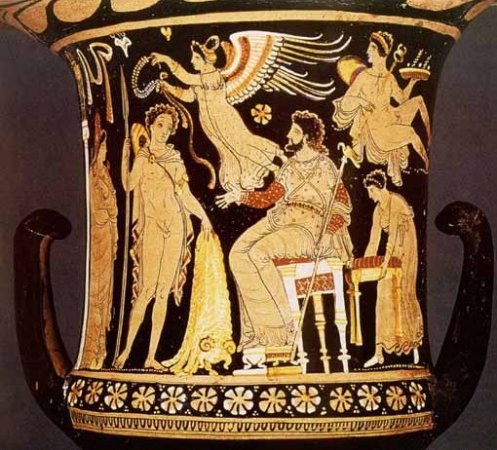
Jason and Pelias

Jason and Pelias
Greek kratera, 350-340 BC
Musée du Louvre, Paris

Pelias was known for his violent rage and lust for power. When his mother's husband Cretheus died, Pelias seized the throne from his half-brother Aeson, and had him imprisoned. His other half-brothers were driven out of Iolcus, along with his twin-brother, Neleus. Neleus fled to Messenia, while Pheres founded a city in Thessaly. Amythaon and his family went to Elis.

Pelias had a son named Acastus and many daughters by either Anaxibia or Phylomache. One of his daughters, Alcestis, married Admetus, son of his half brother, Pheres. See Heracles about the story of Admetus and Alcestis.


When Jason grew to manhood, he arrived in Iolcus wearing only one sandal, and demanded that he had more right to the throne than his uncle, the usurper. Pelias tricked Jason, saying that he would give up the throne if Jason would fetch the Golden Fleece in Colchis, hoping that Jason would not survive that quest. Jason agreed.

Jason had Argus build the ship called Argo. Jason organised the crew and gathered heroes all over Greece to join in. The heroes who sailed on the Argo became known as the Argonauts. Even Pelias' son Acastus joined the Argonauts.

Jason returned to Iolcus with his new wife, Medea, the Colchian sorceress. Jason's father Aeson was either still in prison or murdered by Pelias. Jason asked Medea to help him kill Pelias.

Medea tricked Pelias' daughters by killing an old ram, cutting up the body and throwing the pieces in a boiling cauldron. With her sorcery, Medea not only restored the ram back to life, but she also made ram young again. In the hope of restoring his youth, Pelias' daughters foolishly killed Pelias and tossed his body into the cauldron. Instead restoring Pelias' life and youth, Medea left Pelias' daughters after they killed their father. They realised to their horror that they had been duped into murdering their father. Acastus was outraged by this deed, and drove Jason and Medea out of Iolcus.


At his funeral, Acastus held the great games at Iolcus in honour of Pelias. Many heroes, including a number of Argonauts, took part in the funeral games.

The four-horse chariot race was the most interesting of the game's events. Glaucus, son of Sisyphus and king of Corinth, took part in the race. His horses were not only known for their speed, but for the fact that the king fed human flesh to his horses. Glaucus did this whenever he won a race, throwing the losers where his mares could feed on their flesh. Iolaus, the nephew and companion of Heracles, won the chariot race, defeating Glaucus. Justice was done, and his own mares killed and devoured him.

Another interesting event in the games was the wrestling match. According to Apollodorus, Atalanta, the huntress, won the wrestling match when she defeated Peleus. However, Hyginus said that Peleus won the event (Fabulae 273), and there was no mention of Atalanta.

Related Information

Name

Pelias, Πελιάς.
His name came from livid mark (pelios) of his face, when a horse trampled on his face.

Sources

Argonautica, written by Apollonius of Rhodes.

Pythian IV was written by Pindar.

Description of Greece was written by Pausanias.

The Iliad and the Odyssey were written by Homer.

Theogony was written by Hesiod.

Related Articles

Tyro, Neleus, Acastus, Alcestis, Admetus, Jason, Medea.

Argonauts, Golden Fleece.

Genealogy: Aeolids 1: Thessaly

Jimmy Joe Timeless Myths

By Jimmy Joe

Aeolids:

  • • Hellen
  • • Creusa and Ion
  • • Aeolus
  • • Melanippe
  • • Tyro
  • • Pelias
  • • Acastus
  • • Athamas
  • • Sisyphus
  • • Glaucus
  • • Perieres
  • • Aphareus
  • • Neleus
  • • Nestor
Death of King Pelias

Death of King Pelias

Upon returning home, the Argonauts were disbanded, while Jason and Medea went to Iolcus with the Golden Fleece. Jason gave the Golden Fleece to his uncle Pelias. But during Jason's absence, Pelias had either murdered Jason's father or forced Aeson...

May 22nd, 1999 • Timeless Myths
Tyro

Tyro

King of Salmonia, in Elis, Salmoneus (Σαλμωνεύς) was the father of Tyro (Τυρώ) by Alicidice, daughter of Aleüs (Aleus), king of Arcadia. Not long after taking his second wife, Sidero (Σιδηρύ), Salmoneus' daughter bore twin sons, Neleus (Νηλεύς) an...

April 27th, 1999 • Jimmy Joe
Jason

Jason

The leader of the Argonauts. Jason was the son of Aeson and of Polymede, Alcimede Amphinome. According to Diodorus Siculus, Jason had a younger brother named Promachus. Being the eldest son of Cretheus, his father Aeson should have become king of ...

April 9th, 1999 • Jimmy Joe
Neleus

Neleus

Neleus (Νηλεύς) was the son of Tyro and Poseidon, and the twin brother of Pelias. When Pelias drove him from Iolcus, Neleus migrated south, where he was warmly welcomed by his cousin Aphareus. Neleus received most of the coastal land in Messenia f...

April 27th, 1999 • Jimmy Joe
Iolcus

Iolcus

Iolcus was a city on the shores of the Pagasaean Gulf, near the port-city of Pagasae. It is now called Volos. Cretheus, son of Aeolus, founded Iolcus. When he died, his eldest son Aeson (father of Jason) should have inherited the kingdom. Instead,...

August 8th, 1999 • Jimmy Joe
Acastus

Acastus

Argonaut. Acastus was the son of Pelias and Anaxibia or Phylomachus. Acastus joined his cousin Jason in the quest for the golden fleece. When Medea tricked his sisters into murdering their father, Acastus drove Jason and Medea into exile for causi...

April 27th, 1999 • Jimmy Joe
Peleus

Peleus

A king of Phthia, in Thessaly. Peleus (Πηλεύς) was the son of Aeacus (Aiacos), king of Aegina, and Endeïs. He and his brother Telamon plotted to kill their half-brother Phocus, son of Aeacus by the Nereïd (Nereid) Psamathe, because he excelled in ...

April 9th, 1999 • Jimmy Joe
The Aeolids in Argos

The Aeolids in Argos

At first, Proëtus (Προιτος) ruled in his kingdom at Tiryns, when his twin brother was still ruling in the city of Argos. Proëtus and Acrisius were bitter rivals, both seeking power in Argos. Proëtus only received Argos from his great-nephew, Perse...

April 24th, 1999 • Jimmy Joe
Acrisius and Proëtus

Acrisius and Proëtus

Lynceus' son, Abas, succeeded Lynceus. It was written that Abas was a mighty warrior, but there is no mythology of his own to tell us what heroic deeds Abas had done. His wife Aglaea, daughter of Mantineus, bore him twins, Acrisius (Acrisios or Ἀκ...

April 24th, 1999 • Jimmy Joe
Perseus and his Children

Perseus and his Children

Acrisius (Acrisios, Ἀκρίσιοσ) consulted the oracle from Delphi about having a son; instead the oracle warned him that his grandson would kill him one day. Acrisius tried to avoid the fulfilment of the oracle by first imprisoning his daughter Danaë...

April 24th, 1999 • Jimmy Joe
Timeless Myths

Exploring mythology and legends from around the world.

Explore Myths

All Stories Characters All Articles Search Site Map

Mythologies

Norse Mythology Classical Mythology Celtic Mythology Arthurian Legends Mythology Gods Ancient Literature

About Us

Introduction About Jimmy Bibliography FAQs Retro Version

Resources

Timeless Myths All Stories All Articles Characters
© 1999-2026 Timeless Myths • Copyright • Privacy Policy • Cookie Policy • Contact
Follow us: