Timeless Myths Logo

Explore myths and legends from cultures around the world

Featured

Classical Mythology
Classical Mythology Greek and Roman myths, gods, heroes, and epic tales
Norse Mythology
Norse Mythology Vikings, Asgard, Ragnarok, and the nine realms
Celtic Mythology
Celtic Mythology Irish, Welsh, and Gaelic legends and folklore
Ancient Literature
Ancient Literature Classical texts, translations, and literary analysis

All Mythologies

Arthurian Legends King Arthur, Camelot, the Round Table, and the Holy Grail Egyptian Mythology Pharaohs, pyramids, and ancient Nile deities Japanese Mythology Shinto gods, spirits, and legendary creatures Chinese Mythology Dragons, immortals, and celestial beings Aztec Mythology Mesoamerican gods, rituals, and creation myths

Discover gods and goddesses from every pantheon

Featured

Greek Gods
Greek Gods The Olympians, Titans, and primordial deities
Norse Gods
Norse Gods Odin, Thor, Loki, and the Aesir and Vanir
Egyptian Gods
Egyptian Gods Ra, Osiris, Isis, Anubis, and more
Japanese Gods
Japanese Gods Amaterasu, Susanoo, and Shinto kami

All Gods & Deities

Roman Gods Jupiter, Mars, Venus, and the Roman pantheon Celtic Gods The Tuatha Dé Danann and Celtic deities Aztec Gods Quetzalcoatl, Tezcatlipoca, and Aztec deities Chinese Gods Jade Emperor, Dragon Kings, and celestial beings View All 150+ Deities Browse the complete collection of mythological deities
View all gods & deities

Tales, legends, and character profiles from mythology

Featured

All Stories
All Stories Browse 800+ mythology and history stories
Characters
Characters Profiles of 67 mythological heroes, gods, and villains

All Stories

Mythology Stories Ancient myths and legends retold History Stories Historical tales from ancient civilizations Religion & Culture Religious traditions and cultural beliefs
View all stories

Tools, references, and site information

Featured

Name Generators
Name Generators Generate fantasy and mythology-inspired names
All Articles
All Articles Browse 1,800+ articles on mythology and history

All Resources

About Timeless Myths Learn about this mythology resource Bibliography Sources and references used on this site FAQ Frequently asked questions Contact Get in touch with us
Search
Classical Mythology Greek and Roman myths, gods, heroes, and epic tales Norse Mythology Vikings, Asgard, Ragnarok, and the nine realms Celtic Mythology Irish, Welsh, and Gaelic legends and folklore Arthurian Legends King Arthur, Camelot, the Round Table, and the Holy Grail Egyptian Mythology Pharaohs, pyramids, and ancient Nile deities Japanese Mythology Shinto gods, spirits, and legendary creatures Chinese Mythology Dragons, immortals, and celestial beings Aztec Mythology Mesoamerican gods, rituals, and creation myths Ancient Literature Classical texts, translations, and literary analysis
Greek Gods The Olympians, Titans, and primordial deities Roman Gods Jupiter, Mars, Venus, and the Roman pantheon Norse Gods Odin, Thor, Loki, and the Aesir and Vanir Egyptian Gods Ra, Osiris, Isis, Anubis, and more Celtic Gods The Tuatha Dé Danann and Celtic deities Aztec Gods Quetzalcoatl, Tezcatlipoca, and Aztec deities Japanese Gods Amaterasu, Susanoo, and Shinto kami Chinese Gods Jade Emperor, Dragon Kings, and celestial beings View All 150+ Deities Browse the complete collection of mythological deities View all gods & deities
All Stories Browse 800+ mythology and history stories Characters Profiles of 67 mythological heroes, gods, and villains Mythology Stories Ancient myths and legends retold History Stories Historical tales from ancient civilizations Religion & Culture Religious traditions and cultural beliefs View all stories
Name Generators Generate fantasy and mythology-inspired names All Articles Browse 1,800+ articles on mythology and history About Timeless Myths Learn about this mythology resource Bibliography Sources and references used on this site FAQ Frequently asked questions Contact Get in touch with us
Search Search the entire mythology archive
  1. Classical Mythology
    Pantheon Heroic Age Royal Houses Geographia Facts & Figures Genealogy Bibliography About Classical Myths
  2. Heroic Age
    Heroes 1 Heroes 2 Heroines Amazons Perseus Theseus Heracles Argonauts Calydonian Boar Hunt Seven Against Thebes Trojan War Odyssey Aeneid Tales of Lovers Giants Centaurs Mythical Creatures
  3. Heracles
    Birth & Early Life Twelve Labours of Heracles Later Life
  4. Twelve Labours of Heracles
    First Labour (Nemean Lion) Second Labour (Hydra) Third Labour (Cerynitian Hind) Fourth Labour (Erymanthian Boar) Fifth Labour (Stables of Augeias) Sixth Labour (Stymphalian Birds) Seventh Labour (Cretan Bull) Eighth Labour (Mares of Diomedes) Ninth Labour (Hippolyte's Girdle) Tenth Labour (Cattle of Geryon) Eleventh Labour (Apples of Hesperides) Twelfth Labour (Cerberus)
  5. Tenth Labour (Cattle of Geryon)
    Tenth Labour (Cattle of Geryon)

Tenth Labour (Cattle of Geryon)

For the tenth labour, Heracles was required to fetch the cattle of Geryon. Geryon (Γηρυονεύς) was the king of Erytheia (Cadiz), in Spain.

The cattle were guarded by Geryon's herdsman and the two-headed hound called Orthus (Ὄρθρος).
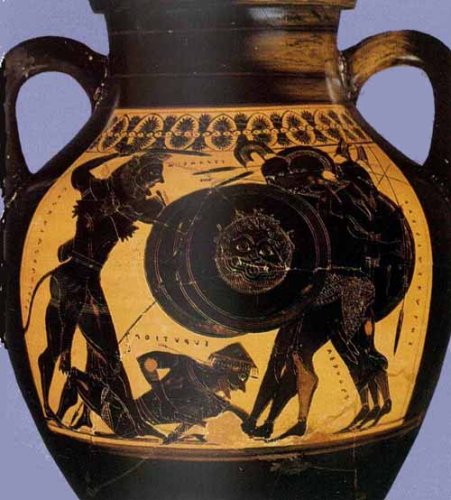
Heracles and Geryons

Heracles and Geryon
Black Figure amphora, c. 550 BC
Musée du Louvre, Paris

The journey was uneventful, until Heracles reached the Straits of Gibraltar. Heracles began piling rocks on the European side and African sides of the straits. The erection of these rocks became known as the Pillars of Hercules.

The work was long and hard, so Heracles became overheated from the sun. Heracles pointed his arrow at the sun, threatening to shoot the sun. Helius, the god of the sun, was far from offended by the impetuous hero. In fact, Helius so admired the hero's boldness that the sun-god gave Heracles a Sun-cup made of gold. This gold cup was large enough for Heracles to sail past the Pillars of Hercules and into the Atlantic Ocean.

(According to Diodorus Siculus, the hero Heracles completely destroyed a race of woman warriors called the Gorgons (similar to the Amazons), in Libya. His great grandfather Perseus had earlier defeated the Gorgons and killed their queen, Medusa.)

Arriving at Erytheia, Heracles had to kill the herdsman Eurytion and the two-headed hound Orthus with his club, near the peak of Mount Abas. Menoetes, the herdsman of Hades, witnessed all of this, and went to Geryon with news of Heracles raiding his cattle. Geryon, who had three heads, was also killed when he pursued the hero to the River Anthemus. Heracles then tried to make his way home.

Passing through Abderia, to the south of Spain, Heracles then entered the land of the Ligurians. Near Massalia (modern Marseille), Ialebion and Dercynus, the sons of Poseidon, who wanted to steal the cattle, attacked him. Heracles killed them, but he was wounded, fighting the Ligurian army. Zeus sent a shower of stone, which Heracles used to pelt his enemies.

The giant Cacus also stole some of the cattle in Italy. Heracles had to leave the rest of the cattle behind, to search for the missing cattle and to kill Cacus.

At Rhegion, one of his bulls left the other cattle, and jumped and swam across the Strait of Messina. Heracles asked the locals if they had seen the missing bull, and they told him where it had gone off to. The locals referred to the bull as italus, so Heracles called the entire Italian peninsula, Italy. The missing bull was the finest of the stock, so Heracles left the rest of cattle behind to fetch the one in Sicily.

When he found the bull, he found it among the herd of a notorious boxer named Eryx (Ἔρυξ), in Eryx, Sicily. According to Apollonius Rhodius, Eryx was a son of the Argonaut Butes and Aphrodite, or according to Apollodorus, a son of Poseidon. Eyrx had the habit of challenging a traveller to a boxing match in which he would kill his opponent. Eryx would only agree to return the bull to the hero if Heracles could defeat him in a boxing match. Eryx, however, was no match for Heracles, and was killed during their bout.

Heracles recovered his bull and returned to the other cattle. New problems arose upon reaching Greece. Hera sent gadflies that stung the cattle, dispersing them out in all directions, but most of the cattle fled to the Thracian mountains. Heracles was forced to pursue them, and managed to recover some of the cattle. Those left behind became wild. He brought the rest to Eurystheus, who offered them in sacrifice to Hera.

There was another person who stole and hid the cattle from Heracles. According to a 1st century BC Greek poet, Parthenius, the Celts were descendants of Heracles.

As Heracles travelled back to Greece with the cattle of Geryon, Celtine, daughter of Bretannus, saw and fell in love with the hero. One day, she hid the cattle, and would not tell Heracles their whereabouts until he made love to her. Heracles slept with her, and Celtine became the mother of Celtus, ancestor of the Celts.

Diodorus Siculus also recorded the same myth about the origin of the Celts, except that Diodorus didn't give a name to the maiden whom Heracles slept with. The only description we were given was that she was from Alesia, and her son was named Galates or Gaul. Greek and Roman authors frequently interchanged the Celts with Gauls and Galatae.

Related Information

Sources

Library was written by Apollodorus.

Theogony was written by Hesiod.

Description of Greece was written by Pausanias.

Isthmian I was written by Pindar.

Library of History was written by Diodorus Siculus.

Metamorphoses was written by Ovid.

Aeneid was written by Vergil.

Related Articles

Helius, Butes, Eurystheus, Zeus.

Geryon, Orthus, Cacus.

Facts and Figures: Astronomy, see the constellation of Hercules.

Jimmy Joe Timeless Myths

By Jimmy Joe

Twelve Labours of Heracles:

  • • First Labour (Nemean Lion)
  • • Second Labour (Hydra)
  • • Third Labour (Cerynitian Hind)
  • • Fourth Labour (Erymanthian Boar)
  • • Fifth Labour (Stables of Augeias)
  • • Sixth Labour (Stymphalian Birds)
  • • Seventh Labour (Cretan Bull)
  • • Eighth Labour (Mares of Diomedes)
  • • Ninth Labour (Hippolyte's Girdle)
  • • Tenth Labour (Cattle of Geryon)
  • • Eleventh Labour (Apples of Hesperides)
  • • Twelfth Labour (Cerberus)
Geryon

Geryon

Geryon was the son of Chrysaor and the Oceanid Callirrhoë. Geryon was the king of Erytheia (Cadiz), in Spain. Geryon was a man or monster with three bodies, joined at the waist. Geryon was the owner of cattle which was placed in the care of Euryti...

June 1st, 2000 • Jimmy Joe
Twelfth Labour (Cerberus)

Twelfth Labour (Cerberus)

For the twelfth labour, Heracles needed to go to Hades and fetch the Cerberus. Cerberus was a three-headed hound with a snake's head at the end of its tail. The dreaded hound guarded the gates of Hades, to keep the dead in the Underworld. Cerberus...

April 9th, 1999 • Jimmy Joe
Seventh Labour (Cretan Bull)

Seventh Labour (Cretan Bull)

For the seventh labour, Heracles needed to fetch the Cretan Bull, the bull that belonged to Minos, king of Crete. This bull was sacred to Poseidon, and had the ability to walk and even run on the surface of the sea. When Minos gained the bull from...

April 9th, 1999 • Jimmy Joe
Fourth Labour (Erymanthian Boar)

Fourth Labour (Erymanthian Boar)

For the fourth labour, Heracles needed to fetch Erymanthian Boar. On this trip, he visited a Centaur named Pholus, who lived in Mount Pholoë (Pholoe), which was named after the Centaur. Pholus had some wine with odour to attract the boar. Unfortun...

April 9th, 1999 • Jimmy Joe
Cacus

Cacus

According to the Roman myth, Cacus was the son of Vulcan (Hephaestus). Cacus was a fire-breathing giant. During his tenth labour, Heracles was driving the cattle of Geryon through Italy when the hero encountered Cacus. As Heracles passed through t...

June 1st, 2000 • Jimmy Joe
Twelve Labours of Heracles

Twelve Labours of Heracles

It would not make sense unless you read why Heracles had to perform his Twelve Labours. The Madness of Heracles was the origin of Heracles' great adventures that earned him a place among the immortal gods at Olympus. Madness of HeraclesMadness of ...

April 9th, 1999 • Jimmy Joe
Eighth Labour (Mares of Diomedes)

Eighth Labour (Mares of Diomedes)

The eighth labour was to fetch the flesh-eating mares of Diomedes. Diomedes (Διομήδης) was the king of the Bistones, in Thrace, who fed human flesh to his horses. Heracles threw Diomedes to the mares, and they killed and ate the king. There was a ...

April 9th, 1999 • Jimmy Joe
Eleventh Labour (Apples of Hesperides)

Eleventh Labour (Apples of Hesperides)

For the eleventh labour, Heracles had to fetch the golden apples of Hesperides. The Hesperides ("Daughters of the Evening Star") were the daughters of the Titan Atlas and Hesperis (Evening Star). How many daughters there were, really depended on t...

April 9th, 1999 • Jimmy Joe
Erymanthian Boar

Erymanthian Boar

The Erymanthian Boar was the giant wild boar that roamed around Mount Erymanthus, in northern Arcadia. Heracles captured the boar when he trapped it in the snow for his fourth labour. Since the boar was still alive, Eurystheus cowardly hid inside ...

June 1st, 2000 • Jimmy Joe
Second Labour (Hydra)

Second Labour (Hydra)

For the second labour, Heracles had to kill the Hydra that lived by a spring near Lerna, Argolis. The Hydra was a creature that had many heads. The number of heads varied, depending on the author. Usually there were nine heads. One of the heads wa...

April 9th, 1999 • Jimmy Joe
Timeless Myths

Exploring mythology and legends from around the world.

Explore Myths

All Stories Characters All Articles Search Site Map

Mythologies

Norse Mythology Classical Mythology Celtic Mythology Arthurian Legends Mythology Gods Ancient Literature

About Us

Introduction About Jimmy Bibliography FAQs Retro Version

Resources

Timeless Myths All Stories All Articles Characters
© 1999-2026 Timeless Myths • Copyright • Privacy Policy • Cookie Policy • Contact
Follow us: