Timeless Myths Logo

Explore myths and legends from cultures around the world

Featured

Classical Mythology
Classical Mythology Greek and Roman myths, gods, heroes, and epic tales
Norse Mythology
Norse Mythology Vikings, Asgard, Ragnarok, and the nine realms
Celtic Mythology
Celtic Mythology Irish, Welsh, and Gaelic legends and folklore
Ancient Literature
Ancient Literature Classical texts, translations, and literary analysis

All Mythologies

Arthurian Legends King Arthur, Camelot, the Round Table, and the Holy Grail Egyptian Mythology Pharaohs, pyramids, and ancient Nile deities Japanese Mythology Shinto gods, spirits, and legendary creatures Chinese Mythology Dragons, immortals, and celestial beings Aztec Mythology Mesoamerican gods, rituals, and creation myths

Discover gods and goddesses from every pantheon

Featured

Greek Gods
Greek Gods The Olympians, Titans, and primordial deities
Norse Gods
Norse Gods Odin, Thor, Loki, and the Aesir and Vanir
Egyptian Gods
Egyptian Gods Ra, Osiris, Isis, Anubis, and more
Japanese Gods
Japanese Gods Amaterasu, Susanoo, and Shinto kami

All Gods & Deities

Roman Gods Jupiter, Mars, Venus, and the Roman pantheon Celtic Gods The Tuatha Dé Danann and Celtic deities Aztec Gods Quetzalcoatl, Tezcatlipoca, and Aztec deities Chinese Gods Jade Emperor, Dragon Kings, and celestial beings View All 150+ Deities Browse the complete collection of mythological deities
View all gods & deities

Tales, legends, and character profiles from mythology

Featured

All Stories
All Stories Browse 800+ mythology and history stories
Characters
Characters Profiles of 67 mythological heroes, gods, and villains

All Stories

Mythology Stories Ancient myths and legends retold History Stories Historical tales from ancient civilizations Religion & Culture Religious traditions and cultural beliefs
View all stories

Tools, references, and site information

Featured

Name Generators
Name Generators Generate fantasy and mythology-inspired names
All Articles
All Articles Browse 1,800+ articles on mythology and history

All Resources

About Timeless Myths Learn about this mythology resource Bibliography Sources and references used on this site FAQ Frequently asked questions Contact Get in touch with us
Search
Classical Mythology Greek and Roman myths, gods, heroes, and epic tales Norse Mythology Vikings, Asgard, Ragnarok, and the nine realms Celtic Mythology Irish, Welsh, and Gaelic legends and folklore Arthurian Legends King Arthur, Camelot, the Round Table, and the Holy Grail Egyptian Mythology Pharaohs, pyramids, and ancient Nile deities Japanese Mythology Shinto gods, spirits, and legendary creatures Chinese Mythology Dragons, immortals, and celestial beings Aztec Mythology Mesoamerican gods, rituals, and creation myths Ancient Literature Classical texts, translations, and literary analysis
Greek Gods The Olympians, Titans, and primordial deities Roman Gods Jupiter, Mars, Venus, and the Roman pantheon Norse Gods Odin, Thor, Loki, and the Aesir and Vanir Egyptian Gods Ra, Osiris, Isis, Anubis, and more Celtic Gods The Tuatha Dé Danann and Celtic deities Aztec Gods Quetzalcoatl, Tezcatlipoca, and Aztec deities Japanese Gods Amaterasu, Susanoo, and Shinto kami Chinese Gods Jade Emperor, Dragon Kings, and celestial beings View All 150+ Deities Browse the complete collection of mythological deities View all gods & deities
All Stories Browse 800+ mythology and history stories Characters Profiles of 67 mythological heroes, gods, and villains Mythology Stories Ancient myths and legends retold History Stories Historical tales from ancient civilizations Religion & Culture Religious traditions and cultural beliefs View all stories
Name Generators Generate fantasy and mythology-inspired names All Articles Browse 1,800+ articles on mythology and history About Timeless Myths Learn about this mythology resource Bibliography Sources and references used on this site FAQ Frequently asked questions Contact Get in touch with us
Search Search the entire mythology archive
  1. Classical Mythology
    Pantheon Heroic Age Royal Houses Geographia Facts & Figures Genealogy Bibliography About Classical Myths
  2. Heroic Age
    Heroes 1 Heroes 2 Heroines Amazons Perseus Theseus Heracles Argonauts Calydonian Boar Hunt Seven Against Thebes Trojan War Odyssey Aeneid Tales of Lovers Giants Centaurs Mythical Creatures
  3. Heracles
    Birth & Early Life Twelve Labours of Heracles Later Life
  4. Twelve Labours of Heracles
    First Labour (Nemean Lion) Second Labour (Hydra) Third Labour (Cerynitian Hind) Fourth Labour (Erymanthian Boar) Fifth Labour (Stables of Augeias) Sixth Labour (Stymphalian Birds) Seventh Labour (Cretan Bull) Eighth Labour (Mares of Diomedes) Ninth Labour (Hippolyte's Girdle) Tenth Labour (Cattle of Geryon) Eleventh Labour (Apples of Hesperides) Twelfth Labour (Cerberus)
  5. Eleventh Labour (Apples of Hesperides)
    Eleventh Labour (Apples of Hesperides)

Eleventh Labour (Apples of Hesperides)

For the eleventh labour, Heracles had to fetch the golden apples of Hesperides. The Hesperides ("Daughters of the Evening Star") were the daughters of the Titan Atlas and Hesperis (Evening Star). How many daughters there were, really depended on the author. Some said three, four or seven. They cared for a grove of trees that bore golden fruit. The trees were guarded by a serpent or dragon with a hundred heads, known as Ladon, offspring of Typhon and Echidna.
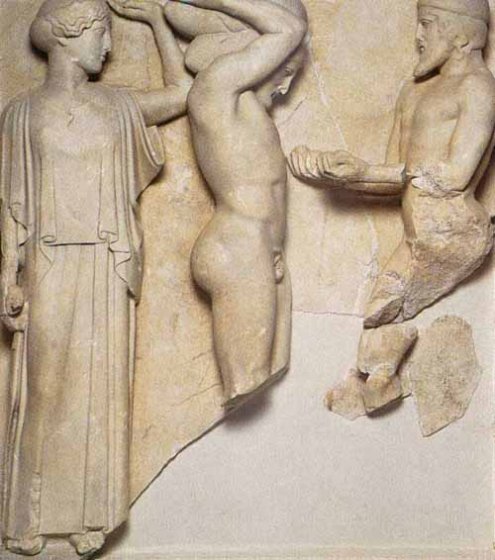
Heracles and Atlas

Heracles and Atlas (Athena on the left, again)
Metope from Zeus temple, c. 460 BC
Archaeological Museum, Olympia

On his journey, at the Caucasus Mountains, he killed the Caucasian Eagle that fed on Prometheus' liver and freed the Titan from his bonds. Prometheus told him that the tree and apples were guarded by Ladon, a dragon or serpent. The Titan advised him to let his brother Atlas fetch the apples, to avoid Ladon.

Heracles then continued his journey south, travelling through Phoenicia and Palestine. Heracles killed Busiris, king of Egypt, who was sacrificing foreign travellers. Some said that Heracles also killed Emathion, king of Arabia, son of Eos and Tithonus, and brother of Memnon.

In Libya, Heracles wrestled with and killed Antaeüs (Antaeus), the son of Poseidon and Gaea, who remained invincible as long as he had contact with the earth. Antaeüs would often let his opponent throw him on the ground, only to spring up, even stronger than before. Heracles had to keep Antaeüs off the ground before crushing his opponent to death.

Finally, he arrived where the Titan Atlas bore the weight of heaven on his shoulders. Heracles asked Atlas where the golden fruit were. Atlas told the hero that he would fetch the golden apples for him, if Heracles would carry heaven on his shoulders. Heracles agreed and carried the sky for Atlas.

Atlas returned with the apples, but did not want to bear the burden of heaven on his shoulders again, and told the hero that he would take the apples to Eurystheus for the hero, trapping Heracles into bearing the burden of heaven.

But Heracles was far cleverer than the Titan. Heracles cunningly told Atlas that he was willing to carry heaven, provided that the Titan would hold the heaven for a moment. Heracles told the Titan he wished to roll his lion cloak as a cushion for his shoulders. So while Atlas was holding the sky once again, Heracles walked away with the apples.

In another version of the story, Heracles actually went into the garden of the Hesperides and killed Ladon.

(In the Argonautica, not long after he left the Garden of Hesperides, the Argonauts arrived. Their ship, Argo, was stranded in the middle of the Libyan desert.

According to Apollonius of Rhodes, the Argonauts were running short of water. At the garden, the nymphs directed the Argonauts to where a spring sprouted from a boulder. Heracles had kicked the boulder, which split in half and fresh water gushed out from underneath the rock. Heracles had unknowingly saved his former comrades, the Argonauts, from dehydration.)

After showing the apples to Eurystheus in Tiryns, Heracles gave the apples to Athena, who returned them to the garden of Hesperides, since they really belonged to Hera.

Related Information

Sources

Library was written by Apollodorus.

Theogony was written by Hesiod.

Fabulae and the Poetica Astronomica were written by Hyginus.

Library of History was written by Diodorus Siculus.

Isthmian III-IV was written by Pindar.

Argonautica was written by Apollonius of Rhodes.

Related Articles

Atlas, Prometheus, Antaeüs, Eurystheus.

Hesperides, Ladon, Caucasian Eagle.

Argonauts.

Facts and Figures: Astronomy, see the constellations of Hercules, the Eagle and Draco.

Jimmy Joe Timeless Myths

By Jimmy Joe

Twelve Labours of Heracles:

  • • First Labour (Nemean Lion)
  • • Second Labour (Hydra)
  • • Third Labour (Cerynitian Hind)
  • • Fourth Labour (Erymanthian Boar)
  • • Fifth Labour (Stables of Augeias)
  • • Sixth Labour (Stymphalian Birds)
  • • Seventh Labour (Cretan Bull)
  • • Eighth Labour (Mares of Diomedes)
  • • Ninth Labour (Hippolyte's Girdle)
  • • Tenth Labour (Cattle of Geryon)
  • • Eleventh Labour (Apples of Hesperides)
  • • Twelfth Labour (Cerberus)
Hesperides

Hesperides

The Hesperides were nymphs who cared for and guarded the grove of trees that grow golden apples in the garden of Hesperides. The name means "Daughter of the Evening Star". There is some confusion over the number of nymphs there were. Some say ther...

August 31st, 2002 • Jimmy Joe
Ladon

Ladon

Ladon was the dragon with a hundred heads which guarded the golden apples of Hesperides. Ladon could also speak with countless different voices. Ladon was an offspring of Typhon and Echidna, or of Phorcys and Ceto. In his eleventh labour, Heracles...

June 1st, 2000 • Jimmy Joe
Twelve Labours of Heracles

Twelve Labours of Heracles

It would not make sense unless you read why Heracles had to perform his Twelve Labours. The Madness of Heracles was the origin of Heracles' great adventures that earned him a place among the immortal gods at Olympus. Madness of HeraclesMadness of ...

April 9th, 1999 • Jimmy Joe
Twelfth Labour (Cerberus)

Twelfth Labour (Cerberus)

For the twelfth labour, Heracles needed to go to Hades and fetch the Cerberus. Cerberus was a three-headed hound with a snake's head at the end of its tail. The dreaded hound guarded the gates of Hades, to keep the dead in the Underworld. Cerberus...

April 9th, 1999 • Jimmy Joe
Tenth Labour (Cattle of Geryon)

Tenth Labour (Cattle of Geryon)

For the tenth labour, Heracles was required to fetch the cattle of Geryon. Geryon (Γηρυονεύς) was the king of Erytheia (Cadiz), in Spain. The cattle were guarded by Geryon's herdsman and the two-headed hound called Orthus (Ὄρθρος). The journey was...

April 9th, 1999 • Jimmy Joe
Ninth Labour (Hippolyte's Girdle)

Ninth Labour (Hippolyte's Girdle)

The ninth labour required Heracles to go to the land of the Amazons to fetch Hippolyte's belt for Eurystheus' daughter, Admeta or Admete. Heracles either went there alone or with the heroes Theseus and Telamon (Τελαμών). The Amazon queen named Hip...

April 9th, 1999 • Jimmy Joe
Second Labour (Hydra)

Second Labour (Hydra)

For the second labour, Heracles had to kill the Hydra that lived by a spring near Lerna, Argolis. The Hydra was a creature that had many heads. The number of heads varied, depending on the author. Usually there were nine heads. One of the heads wa...

April 9th, 1999 • Jimmy Joe
Eighth Labour (Mares of Diomedes)

Eighth Labour (Mares of Diomedes)

The eighth labour was to fetch the flesh-eating mares of Diomedes. Diomedes (Διομήδης) was the king of the Bistones, in Thrace, who fed human flesh to his horses. Heracles threw Diomedes to the mares, and they killed and ate the king. There was a ...

April 9th, 1999 • Jimmy Joe
Third Labour (Cerynitian Hind)

Third Labour (Cerynitian Hind)

For the third labour, Heracles needed to fetch the Cerynitian hind that lived at Oinoe or the forest of Cerynitia, and was sacred to the goddess Artemis. The Cerynitian hind had golden antlers and brazen hooves. The Pleiad Taÿgete had given the hi...

April 9th, 1999 • Jimmy Joe
Atlas

Atlas

Titan. Atlas was the son of the Titan Iapetus by the Oceanid Clymene or Asia. He was the brother of Menoetius, Prometheus and Epimetheus. When his brother Prometheus tried to persuade him not to go to war against the Olympians, he did not listen. ...

April 19th, 1999 • Jimmy Joe
Timeless Myths

Exploring mythology and legends from around the world.

Explore Myths

All Stories Characters All Articles Search Site Map

Mythologies

Norse Mythology Classical Mythology Celtic Mythology Arthurian Legends Mythology Gods Ancient Literature

About Us

Introduction About Jimmy Bibliography FAQs Retro Version

Resources

Timeless Myths All Stories All Articles Characters
© 1999-2026 Timeless Myths • Copyright • Privacy Policy • Cookie Policy • Contact
Follow us: