Timeless Myths Logo

Explore myths and legends from cultures around the world

Featured

Classical Mythology
Classical Mythology Greek and Roman myths, gods, heroes, and epic tales
Norse Mythology
Norse Mythology Vikings, Asgard, Ragnarok, and the nine realms
Celtic Mythology
Celtic Mythology Irish, Welsh, and Gaelic legends and folklore
Ancient Literature
Ancient Literature Classical texts, translations, and literary analysis

All Mythologies

Arthurian Legends King Arthur, Camelot, the Round Table, and the Holy Grail Egyptian Mythology Pharaohs, pyramids, and ancient Nile deities Japanese Mythology Shinto gods, spirits, and legendary creatures Chinese Mythology Dragons, immortals, and celestial beings Aztec Mythology Mesoamerican gods, rituals, and creation myths

Discover gods and goddesses from every pantheon

Featured

Greek Gods
Greek Gods The Olympians, Titans, and primordial deities
Norse Gods
Norse Gods Odin, Thor, Loki, and the Aesir and Vanir
Egyptian Gods
Egyptian Gods Ra, Osiris, Isis, Anubis, and more
Japanese Gods
Japanese Gods Amaterasu, Susanoo, and Shinto kami

All Gods & Deities

Roman Gods Jupiter, Mars, Venus, and the Roman pantheon Celtic Gods The Tuatha Dé Danann and Celtic deities Aztec Gods Quetzalcoatl, Tezcatlipoca, and Aztec deities Chinese Gods Jade Emperor, Dragon Kings, and celestial beings View All 150+ Deities Browse the complete collection of mythological deities
View all gods & deities

Tales, legends, and character profiles from mythology

Featured

All Stories
All Stories Browse 800+ mythology and history stories
Characters
Characters Profiles of 67 mythological heroes, gods, and villains

All Stories

Mythology Stories Ancient myths and legends retold History Stories Historical tales from ancient civilizations Religion & Culture Religious traditions and cultural beliefs
View all stories

Tools, references, and site information

Featured

Name Generators
Name Generators Generate fantasy and mythology-inspired names
All Articles
All Articles Browse 1,800+ articles on mythology and history

All Resources

About Timeless Myths Learn about this mythology resource Bibliography Sources and references used on this site FAQ Frequently asked questions Contact Get in touch with us
Search
Classical Mythology Greek and Roman myths, gods, heroes, and epic tales Norse Mythology Vikings, Asgard, Ragnarok, and the nine realms Celtic Mythology Irish, Welsh, and Gaelic legends and folklore Arthurian Legends King Arthur, Camelot, the Round Table, and the Holy Grail Egyptian Mythology Pharaohs, pyramids, and ancient Nile deities Japanese Mythology Shinto gods, spirits, and legendary creatures Chinese Mythology Dragons, immortals, and celestial beings Aztec Mythology Mesoamerican gods, rituals, and creation myths Ancient Literature Classical texts, translations, and literary analysis
Greek Gods The Olympians, Titans, and primordial deities Roman Gods Jupiter, Mars, Venus, and the Roman pantheon Norse Gods Odin, Thor, Loki, and the Aesir and Vanir Egyptian Gods Ra, Osiris, Isis, Anubis, and more Celtic Gods The Tuatha Dé Danann and Celtic deities Aztec Gods Quetzalcoatl, Tezcatlipoca, and Aztec deities Japanese Gods Amaterasu, Susanoo, and Shinto kami Chinese Gods Jade Emperor, Dragon Kings, and celestial beings View All 150+ Deities Browse the complete collection of mythological deities View all gods & deities
All Stories Browse 800+ mythology and history stories Characters Profiles of 67 mythological heroes, gods, and villains Mythology Stories Ancient myths and legends retold History Stories Historical tales from ancient civilizations Religion & Culture Religious traditions and cultural beliefs View all stories
Name Generators Generate fantasy and mythology-inspired names All Articles Browse 1,800+ articles on mythology and history About Timeless Myths Learn about this mythology resource Bibliography Sources and references used on this site FAQ Frequently asked questions Contact Get in touch with us
Search Search the entire mythology archive
  1. Classical Mythology
    Pantheon Heroic Age Royal Houses Geographia Facts & Figures Genealogy Bibliography About Classical Myths
  2. Heroic Age
    Heroes 1 Heroes 2 Heroines Amazons Perseus Theseus Heracles Argonauts Calydonian Boar Hunt Seven Against Thebes Trojan War Odyssey Aeneid Tales of Lovers Giants Centaurs Mythical Creatures
  3. Heracles
    Birth & Early Life Twelve Labours of Heracles Later Life
  4. Twelve Labours of Heracles
    First Labour (Nemean Lion) Second Labour (Hydra) Third Labour (Cerynitian Hind) Fourth Labour (Erymanthian Boar) Fifth Labour (Stables of Augeias) Sixth Labour (Stymphalian Birds) Seventh Labour (Cretan Bull) Eighth Labour (Mares of Diomedes) Ninth Labour (Hippolyte's Girdle) Tenth Labour (Cattle of Geryon) Eleventh Labour (Apples of Hesperides) Twelfth Labour (Cerberus)
  5. Fifth Labour (Stables of Augeias)
    Fifth Labour (Stables of Augeias)

Fifth Labour (Stables of Augeias)

Angry at Heracles for running off seeking new adventure with the Argonauts, Eurystheus decided that the fifth labour would be the most humiliating of his tasks: cleaning the Augeian stables in a single day.

Augeias was the king of Elis, and he owned the largest herd of cattle. Heracles wanted a tenth of the cattle as payment for cleaning the stables. Augeia readily agreed, not believing that it was possible to do so in a single day.
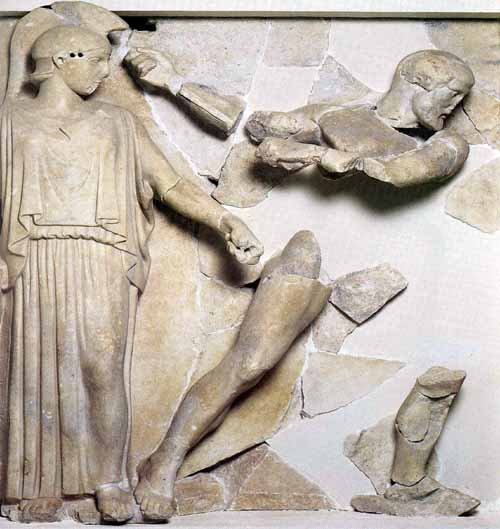
Heracles cleaning Augeias' Stables

Heracles cleaning Augeias' Stables (Athena on the left)
Metope from Zeus temple, 460 BC
Archaeological Museum, Olympia

The task was enormous, because of the number of stalls of the stable, as well as the sheer size of the building. Heracles completed this task by diverting the water on the rivers Alpheius and Peneius to flow through the stables.

However, Augeias refused to honour his bargain, because the king had found out that the hero was performing one of the labours for Eurystheus. Only Phyleus, Augeias' eldest son, supported Heracles, asking his father to not break his promise to the hero. Augeias angrily banished his son from Elis. Phyleus left the city of Elis and settled in Dulichium.

Angry at being cheated of his payment that was promised to him, Heracles vowed to make war upon Elis when he was released from his services with Eurystheus. Augeias, realising that he had made a powerful enemy, allied himself with the general Amarynceus and the Moliones, Augeias' nephews. See the Wars in the Peloponnesus.

Again, Eurystheus refused to count this as a labour. Eurystheus told Heracles that he must do any labour without payment. Therefore, Heracles had to do another extra task.

Dexamenus, king of Olenus (in Arcadia or Achaea?), entertained Heracles as his guest. While he was at court in Olenus, the Centaur Eurytion tried to force Mnesimache, daughter of Dexamenus, to marry him. Heracles repaid his host by killing Eurytion.

Related Information

Sources

Library was written by Apollodorus.

Description of Greece was written by Pausanias.

Argonautica was written by Apollonius of Rhodes.

Related Articles

Augeias, Eurystheus.

Centaurs, Eurytion.

Argonauts. Wars in the Peloponnesus.

Jimmy Joe Timeless Myths

By Jimmy Joe

Twelve Labours of Heracles:

  • • First Labour (Nemean Lion)
  • • Second Labour (Hydra)
  • • Third Labour (Cerynitian Hind)
  • • Fourth Labour (Erymanthian Boar)
  • • Fifth Labour (Stables of Augeias)
  • • Sixth Labour (Stymphalian Birds)
  • • Seventh Labour (Cretan Bull)
  • • Eighth Labour (Mares of Diomedes)
  • • Ninth Labour (Hippolyte's Girdle)
  • • Tenth Labour (Cattle of Geryon)
  • • Eleventh Labour (Apples of Hesperides)
  • • Twelfth Labour (Cerberus)
Augeias

Augeias

Augeias (Αὐγείας), the son of Phorbas, the Lapith chieftain, and of Hyrmina, the daughter of Epeius. Augeias was also called the son of the sea god Poseidon or of the sun god Helius. Augeias was the brother of Actor and Tiphys. Apollonius of Rhode...

May 12th, 2001 • Jimmy Joe
Fourth Labour (Erymanthian Boar)

Fourth Labour (Erymanthian Boar)

For the fourth labour, Heracles needed to fetch Erymanthian Boar. On this trip, he visited a Centaur named Pholus, who lived in Mount Pholoë (Pholoe), which was named after the Centaur. Pholus had some wine with odour to attract the boar. Unfortun...

April 9th, 1999 • Jimmy Joe
Eighth Labour (Mares of Diomedes)

Eighth Labour (Mares of Diomedes)

The eighth labour was to fetch the flesh-eating mares of Diomedes. Diomedes (Διομήδης) was the king of the Bistones, in Thrace, who fed human flesh to his horses. Heracles threw Diomedes to the mares, and they killed and ate the king. There was a ...

April 9th, 1999 • Jimmy Joe
Tenth Labour (Cattle of Geryon)

Tenth Labour (Cattle of Geryon)

For the tenth labour, Heracles was required to fetch the cattle of Geryon. Geryon (Γηρυονεύς) was the king of Erytheia (Cadiz), in Spain. The cattle were guarded by Geryon's herdsman and the two-headed hound called Orthus (Ὄρθρος). The journey was...

April 9th, 1999 • Jimmy Joe
Erymanthian Boar

Erymanthian Boar

The Erymanthian Boar was the giant wild boar that roamed around Mount Erymanthus, in northern Arcadia. Heracles captured the boar when he trapped it in the snow for his fourth labour. Since the boar was still alive, Eurystheus cowardly hid inside ...

June 1st, 2000 • Jimmy Joe
Seventh Labour (Cretan Bull)

Seventh Labour (Cretan Bull)

For the seventh labour, Heracles needed to fetch the Cretan Bull, the bull that belonged to Minos, king of Crete. This bull was sacred to Poseidon, and had the ability to walk and even run on the surface of the sea. When Minos gained the bull from...

April 9th, 1999 • Jimmy Joe
Sixth Labour (Stymphalian Birds)

Sixth Labour (Stymphalian Birds)

For the sixth labour, Heracles was required to chase away Stymphalian Birds that were ravaging the countryside around the lake called Stymphalus, in north-eastern Arcadia. The Stymphalian birds were so numerous that Heracles was at a loss on how t...

April 9th, 1999 • Jimmy Joe
First Labour (Nemean Lion)

First Labour (Nemean Lion)

The first labour required Heracles to kill the Nemean Lion. The lion was invulnerable to all weapons, being an offspring of the monsters Orthus and Echidna. Heracles stayed at Cleonai with a labourer by the name of Molorchus, before heading out to...

April 9th, 1999 • Jimmy Joe
Twelve Labours of Heracles

Twelve Labours of Heracles

It would not make sense unless you read why Heracles had to perform his Twelve Labours. The Madness of Heracles was the origin of Heracles' great adventures that earned him a place among the immortal gods at Olympus. Madness of HeraclesMadness of ...

April 9th, 1999 • Jimmy Joe
Second Labour (Hydra)

Second Labour (Hydra)

For the second labour, Heracles had to kill the Hydra that lived by a spring near Lerna, Argolis. The Hydra was a creature that had many heads. The number of heads varied, depending on the author. Usually there were nine heads. One of the heads wa...

April 9th, 1999 • Jimmy Joe
Timeless Myths

Exploring mythology and legends from around the world.

Explore Myths

All Stories Characters All Articles Search Site Map

Mythologies

Norse Mythology Classical Mythology Celtic Mythology Arthurian Legends Mythology Gods Ancient Literature

About Us

Introduction About Jimmy Bibliography FAQs Retro Version

Resources

Timeless Myths All Stories All Articles Characters
© 1999-2026 Timeless Myths • Copyright • Privacy Policy • Cookie Policy • Contact
Follow us: