Who Are the Achaeans in the Odyssey: The Prominent Greeks
Who are the Achaeans in the Odyssey, this is a question to ask as a reader, the Achaeans play an exciting part in the life of the ancient Greeks. Through this article, you can also discover the answer to the questions, who are the Achaeans in the Iliad, and who are the Danaans in the Iliad. Doesn't that sound so interesting? Continue reading to learn more about the life of the Achaeans in the Odyssey.
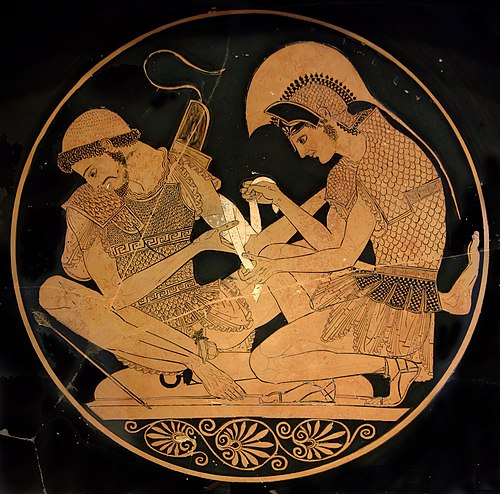
Achilles and Patroclus
The Achaeans
Achaean meaning in Greek is Achaios, which refers to any of the native Greeks identified by the legendary Homer, along with the Danaans and Argives in the Odyssey. Interestingly, some resources state that even if these three terminologies are the same in meaning, they still manifest differences, especially the Achaeans vs Danaans.
Origins
The word Achaean originated from Achaeus meaning one of the ancestors of the Greeks. In Euripides' play, he wrote that anyone who will call him by his name (Achaeus) will be portrayed to have his name.
Many Archaeologists seek evidence that can prove that the Trojan War occurred. It has also happened that the term "Ahhiyawa" from the Hittites is highly similar to the word "Achaean."
The people of Ahhiyawa were said to live in western Turkey, and many Greeks turned out to occupy the land of western Turkey as well during those times, of course. Meanwhile, there was a recorded conflict between the people of Ahhiyawa and the people of Anatolia. In addition to this, there are some believe that this incident was probably the so-called Trojan War.
In the Odyssey
The Achaeans generally refer to the ancient Greeks who lived in the region of Achaea, as mentioned. However, the famous Greek Author, Homer, used the terms Achaeans, Danaans, and Argives in his epic Iliad and Odyssey to describe them, which means they all refer to the same people. However, there has been no agreement or common ground among scholars about whether Homeric Achaeans were really connected to the ancient Greeks.
In the Iliad
The legendary author Homer described this civilization in his famous piece, the Iliad 598 times, the Danaans 138 times, and the Argives 182 times. In addition to that, there were two other terminologies mentioned once in Homer's epic: the Panhellenic and the Hellenes.
Herodotus identified them as descendants of Homeric Achaeans in the Iliad. The Archaic and Classical periods of Greece used the term Achaeans to refer to the group of people in the region of Achaea. However, some writings of Pausanias stated that Achaeans initially referred to the people residing in Laconia and Argolis.
Both Pausanias and Herodotus narrated that during the Dorian invasion, the Dorians forced the Achaeans to flee their homelands and then later moved into a new land called Achaea.
The Greek's Association
The Greeks were called Achaeans because of the belief that these groups of people from ancient Greece were the descendants of Achaeus, the father of all Greeks and Hellen grandson.
Some beliefs also stated that Achaeans were associated with Ahhiyawa, Ekwesh or Eqwesh, and Mycenaean. The term Achaeans was used in general to describe the ancient Greeks and was supposed to be reserved only for the specific region of Achaea in the north-central area of the Peloponnese that later on formed an alliance called the Achaean League.
However, in Greek mythology, their ethnicity is determined based on their ancestors as a show of their respect: Achaeus of the Achaeans, Cadmus of the Cadman's, Danaus of the Danaans, Aeolus of the Aeolians, Hellen of the Hellenes, Dorus of the Dorians, and Ion of the Ionians. Among these groups, the Hellenes were the strongest.
Ahhiyawa
A Swiss Hittitologist named Emil Forrer directly associated Achaeans with the "Land of Ahhiyawa" in the Hittite texts. Some of the Hittite texts that were mentioned were the existence of the nation called Ahhiyawa and the earliest letter of treaty violations of King Maduwatta, which is called Ahhiya.
Some scholars debated the exact relation between the terms Ahhiyawa and Achaeans, and in 1984, Hans G. Guterbock concluded the earlier debates. The material pieces of evidence and readings of ancient Hittite texts led to the conclusion that Ahhiyawa was associated with the Mycenaean civilization.
Ekwesh
It was suggested that the Egyptian records of Ekwesh may be related to Achaea, similar to how the Hittite records are linked with Ahhiyawa.
A confederation that includes Libyan and northern peoples is supposed to have attacked the western delta during Pharaoh Merneptah's fifth year as a ruler. However, it is key to know that among the invaders are the Ekwesh or Eqwesh, who are believed to be the Achaeans, themselves.
The Trojan War
The Trojan War is described as the conflict between two different parties: the people of Troy and the Greeks. This story is one of the most famous ones in Mythology.
It was Agamemnon, the brother of Menelaus, who led the Achaeans' Trojan War. The conflict started after Helen was abducted by a Trojan Prince named Paris. Helen was known to be the wife of the Spartan leader Menelaus. The Trojans disregarded the request for Menelaus to return his wife, so the conflict between the two sides ignited.
Unfortunately, after the war, some of the Achaean heroes were not able to return to their families, and this is how civilization is mentioned. They died, and some of them found a new community outside the Greek territory. According to the Latin author Hyginus, the battle of Troy lasted for ten years and resulted in the killings of many Achaeans and Trojans. The level of damage and destruction was so high after the Trojan war.
Victory
Menelaus encouraged his brother Agamemnon to command an army of his men to attack Troy. Many of the troopships led by the greatest Greek heroes like Achilles, Odysseus, Diomedes, Nestor, and Patroclus gathered around Aulis. Other great warriors such as Ajax, also gathered at Aulis along with the Greek heroes.
Agamemnon sacrificed his own daughter to Artemis for them to gain favorable winds throughout their journey. The winds then favored Agamemnon's side as they set sail to Troy. The Greeks proceeded to ravage the surroundings, cities, and countryside of Troy for nine years. However, the city managed to withstand these attacks for it was fortified by Hector and men from the royal household of Troy.
The people then pretended to sail away from Troy, in this army were plenty of achaeans warriors and fighters who were part of the scheme to build a large wooden horse that will allow them to sneak inside the city walls of Troy. Only a small group of the Greeks' greatest warriors was concealed inside the hollow wooden horse, and they were loyal to help them in the war.
At night, the Greeks invaded the city walls of Troy and ravaged the city. The gods found the war interesting and picked sides to provide their aid. Athena, Hera, and Poseidon favored the Greeks, whereas Ares and Aphrodite sided with the Trojans. Although Apollo and Zeus are known to frequently join wars, they remained neutral throughout the Trojan war.
Odysseus, the king of Ithaca, was known for his cunning skills, and he used them because they were ready to fight and sacrifice themselves during the war until they finally won them.
Achaean League
The Achaean League was the greatest alliance of Greek territories and states. According to Homer's epic The Iliad and The Odyssey and other ancient resources, the Achaean League included the following:
Mycenae under the leadership of King Agamemnon
Sparta under the leadership of King Menelaus
Ithaca under the leadership of Laertes and, later on, his successor Odysseus
It was c. 281 BCE in Achaea, Greece when the Achaean League was established by the 12 different city-states. Later on, this confederation grew the most, especially when Sicyon joined the league until the membership covered the whole of Peloponnese.
FAQ
Are Achaeans, Danaans, and Argives the same?
Yes, these are the terms used by Homer in his epic The Iliad and The Odyssey to refer to the ancient Greeks. They might be different in terms, but they all have the same meaning.
Conclusion
The Achaeans in the Odyssey were widely portrayed in the epic, The Iliad and The Odyssey. This is another portrayal of how Greek myth has widely appeared in ancient history. Let's find out how these representations are portrayed in the eyes of many. Let's sum up everything that we covered.
The Achaeans, Danaans, and Argives are different terminologies but have the same meaning. They are referring to the ancient Greeks.
The epic of Homer, The Iliad and The Odyssey, played an important role in Greek mythology, in particular to the Achaeans.
The Achaeans, Danaans, and Argives were also associated with some other terminologies, such as Ahhiyawa and Ekwesh.
The Achaeans won the war over Troy during the Trojan War that lasted for over ten years.
The Achaeans, later on, established an alliance that they called the Achaean League.
The Achaeans in the Odyssey represented the ancient Greeks, and their story is intriguing, with some questioning the details presented by Homer in his epic The Iliad and The Odyssey. However, one thing is for sure; the ancient life of the ancient Greeks was amazing.