Charybdis in the Odyssey: The Unquenchable Sea Monster
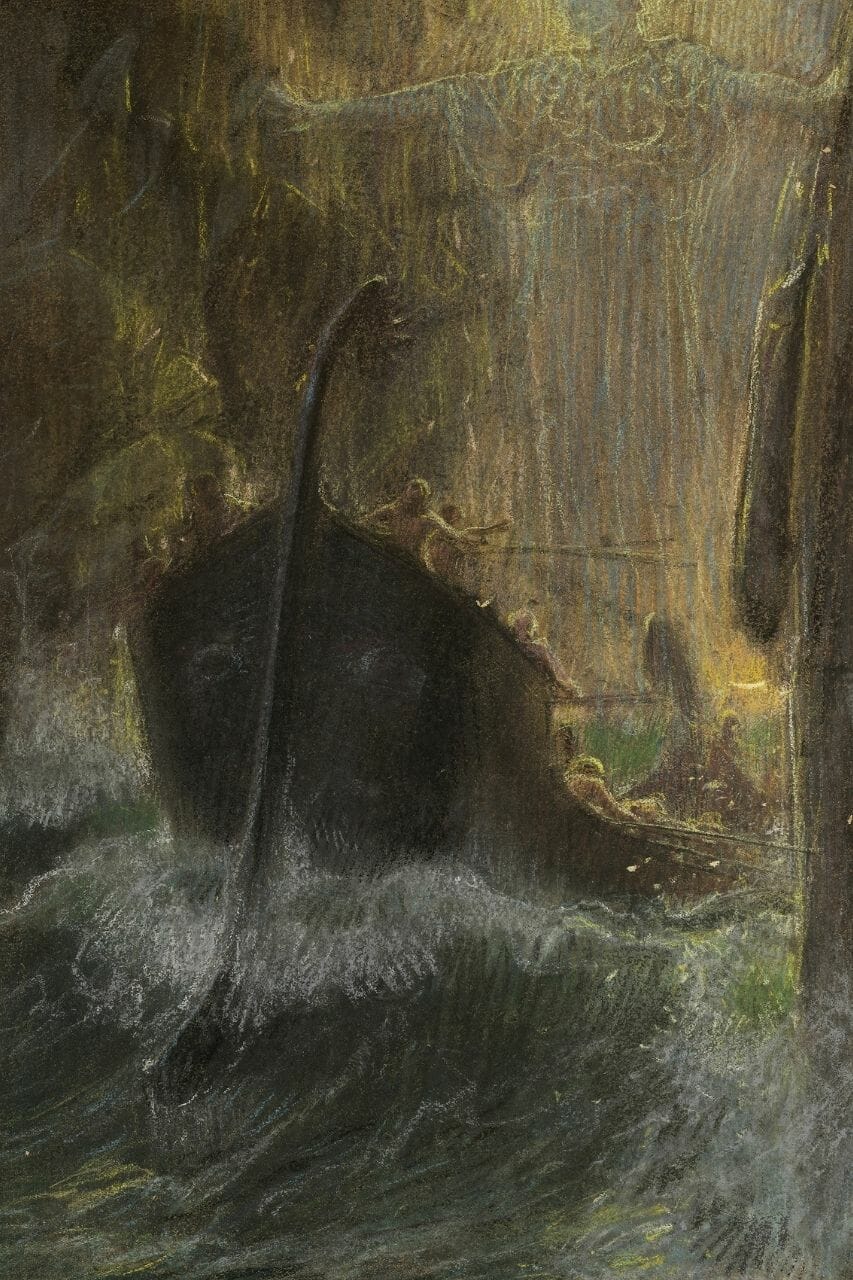
Charybdis, the deadly sea monster from the Odyssey
Charybdis in the Odyssey is one of the most remarkable creatures in The Odyssey. This story in Greek mythology tells of the struggles of Odysseus while on his journey home from the Trojan War. Charybdis is often described as a sea monster that can swallow a huge amount of water and then belch it back out again.
Referred to as a "she" monster, many men avoid passing through the channel in which she dwells with another sea monster, Scylla. Read more about the Charybdis and Scylla in this story about Odysseus' journey.
Who Is Charybdis in the Odyssey?
Charybdis pronunciation is Ke-ryb-dis, aided by her father in his feud with his brother Zeus by engulfing the land and islands with water. As Zeus was angered by the amount of land Charybdis stole, so he cursed her by chaining her to the sea bed and turning her into a hideous monster. In another tale, Charybdis was once a voracious woman who stole the cattle of Heracles. Because of this, the god of thunder, Zeus, cast her out into the sea with a bolt of thunder.
Furthermore, Zeus also cursed her with an eternal uncontrollable and unquenchable thirst for the sea. Thus, she drinks three times a day, and this action creates a gigantic whirlpool in the sea.
Charybdis and Scylla in the Odyssey
After passing through the sirens' island, Odysseus and his men had to go through the strait between the lairs of the sea monsters Charybdis and Scylla. When you think about it, passing through a narrow channel flanked by two hideous monsters seemingly presents a zero chance for Odysseus and his crew to survive.
However, Circe has given Odysseus some useful instructions. She said that he had to choose which monster to face between Scylla and Charybdis. She recommended that Odysseus choose Scylla over Charybdis.
This instruction was so hard for Odysseus to follow as it meant that he had to sacrifice some of his men. Nevertheless, Odysseus saw it as a better plan and came to conclude that it is indeed better to lose six men than to lose his life with his entire crew.
The entire crew held their course tight against the cliffs of Scylla's lair, avoiding Charybdis. As Odysseus and his men were busy staring at the other side of the strait, Scylla lunged at them quickly and gobbled up the six sailors who accompanied Odysseus.
Arrival in Thrinacia
Odysseus arrived in Thrinacia and instructed his men to heed Circe's warning not to kill any cattle while they were staying on the island. Thrinacia was a temptation island, and their greatest test was to resist the temptation to harm the sacred cattle of the god of the sun. Months later, Eurylochus, the second in command of Odysseus' crew, said it is better to die at sea from the wrath of the gods than to die of hunger. The men bountifully grilled and ate the cattle. Their actions caused Helios, the god of the sun, to be furious.
How Odysseus Escape Charybdis the Second Time
When Helios found out about what they did, he asked Zeus to punish Odysseus and his men. The crew continued their journey, but Zeus conjured a storm that destroyed the entire ship and sent the crew to their death beneath the waves. As foretold, Odysseus remained alive but was stranded on a raft. The storm swept him all the way back to Charybdis, but he survived by clinging to a fig tree growing on the rock over her lair.
The next time Charybdis belched out the water, the raft was thrown back out, and Odysseus recovered it and paddled quickly away to safety. Ten days later, he reached Ogygia, Calypso's island.
Where else was Charybdis mentioned?
Charybdis was mentioned in Jason and the Argonauts, who were able to pass through the strait with the help of the goddess Hera. She was also mentioned in the Book three of The Aeneid, a Latin epic poem written by Virgil.
What Are the Drifters in the Odyssey
In book 12, Circe told Odysseus to choose between the two paths that they can traverse for his journey back home. First was the Wandering Rocks or what was also called the Drifters. In this area, the sea was merciless and violent, and the rocks were so big and destructive that they could smash ships. Whatever remains will be scattered by the sea or destroyed by flames. The second was the channel between Charybdis and Scylla, which was the path that Circe recommended. Odysseus thought that the sacrifice of some will justify the salvation of others.
Characteristics of Charybdis and Scylla
Charybdis and Scylla respectively originated from the Greek names Kharybdis and Skylla, which literally mean "a giant whirlpool" and "tear, rip, or smashed to pieces."
Charybdis and Scylla are not sisters; however, they were both former water nymphs who were cursed by the gods. Charybdis was the daughter of Poseidon and Gaia, whereas Scylla is known to be the daughter of Phorcys, a primordial sea god. However, her father may have also been Typhon, Triton, or Tyrhennius, all figures related to the sea. Scylla's mother was Keto (Crataiis), a goddess of dangers at sea.
They could not have been on good terms, as some stories held that Scylla in the Odyssey was cursed by one of the consorts of Charybdis' father, Poseidon, turning her into a monster.
Scylla and Charybdis were known as mythical monsters dwelling on opposite sides of a strait of water. Many scholars generally agree that the real-life location of the strait is the Strait of Messina, the narrow body of water between Sicily and the Italian mainland.
Charybdis vs Scylla
Both are hideous man-eating monsters, but based on the ancient text, Circe instructed Odysseus that it is much better for a few crew members to be eaten than for the entire crew to be engulfed and destroyed by Charybdis. Should they have confronted Charybdis, the aftermath will be that every human being passing through the strait perishes, and even the ship they are using will be obliterated.
What Is The Meaning of Choosing Between Scylla and Charybdis?
The meaning of choosing between Scylla and Charybdis is characterized as choosing "between the devil and the deep blue sea," "to be caught between a rock and hard place," or "to be caught between equally unpleasant alternatives." This is because choosing either one of them would be dangerous, unpleasant, and risky.
The Relationship Between Lastrygoneans and Charybdis
Laestrygonians were present in Book 10 of The Odyssey. They are man-eating giants thought to be the offspring of Poseidon's son, Laestrygon, or descendants of Poseidon and Gaia. Laestrygonians and Charybdis might be related because they came from Poseidon and Gaia and their nature of eating people and wrecking things as monsters.
FAQ Section
Was it Right for Odysseus to Sacrifice Six of his Crew Members?
The complex decision Odysseus faced while trying to continue their voyage home gave rise to the ethical issue of whether it was right to sacrifice his six crew members without telling them that rowing hard to get away from Charybdis will end their lives helplessly.
Greek mythical culture might not have ethical guidelines, but this choice follows the universal concept that the end justifies the means. It could be unfair or wrong, but it is fine as long it is done for the greater good and the best possible outcome. This decisive approach is not uncommon, especially in Greek mythology and literature.
In What Book Can Charybdis Be Seen in The Odyssey?
Charybdis and Scylla can be seen in Books 12 to 14 of Homer's "The Odyssey". These books describe where Odysseus and his crew remained for a night with Circe and detail the ordeals they will be going through and the actions they should take on the journey.
Conclusion
In Odysseus' journey, his need to choose between Scylla and Charybdis can be likened to the idiom of being caught "between a rock and a hard place" or "between the devil and the deep blue sea." This means that both monsters are equally dangerous and can inevitably lead to death.
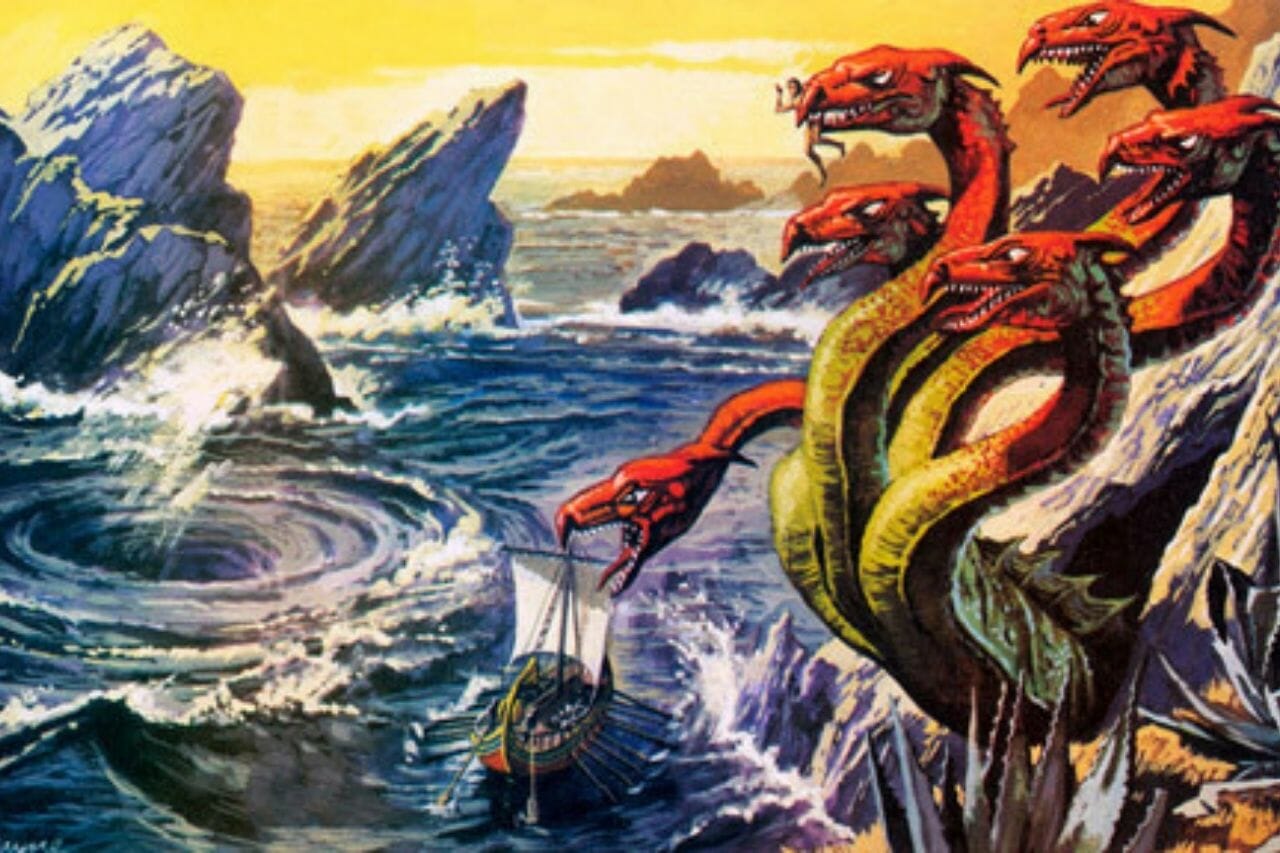
The monsters Scylla and Charybdis threatened all who passed through the strait
Below, you can find some important information that you need to remember about Scylla and Charybdis in the Odyssey:
Charybdis was once a nymph cursed by Zeus due to her intervention in Poseidon and Zeus' feud.
Scylla was a fair nymph cursed by Circe and turned into a half-human and half-monster with six long, scrawny necks.
Charybdis and Scylla lived on opposite sides of a strait of water, and men choosing which to face between them will inevitably fall to their own demise.
The curse placed upon them made Charybdis and Scylla monsters in both appearance and behavior. The sin that they committed may or may not justify the punishment given to them. However, the gods of Greek mythology continue to reign supreme, and their will is imposed upon them.