Patrick the Red, Son of King Arthur

Patrick the Red is an obscure character from the legends of King Arthur. He only appears in a single source, which itself is very obscure. Nonetheless, there are a lot of interesting things that could be said about him. Can he be connected to any historical figure, or at least someone who appears in earlier records?
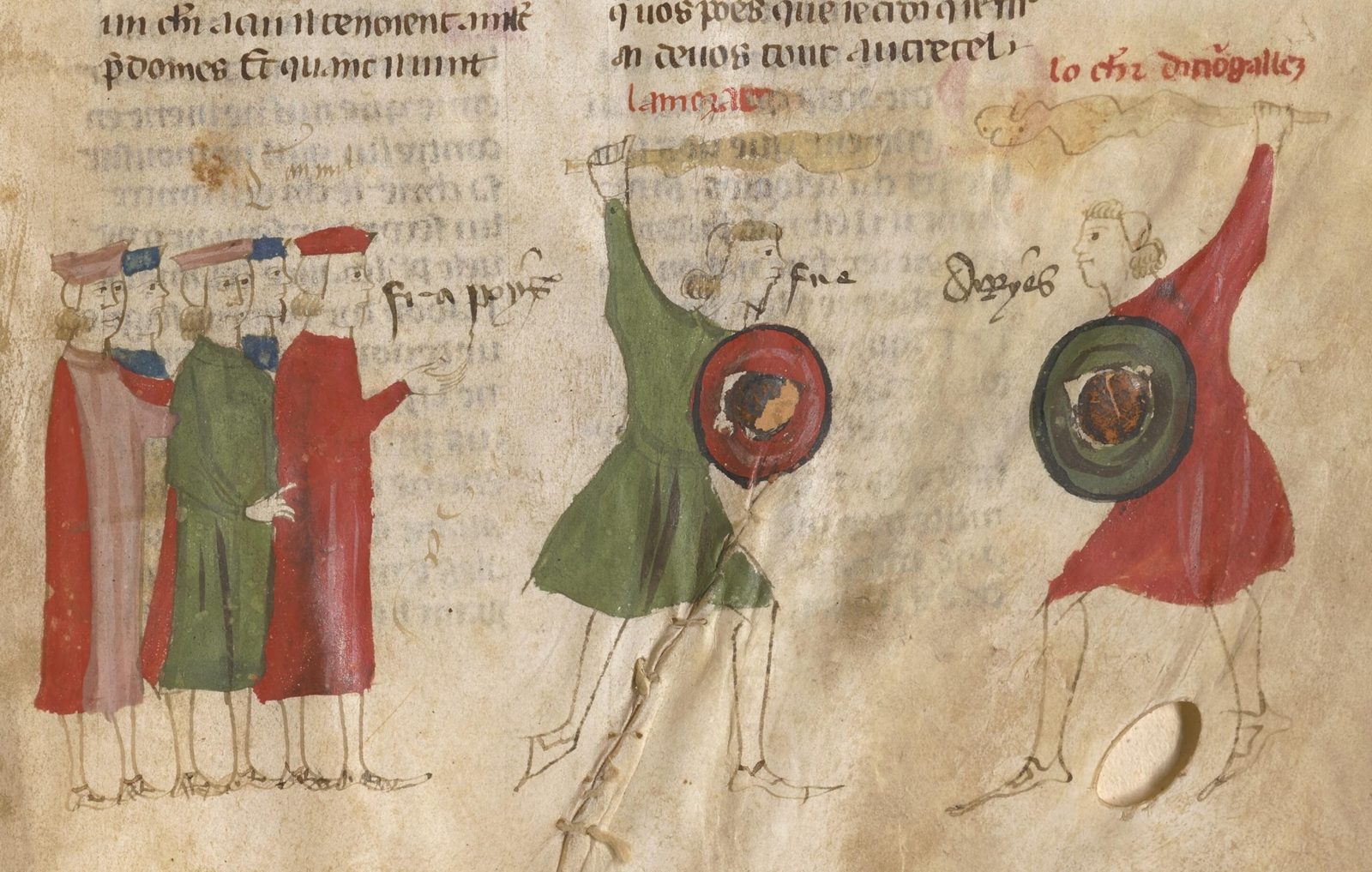
Who Was Patrick the Red?
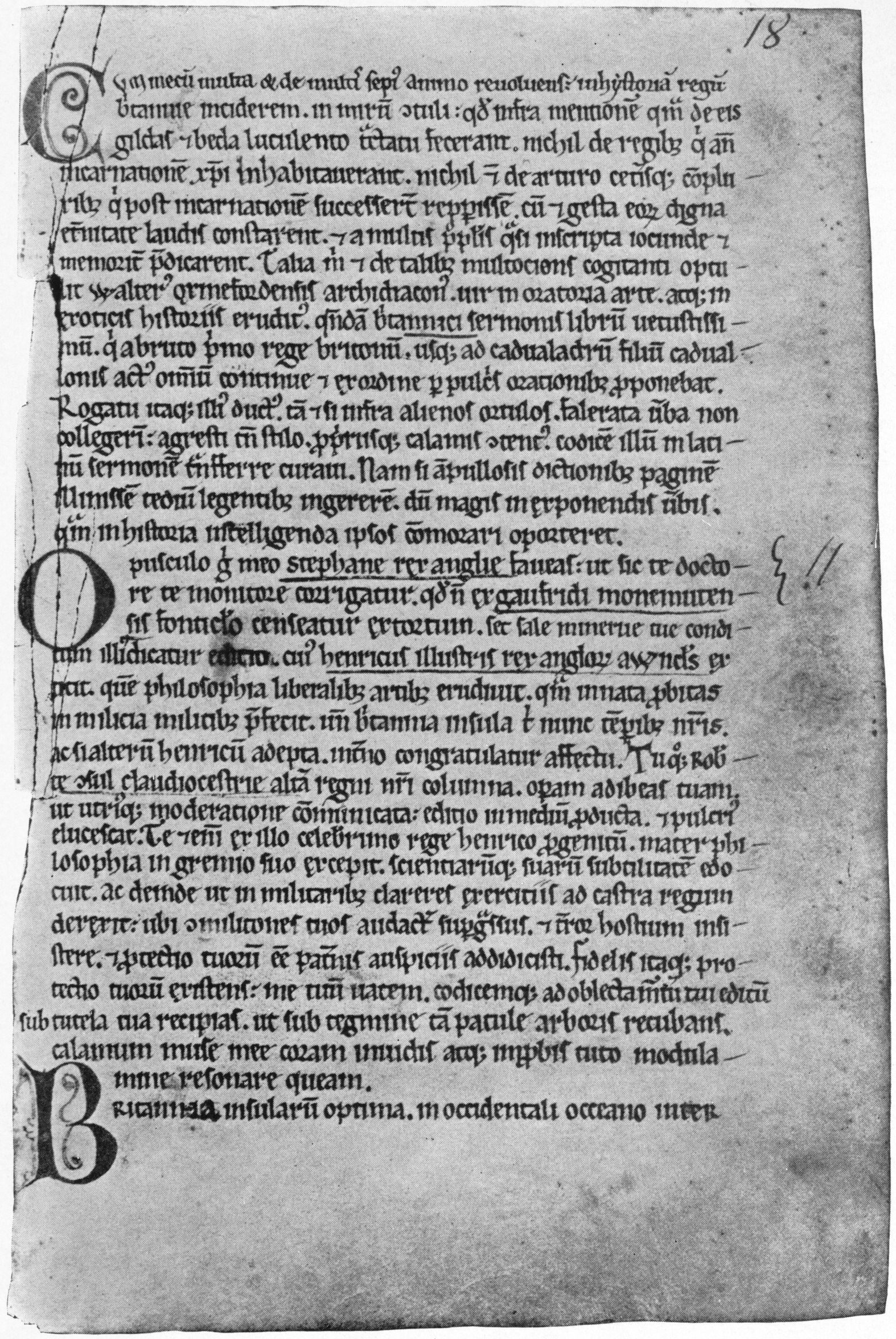
Patrick the Red is recorded as the son of King Arthur. He only appears in a single source, which is called Le Petit Bruit. This was written in the year 1309 by a man named Ralph de Bohun. His name is also written as Rauf de Boun.
While Patrick the Red is only known from this work by Ralph, we know that Ralph did not invent him. In reality, Le Petit Bruit is a summary of a larger chronicle which is now entirely lost to us outside of Ralph’s abbreviation of it.
We do not know exactly how far back the tradition about Patrick goes. However, since Ralph’s abbreviation was written right at the start of the fourteenth century, it is likely that we can put this tradition in the thirteenth century if not earlier.
Family
Ralph’s Le Petit Bruit presents King Arthur as having three sons. All of them were born from an unnamed Fairy Queen, who may or may not be intended to be identical to Guinevere.
The three sons were named Adeluf III, Morgan the Black, and Patrick the Red. It is interesting that Morgan and Patrick are both associated with colours, while Adeluf does not appear to have been. It is possible that this is simply due to the fact that Ralph’s account is abbreviated, and he just left out the detail about Adeluf’s colour.
On the other hand, and perhaps more likely, Adeluf was not associated with a colour because he already had a different epithet, which was ‘the Third’. He was called this because he had two recent ancestors with that same name.
Adeluf is explicitly described as the eldest, while Morgan is not only described as the second son but is also described as Arthur’s favourite. In comparison, Patrick is not given much attention; he does not appear to have been especially important. Perhaps this was because he was the youngest and thus furthest from the throne.
Patrick the Red’s Kingdom
One interesting detail provided about Patrick is the fact that Arthur gave him Scotland to rule. In fact, Le Petit Bruit presents Arthur as ruling all of Britain and dividing it into three parts between his three sons.
Adeluf III is given England, Morgan the Black is given Wales, and Patrick the Red is given Scotland. Le Petit Bruit does not go into detail about how exactly this succession occurred – perhaps this was explained fully in the original, longer chronicle. Yet, it appears that these sons began their rule only after Arthur’s death. This is indicated by the fact that Ralph writes that Arthur gave Scotland to Patrick ‘as a heritage’, indicating that it would be received by him at some later point.
In any case, certainly by some point after Arthur’s death if not before, Britain is divided between these three sons. Patrick receiving Scotland may be associated with him being the youngest.
England was the largest part of the kingdom, so it makes sense that it was the inheritance of the eldest son. Wales, meanwhile, is described as being Arthur’s preferred location to live, thus making it logical as the inheritance of Morgan, Arthur’s favourite son. Yet there is nothing special to be noted in Le Petit Bruit about Scotland, which likely explains why it was left for Patrick, the youngest and apparently least important son.
Patrick’s Legacy
What came of Patrick’s rulership over Scotland? This is something that Le Petit Bruit touches on briefly. It says:
“His third son was Patrick the Red, to whom he gave the land of Scotland as a heritage, and in this manner he and his successors retained it for a long time, until the time of Athelstan the first, who conquered the whole of the lordship of Scotland and subjugated them under our rule forever.”
According to this brief summary, Patrick’s descendants continued ruling over Scotland for an unstated period of time. This dynasty continued until it was overthrown by Athelstan I. From that time on, it remained under the rule of the English.
Although this makes it sound as if Patrick’s descendants continued ruling Scotland for centuries (especially since Athelstan is most famously the name of a tenth century English king), a closer reading of Le Petit Bruit shows that this is not the case.
In fact, the Athelstan mentioned in this passage is elsewhere explicitly identified as the third son of Adeluf, the eldest son of Arthur. Thus, the conquest of Scotland cannot have occurred much more than several decades after Patrick himself received the kingdom.
Understanding the Chronology of Patrick the Red
Before we can understand the legacy of Patrick, we first need to understand when he was supposed to have lived. Le Petit Bruit does not explicitly tell us this, although it does provide some very helpful information in the context of Morgan, Patrick’s older brother.
What Le Petit Bruit tells us regarding Morgan is the following:
“Arthur dwelled with him for most of his life in the south of Wales where he had his son educated by Sir Gawain, who was his mentor at the time.”
According to this, Arthur’s son Morgan was educated by Gawain. This is most interesting, since we can confidently date Gawain to quite late into Arthur’s reign.
Geoffrey of Monmouth’s Date for Gawain
In his Historia Regum Britanniae, written in c. 1137, Geoffrey of Monmouth provides the earliest direct information for the date of Gawain. According to him, this figure (whom he calls Walgan) was twelve years old when he was sent to Pope Supplicius to be educated. Geoffrey places this event about twelve or thirteen years after the Battle of Badon.
A variety of records, such as the Annales Cambriae (a tenth century chronicle), place the Battle of Badon between twenty and twenty-two years before the Battle of Camlann, at which Arthur ‘fell’ (which does not necessarily mean that he died, although this was evidently very near the end of his reign).
If Gawain was born at around the time of the Battle of Badon or just a year or so before, then he would have been an adult essentially right at the end of Arthur’s reign and no earlier. This would mean, in turn, that he cannot have been in a position to educate any of Arthur’s sons until that time.
Since Gawain obviously would have educated someone much younger than him, this means that Morgan and therefore Patrick must have been born very late in Arthur’s life.
Based on Geoffrey’s chronology, this would place the birth of Patrick in the latter half of the sixth century. While it is true that Geoffrey places the death of Arthur in the year 542, this year is an outlier. All the other information he provides points to Arthur dying well into the latter half of the century.
For instance, Geoffrey places the death of Saint David in the reign of Constantine, King Arthur’s successor in the Historia Regum Britanniae. All other sources agree that David died in the end of the sixth century or even the beginning of the seventh.
Another example is that, earlier on, Geoffrey has David succeed Dubricius as the chief bishop of the Britons when Gawain was sent to Pope Supplicius. This succession event appears in other records and occurred at the Synod of Brefi, which occurred in around 560.
Thus, the evidence indicates that Geoffrey’s chronology makes Gawain a twelve-year-old in c. 560. This is consistent with his reference to Gawain being sent to Supplicius, which is likely a corruption of ‘Pelagius’, who served as pope between 556 and 561, with the prefix ‘escop’ (meaning ‘bishop’) attached to the beginning.
The Historical Date of Gawain
These dates are supported by what is known about Gawain historically. Although he himself was not definitely a historical figure, his family members are well established from other records. Gawain was the son of King Lot of Lothian, who appears elsewhere as Llew and Leudunus.
This was a mid- to late-sixth century king. His brother was Urien, another king who can be firmly dated to the mid- to late-sixth century. Gawain’s first cousin was therefore Owain of Rheged, definitely a late-sixth century figure.
Therefore, all the evidence agrees that Gawain was active in the late-sixth century.
What This Means for Patrick’s Chronology
The reason that establishing Gawain’s chronology is so important is that this has a major impact on our understanding of Patrick the Red. Since Gawain was the educator of Morgan, and Patrick was Morgan’s younger brother, this shows that Patrick must have been born well into the second half of the sixth century.
Exactly when he was supposed to have been born is unknown. Some time around 570 seems plausible in view of the aforementioned evidence.
If we assume that he died of old age, perhaps at the age of seventy, then the dates of his life can be placed broadly between 570 and 640. Of course, this is only approximate.
Understanding Patrick’s Legacy
This chronological information helps us greatly in terms of understanding what the origin of Patrick the Red may have been and how we can interpret the legacy ascribed to him in Le Petit Bruit.
However, another important piece of the puzzle is the information that Le Petit Bruit provides concerning Adeluf III’s descendants. As we saw earlier, Le Petit Bruit claims that Adeluf’s third son was Athelstan I, and this Athelstan conquered Scotland from the descendants of Patrick.
A fuller consideration of this issue is found on the article about Adeluf III himself, but to summarise, the evidence shows that King Arthur’s son Adeluf is largely derived from Athelfrith, the Northumbrian king who ruled from 593 to 616.
Adeluf’s four legendary sons can be shown to derive from four of the successors of Athelfrith. The first two sons correspond to Oswald and Oswiu, historical sons of Athelfrith. The third son, Athelstan I, must be Athelwald of Deira, historically a grandson rather than direct son of Athelfrith.
Le Petit Bruit explains that Athelstan was succeeded by Alfred. In this context, this must be the historical successor of Athelwald of Deira, another grandson of Athelfrith, this one named Alhfrith.
How Athelstan Conquered Scotland from the Successors of Patrick the Red
With these identifications in mind, how can we understand Ralph de Bohun’s account of Athelstan conquering Scotland from Patrick’s dynasty? By examining the historical activities of Athelwald (the figure behind Le Petit Bruit’s Athelstan I), this may help us to work out the historical origin of Patrick himself.
There are only really two events that Athelwald was involved in that may have led to this legend as recorded by Ralph de Bohun.
Successful Conquest of Deira
The first event is the fact that Athelwald took power in Deira apparently by force. Deira was one half of the kingdom of Northumbria, with the other half being Bernicia. It had been united under the rulership of Athelfrith. Oswald also ruled both halves of this kingdom.
However, after Oswald died, his brother Oswiu succeeded him only to the throne of Bernicia. Deira was taken by an outsider named Oswine. Eventually, Oswiu killed Oswine. Yet, Oswiu did not become the next king of Deira. Instead, his nephew Athelwald became king and is recorded as fighting against Oswiu.
This strongly suggests that Athelwald took Deira by force from Oswiu after the latter had killed Oswine. This apparent conquest of Deira by Athelwald could plausibly have led to the legend of ‘Athelstan I’ conquering Scotland.
Deira as Scotland
One obvious objection to this idea is that Deira is not Scotland. However, when we examine some other statements from medieval records about ancient and early Dark Age Britain, we can find a satisfying explanation for this.
For one thing, let it be noted that sometimes writers would exaggerate the extent or distance of a king’s territory. For example, Geoffrey of Monmouth refers to Urien Rheged as the king of Moreif, or Moray, which is in northeast Scotland, when he actually ruled a kingdom that straddled the border of Scotland and England.
However, perhaps even more significant than that is something else seen in Geoffrey’s Historia Regum Britanniae. In Book IV, he refers to the division of the island between three metropolitan dioceses. Regarding one of these, Geoffrey writes:
“To the metropolitan of York were subject Deira and Albania, which the great river Humber divides from Loegria.”
Notice how the kingdom of Deira is associated with Albania (Scotland) in being separated from the rest of the island by the Humber River. The Humber is regularly referred to as a great divider in the Historia Regum Britanniae, and this work also often depicts the land north of it, even before the actual border of Scotland, as being distinct and separate from the rest of Britain.
Therefore, it is entirely plausible that Athelwald’s successful conquest of Deira came to be remembered in exaggerated form as a conquest of Scotland.
Unsuccessful Conquest of Bernicia
Another possibility, although less likely, is that this legend has its origin in the fact that Athelwald attempted to defeat Oswiu of Bernicia, the kingdom to the north of Deira. Some historians suggest that he was hoping to capture Bernicia for himself and re-establish the kingdom of Northumbria.
This is preferable to the previous suggestion by virtue of the fact that Bernicia is further north than Deira. However, it is less likely due to the fact that this attempt to defeat Oswiu was unsuccessful, and it appears to have been well remembered as such.
Therefore, the first suggestion is far more likely to be correct. The original ‘Scotland’ of the story in Le Petit Bruit was very probably Deira, the kingdom immediately north of the Humber.
Did Patrick the Red Really Exist?
Now that we have established when Patrick would have lived and what the origin appears to be behind the legend that Athelstan I conquered his territory, this can help us to work out who he really was.
Based on the aforementioned information, it appears that we are looking for a figure who was active between c. 570-640 and was closely associated with the region of Deira. Can we identify such an individual from other records?
Padrig ap Alfryd
It appears that the only figure definitely recorded as having the name ‘Patrick’ (or the Welsh form thereof) in the sixth century was Padrig ap Alfryd. This individual lived in the late sixth century, although his exact dates are obscure because he himself is not very well attested.
Nonetheless, what little is known about his chronology appears to match the dates of Patrick the Red, son of King Arthur. His sister is recorded as marrying into the line of Urien Rheged and giving birth to a religious figure named Nidan. Since Nidan was the great-grandson of Urien, this would put Padrig in the same generation as the grandsons of Urien.
Therefore, Padrig would presumably have been born in approximately 570, exactly when Patrick the Red would have been born. This is the date given to Padrig’s birth by Peter Bartrum in his A Welsh Classical Dictionary.
However, there are two problems with this identification. The first is that there does not appear to be any particular association between Padrig and the region between the Humber and Scotland. Rather, Padrig was from a dynasty based in Northwest Wales, and he is associated with Llanbadrig in Anglesey in particular.
The second problem is that Padrig being the namesake of Llanbadrig suggests that he was a religious figure, not a king.
One of the Peredurs
In view of the evident fact that Le Petit Bruit uses loose approximations of names (such as ‘Athelstan’ for ‘Athelwald’), it is likely that the real origin behind Patrick the Red was a figure whose real name was a little bit more different.
The most likely solution for this is that it was one of the figures of this era named Peredur. This is made particularly likely by the fact that there was a Peredur recorded in medieval records as having the epithet ‘Goch’, which is the Welsh word for ‘Red’.
This is not to say that Peredur Goch was the real Patrick the Red, since he lived in the tenth century in Powys, Wales. However, there are many examples of epithets being accidentally applied to other figures who had the same first name. Therefore, it may be that this same epithet, ‘Goch’, was applied to one of the other Peredurs of the medieval era, such as one of those who better fits the profile of Patrick the Red.
Peredur ap Efrog
The most notable Peredur of the Arthurian era was Peredur ap Efrog. His father’s name, ‘Efrog’, is the Welsh name for the city of York. This was in the kingdom of Deira. Evidently, Peredur’s father was a king who ruled in the vicinity of York.
Peredur ap Efrog appears in various Arthurian sources. In more historically reliable sources, there are a number of references to a certain Peredur ap Eliffer. This historical figure was active in the mid-sixth century and died in c. 580. He was likely killed by a prince of Deira or Bernicia.
This places Peredur ap Eliffer in the right place to be Peredur ap Efrog. Further supporting this identification is the fact that Geoffrey of Monmouth mentions Peredur ap Eliffer as an ally of King Arthur, just as Peredur ap Efrog is his ally in other Arthurian sources.
Objections to This Identification
However, could this historical Peredur be the origin of Patrick the Red? Although this was a fairly prominent Peredur and he was definitely associated with the region of Deira, this does not seem very likely.
The main issue is that Peredur died in 580, meaning that his lifetime hardly overlapped at all with the expected lifetime of Patrick the Red, son of King Arthur. Remember, he would likely have been born around 570 based on the information provided in Le Petit Bruit.
Furthermore, it would seem very strange for Peredur to be presented in this way in Le Petit Bruit, since Peredur was a fairly prominent Arthurian character and was never presented as Arthur’s son. In fact, Sir Percival (the English version of the Welsh Peredur) appears in the account elsewhere as one of Arthur’s knights.
Thus, it does not appear that Peredur ap Efrog was the core origin of Patrick the Red.
Peredur of Catraeth, Relative of Rhydderch Hael
A less prominent Peredur – but one who is more chronologically plausible – is the one mentioned in the famous poem Y Gododdin. This was written in the early seventh century concerning the Battle of Catraeth, which battle occurred in c. 600.
Peredur receives only a fleeting mention in the poem, but he is described as one of the warriors who fought at Catraeth and was slain in that battle. This means that he must have been an adult, even if quite young, by the year 600.
There is a Peredur who appears in one medieval genealogy who chronologically fits as the Peredur of this poem. He is Peredur the son of Brwydr. This Brwydr was the son of a man named Gwyddien Astrus, who appears as a contemporary of Arthur (albeit in the form of a wolf due to his sins) in the Welsh tale Culhwch and Olwen. Therefore, Brwydr’s son Peredur would logically have been born towards the latter part of Arthur’s reign.
Furthermore, some versions of the genealogy of Brwydr contain the detail that two of his sons were mothered by Gwladus, the daughter of Rhydderch Hael. As it happens, Rhydderch Hael was one of the most prominent and powerful kings of the north in the late sixth century.
Although Peredur is not specifically described as the son of Gwladus, she is the only recorded wife of Brwydr. Thus, in the absence of other evidence, it is reasonable to propose that Peredur was the grandson of Rhydderch Hael. This would place his birth in perhaps 580, which allows him to be identified as the Peredur of Y Gododdin.
Objections to This Identification
Unfortunately, this theory is not without its problems either. For one thing, although this Peredur is associated with the north, it is arguable that he is actually too far north. In reality, we do not actually know where he lived. However, Rhydderch Hael ruled from Dumbarton Rock, which is near Glasgow in Scotland. This is very far from the Kingdom of Deira.
On the other hand, Catraeth is usually identified with Catterick in North Yorkshire. If this Peredur fought at Catraeth, then that would make him active in Deira, exactly where Athelwald conquered in the seventh century.
Perhaps more significant than this is that there is no evidence that he was a king, nor does he seem to have been very important. While the chronology essentially matches that of Patrick the Red, and the geography arguably matches, there is simply no basis for suggesting that this Peredur could have been remembered as the founder of a dynasty that ruled over Scotland after Arthur.
Speaking of Arthur, this identification would also offer no explanation for how this Peredur came to be remembered as one of Arthur’s sons.
Pedur ap Cadwy of Dumnonia
The most likely candidate for the historical origin behind Patrick the Red is a figure found in modern sources as Peredur ap Cadwy. In fact, his name is actually spelled ‘Pedur’ in the manuscript in which he appears, which is even closer to ‘Patrick’ than ‘Peredur’ is. It is assumed that this is a mistaken spelling for ‘Peredur’, although this is uncertain, as ‘Pedr’ is an attested name.
So, who was Pedur ap Cadwy? His father, Cadwy, was a prominent king of the large kingdom of Dumnonia. Therefore, Pedur was a high status prince of the era. In fact, his brother Constantine is the person who, according to Arthurian tradition (such as in Geoffrey’s Historia Regum Britanniae), succeeded Arthur as high king. Thus, Pedur was very high status indeed.
Year of Birth
Crucially, when did Pedur live? Well, we immediately get an indication of this from the fact that his brother Constantine succeeded Arthur. Pedur was therefore of the generation that flourished after Arthur’s reign.
The genealogical evidence, along with other tradition, indicates that Cadwy of Dumnonia was born around 532. Constantine, evidently his eldest son, would therefore have been born around 554. We do not know what the age difference between Constantine and Pedur was. However, Cadwy could reasonably have fathered him at any time from Constantine’s birth up until forty years of age. He may even have been older, although this is naturally unlikely.
This would place the birth of Pedur at some point between 555 and 572. This is broadly consistent (especially the upper end of this range) with the expected birth of King Arthur’s son Patrick the Red.
Connection to Arthur
Another attractive aspect of this identification is that it offers something of an explanation for how this figure could have been remembered as a son of King Arthur.
For one thing, Cadwy and Arthur were closely associated. The kingdom of Dumnonia is regularly shown to be allied with Arthur. The king calls on them to support him in Culhwch and Olwen, for example. In fact, the entire sequence of Dumnonian kings from Geraint to Constantine are presented as associates and allies of Arthur.
Regarding Cadwy in particular, the hagiography known as The Life of Saint Carannog portrays Arthur and Cadwy ruling together at a site in the West Country. This reinforces the fact that the two dynasties were closely connected.
Constantine is not featured in Le Petit Bruit. Instead, Arthur’s heir is Adeluf. Therefore, the fact that Pedur was the brother of the person who normally featured as Arthur’s heir (Constantine) would easily have given rise to the mistaken belief that he was Adeluf’s brother among those who held to the tradition that Adeluf (rather than Constantine) was Arthur’s heir.
Connection to Athrwys ap Meurig
The possibility that Pedur ap Cadwy was sometimes remembered as a son of Arthur is strengthened further when we examine the identity of Arthur himself in Le Petit Bruit.
A good case can be made that the historical figure behind the legends of King Arthur was Athrwys ap Meurig, a king of southeast Wales in the post-Roman era. The case is an involved and intricate one, and it has its critics, but it is certainly clear that the Arthur of Le Petit Bruit, at the very least, is heavily drawn from the historical Athrwys.
For one thing, Le Petit Bruit describes the fact that Arthur lived in South Wales with his son Morgan, who then succeeded him in that country. This fits Athrwys perfectly. He really was based in South Wales, and he really was succeeded in that territory by his son Morgan.
Furthermore, Athrwys’ other attested son was Ithel. The similarity between the name of this son and that of Adeluf, Arthur’s son in Le Petit Bruit, is obvious. This offers a satisfying explanation for how Arthur was connected to the dynasty of Athelfrith the English king – evidently it was through a case of mistaken identity regarding Athrwys’ son Ithel.
In Athrwys’ Kingdom
The Book of Llandaff contains numerous records of land grants from the crown to the church, with a focus on southeast Wales. It covers several centuries of the post-Roman era. Each land grant is accompanied by a witness list.
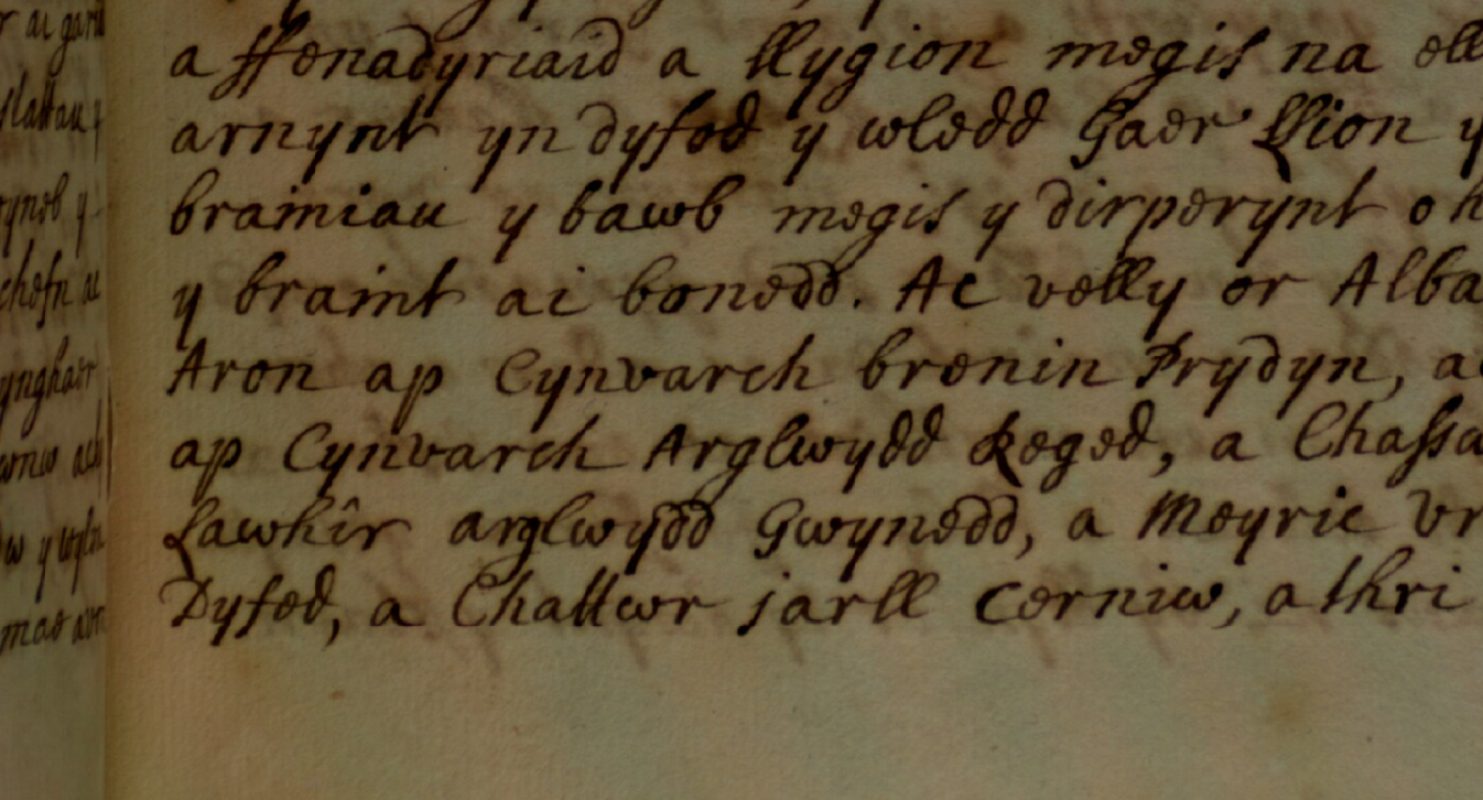
Accompanying one land grant in which King Morgan son of Athrwys is the chief witness, we find that one of the other witnesses (listed soon after the king himself) is a certain Petyr.
This figure does not appear again, and nothing is known of him. Yet, we can speculate that he may have been someone of importance, since he is listed soon after the king. However, if he lived within Morgan’s own territory, then it would seem unusual to only find him in a single land grant.
Potentially then, this Petyr can be identified with Pedur of Dumnonia, closely associated with but some distance from Morgan’s own territory. However, another distinct possibility is that he should be identified with Pedr of Dyfed, the grandson of the Vortipor who ruled over Dyfed as an elderly king in the time of Gildas.
Ancestor of Athrwys’ Descendants
A more substantial and certain connection between Pedur and Athrwys is the fact that the Jesus College MS 20 portrays Pedur as the ancestor of some of Athrwys’ descendants. The genealogical record in question is abbreviated and apparently corrupt in some ways, so it is not possible to establish with certainty how Pedur was connected to Athrwys’ dynasty.
What the record does reveal is that an unnamed granddaughter of Pedur married into the line of kings descended from Athrwys and became the ancestress of the subsequent kings. Who she married is not clear, although for chronological reasons, it is likely to have been Rhys ap Ithel ap Morgan ap Athrwys.
In any case, Pedur was somehow the ancestor of the line of kings who were also the descendants of Athrwys, the Arthur of Le Petit Bruit. If any tradition circulated which preserved this fact, this would surely have encouraged the conclusion that Pedur was a son of Arthur.
King of the North
The most notable objection to this identification is that Pedur was from the dynasty of Dumnonia in southeast Britain, very far from Deira, Bernicia, or Scotland. How, then, could Pedur have been remembered as the king of Scotland?
We cannot say for sure. We do know, however, that some kings of Dumnonia were also associated with the north of Britain. For example, there are a variety of records which state that King Constantine of Dumnonia (possibly the brother of Pedur named Constantine, but possibly a different member of the same royal family) moved permanently to Scotland.
King Mark of Cornwall, in Welsh tradition, is associated not just with Cornwall but also with a place called Llychlyn, which is the Welsh word for Scotland.
The poem Y Gododdin, written in c. 600, records the presence of a certain ‘Gereint of the south’ at the Battle of Catraeth, which occurred north of York. Since ‘Gereint’ was a dynastic name of the kings of Dumnonia, and this figure is explicitly said to be ‘of the south’, this was likely a prince from Dumnonia.
Therefore, although we cannot confirm it, it is broadly consistent with the available facts to suggest that Pedur of Dumnonia had a connection to the north of Britain, whether in genuine history or merely in later tradition.
Conclusion
In conclusion, Patrick the Red was one of the three sons of King Arthur in Le Petit Bruit, an obscure history of Britain written in 1309. He receives Scotland as an inheritance from Arthur. Several decades later, Scotland is conquered from Patrick’s dynasty by Athelstan, the son of Adeluf III, son of King Arthur.
The historical origin of the story of ‘Athelstan’s’ conquest of Scotland evidently comes from the historical conquest of Deira by Athelwald in the mid seventh century. Patrick the Red himself is far more elusive. However, the most likely conclusion is that he can be identified with Pedur of Dumnonia, a historical figure who flourished in the generation after Arthur. Although not actually one of Arthur’s sons, he was the brother of Constantine, normally portrayed as Arthur’s heir. The epithet ‘the Red’ is likely misapplied from Peredur Goch, a historical figure of the tenth century.
Sources
Bartrum, Peter*, A Welsh Classical Dictionary*, 1993
Putter, Ad, Arthur’s Children in Le Petit Bruit and the Post-Vulgate Cycle, 2012
Barber, Chris, King Arthur: The Mystery Unravelled, 2016
Howells, Caleb, King Arthur: The Man Who Conquered Europe, 2019