Morgan the Black, Son of King Arthur

Morgan the Black is a minor character from the Arthurian legends. Yet, he is a very close member of King Arthur’s family, and he held a very important position in the one source in which he appears. What do we know about him, and can he be identified as a historical figure from the time period?
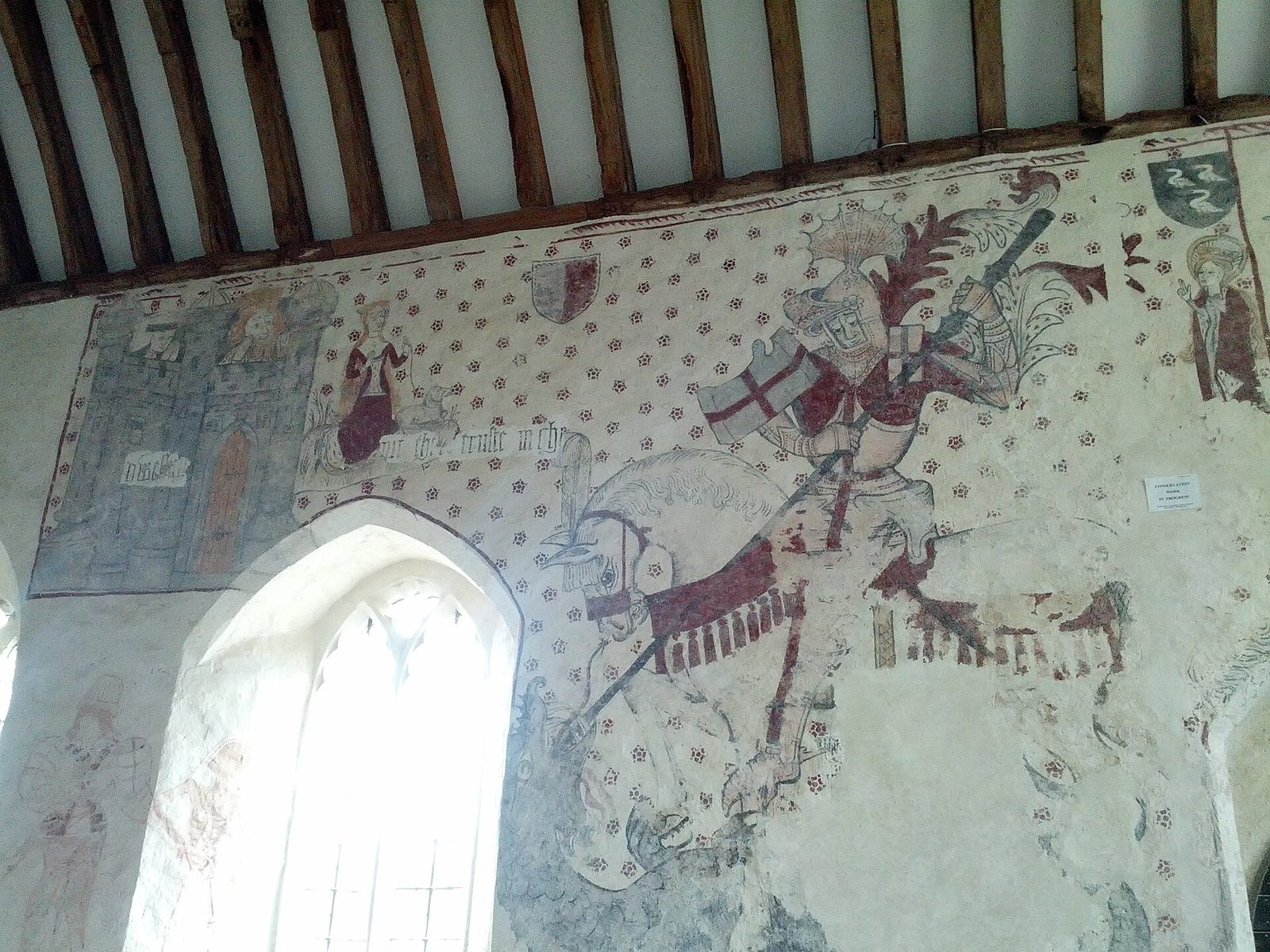
Who Was Morgan the Black?
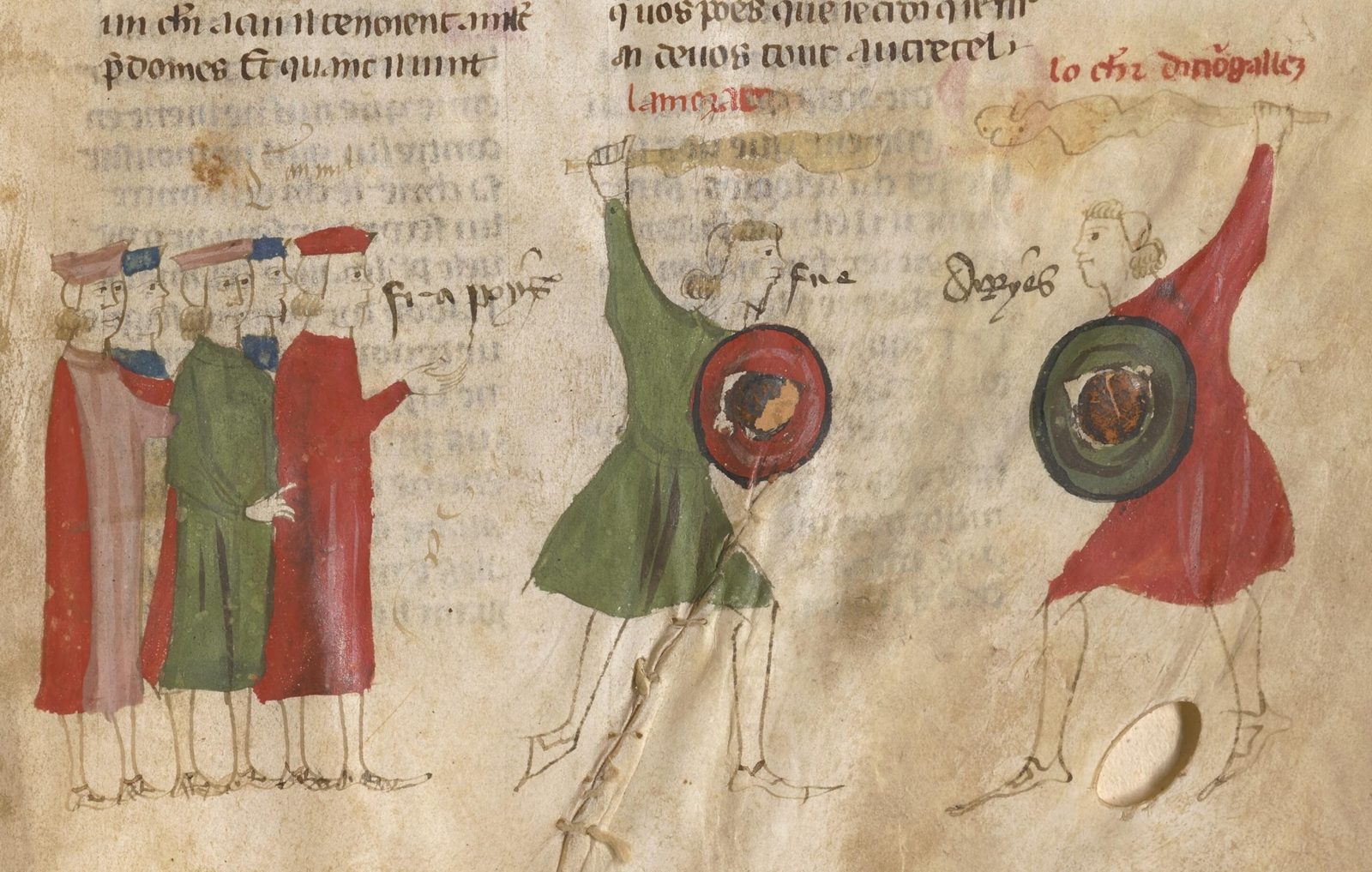
Morgan the Black was the son of King Arthur. He appears in just one Arthurian source, Le Petit Bruit. This was written by a man named Ralph de Bohun (also known as Rauf de Boun) in the year 1309. This is actually an abbreviation of a much longer chronicle which is now lost to us. Thus, the tradition about Morgan the Black presumably dates back to the thirteenth century, if not earlier.
In Le Petit Bruit, King Arthur has three sons. Morgan the Black is the middle child. Morgan’s older brother is Adeluf, while his younger brother is named Patrick the Red. Adeluf is not associated with a colour as far as Ralph de Bohun reveals.
All three children were the sons of Arthur by an unnamed queen, apparently referred to by Ralph as the ‘Fairy Queen’.
Educated by Sir Gawain
There is a line in Le Petit Bruit that explains that Arthur had his son Morgan educated by Sir Gawain. While this only received a passing mention in the document, it suggests a fascinating conclusion regarding the chronology of Morgan.
The Chronology of Gawain and Morgan
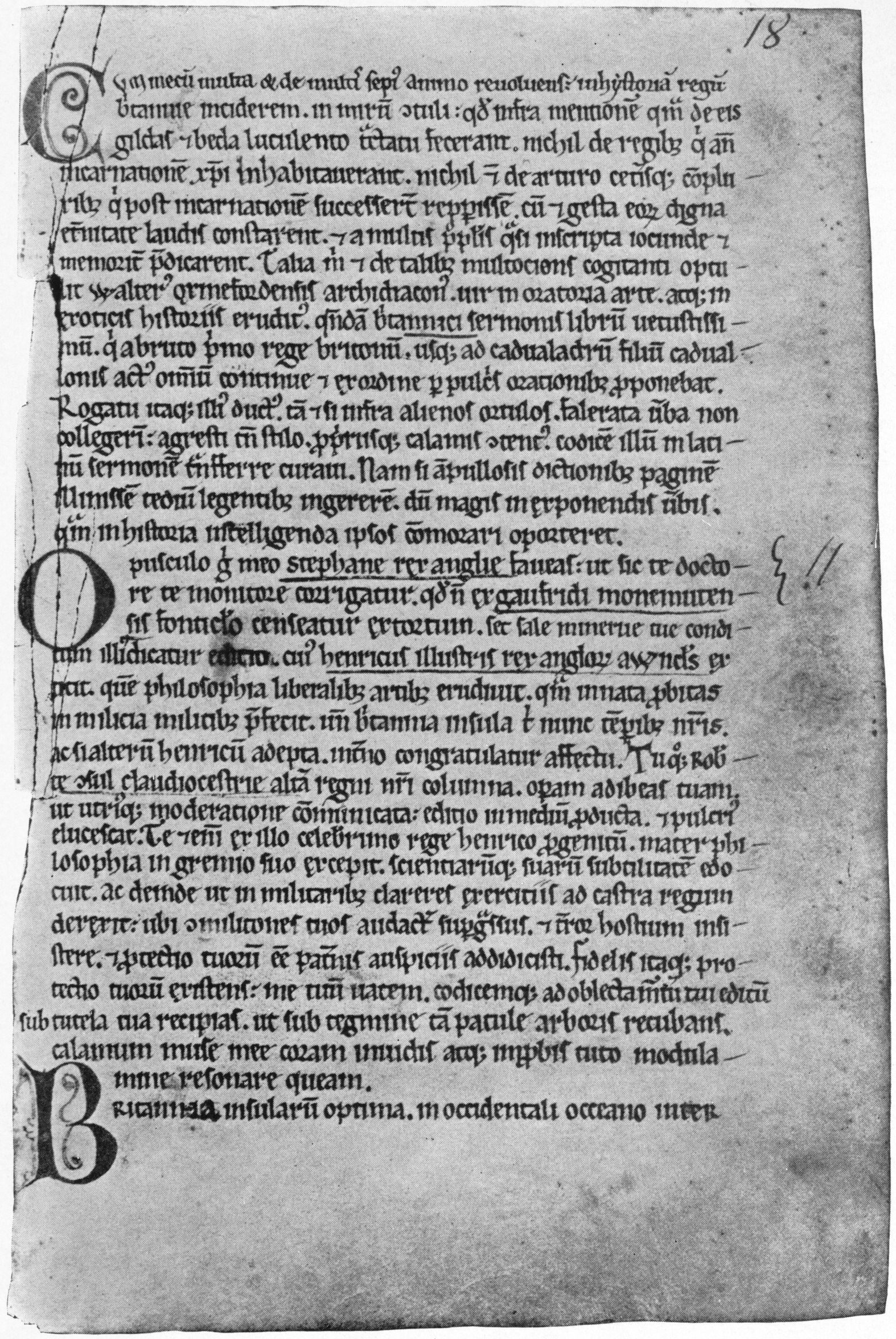
Sir Gawain first appears in any notable way in the Arthurian legends in the Historia Regum Britanniae, written by Geoffrey of Monmouth in c. 1137. There, he is described as being twelve years old at about the time of Arthur’s special coronation, some thirteen years or so after the Battle of Badon, Arthur’s climactic battle against the Anglo-Saxons.
Therefore, Gawain was born late in Arthur’s career. He did not see the Anglo-Saxon wars, being a mere baby when those wars ended. He would thus have just been a young adult at the time of the Battle of Camlann, the battle at which Arthur ‘fell’.
Therefore, if Gawain was the one who educated Morgan, then this means that Morgan must have been a very late son of Arthur. In fact, he must have been born right near the end of Arthur’s life.
Absolute Dates
With this information in mind, when exactly would Morgan have been born? Well, a lot depends on the dates assigned to Arthur’s reign. Many modern sources place him in the early sixth century. However, some more recent scholarship has highlighted some reasons to place him later.
Rachel Bromwich, in her landmark publication Trioedd Ynys Prydein, pointed out that the earliest chronological information about King Maelgwn Gwynedd makes him a late-sixth century king. Since Gildas wrote De Excidio in the time of Maelgwn’s reign, and he placed the Battle of Badon forty-three years before the time he was writing, that would place Badon in approximately the middle of the sixth century.
Various other details from the Arthurian legends support this, such as the people with whom Arthur is associated in the legends.
Gawain himself is a good example. He was the son of King Lot of Lothian, brother of Urien Rheged. This makes Gawain the first cousin of Urien’s son Owain. Urien and Owain are very well documented and are firmly place in the mid to late sixth century. Owain was probably born in the mid-540s, so his first cousin Gawain would logically have been born at around the same time.
Assuming he was at least in his early twenties when he became the educator of Morgan, and assuming that Morgan was a young child when he was given to Gawain’s care, which seems logical, this would place Morgan’s birth in the mid-560s at the earliest.
Why Would Morgan Be a Late Son?
Of course, the historical information in Le Petit Bruit might be complete nonsense with no regard for earlier chronological details. Yet, that is not necessarily the case. Let us pursue this idea and see where it leads us.
Why would Morgan have been born so late in Arthur’s life? The answer may lie in the fact that all the sons ascribed to him in Welsh tradition are recorded as dying during his reign. One example is Amr, killed by Arthur himself. Another is Gwydre, killed during Arthur’s boar hunt in Culhwch and Olwen.
Perhaps the most significant example is Llacheu. According to Welsh tradition, he was slain at the Battle of Llongborth. The evidence indicates that this battle was the prelude to the Battle of Camlann.
Therefore, by the time of the Battle of Camlann near the very end of Arthur’s career, all of Arthur’s recorded children had died. He was thus left without an heir.
In another article, it is shown that the weight of Welsh tradition indicates that the Battle of Camlann did not actually result in Arthur’s death, although it did occur very near the end of his reign. He seems to be recorded as continuing to campaign in the north of Britain in the aftermath of Camlann, and then he went on a voyage in which he was still active in battle.
Therefore, since Arthur apparently survived Camlann without an heir, it would make a great deal of sense for him to attempt to father more children. This would also make sense of the contradictory traditions about the fate of Arthur’s wife.
His wife is definitely recorded as betraying him in favour of the usurper Mordred. She would logically have been punished for this, as claimed by certain traditions.
The fact that other traditions record her living out the rest of her life peacefully suggest that these may be describing a subsequent wife that Arthur took in an effort to produce an heir.
If this theory is correct, it would actually mean that Adeluf, Morgan, and Patrick were all late sons of Arthur, born in approximately 570.
King of Wales
According to Le Petit Bruit, Morgan was Arthur’s favourite son. The text says:
“Arthur dwelled with him for most of his life in the south of Wales where he had his son educated by Sir Gawain, who was his mentor at the time.”
So according to this, Arthur spent most of his time in South Wales with his son Morgan. Furthermore, Le Petit Bruit explains that Arthur entrusted Morgan with the rulership of Wales, while the other two sons ruled other regions of Britain. This chronicle is not explicit about the exact succession process, but it suggests that Wales was to be Morgan’s inheritance after Arthur’s death, and that Morgan did not rule it while Arthur was still alive.
Legacy
Regarding Morgan’s governance of Wales, Le Petit Bruit says:
“His second son was called Morgan the Black, to whom he gave Wales, to hold it in perpetuity without suit or service to anyone living. And this Morgan himself held this privilege as did many of his successors until the time of Athelstan the Second, who was the first to conquer the lordship of Wales, subjecting the Welsh for the first time to a certain tribute, under which subjection the land was held from the King of England.”
Who exactly this ‘Athelstan the Second’ is supposed to be is not entirely clear. Elsewhere, the document mentions Athelstan the First as the conqueror of Scotland and predecessor of Alfred within the generation after Arthur’s son Adeluf.
Given the proximity to Arthur’s lifetime, we can conclude that Athelstan the First is not to be identified with the most famous Athelstan, king of the English in the tenth century, centuries after Arthur’s time. Most likely, he can be identified with Athelwald of Deira, a king of the seventh century who seems to have taken over control of Deira, a northern kingdom, by force. The Alfred mentioned in the account as coming next is probably King Alhfrith, the historical successor of Athelwald.
Regarding ‘Athelstan the Second’, the conqueror of Wales, perhaps he can be identified with Aethelbald of Mercia, the eighth century king who fought against the Welsh.
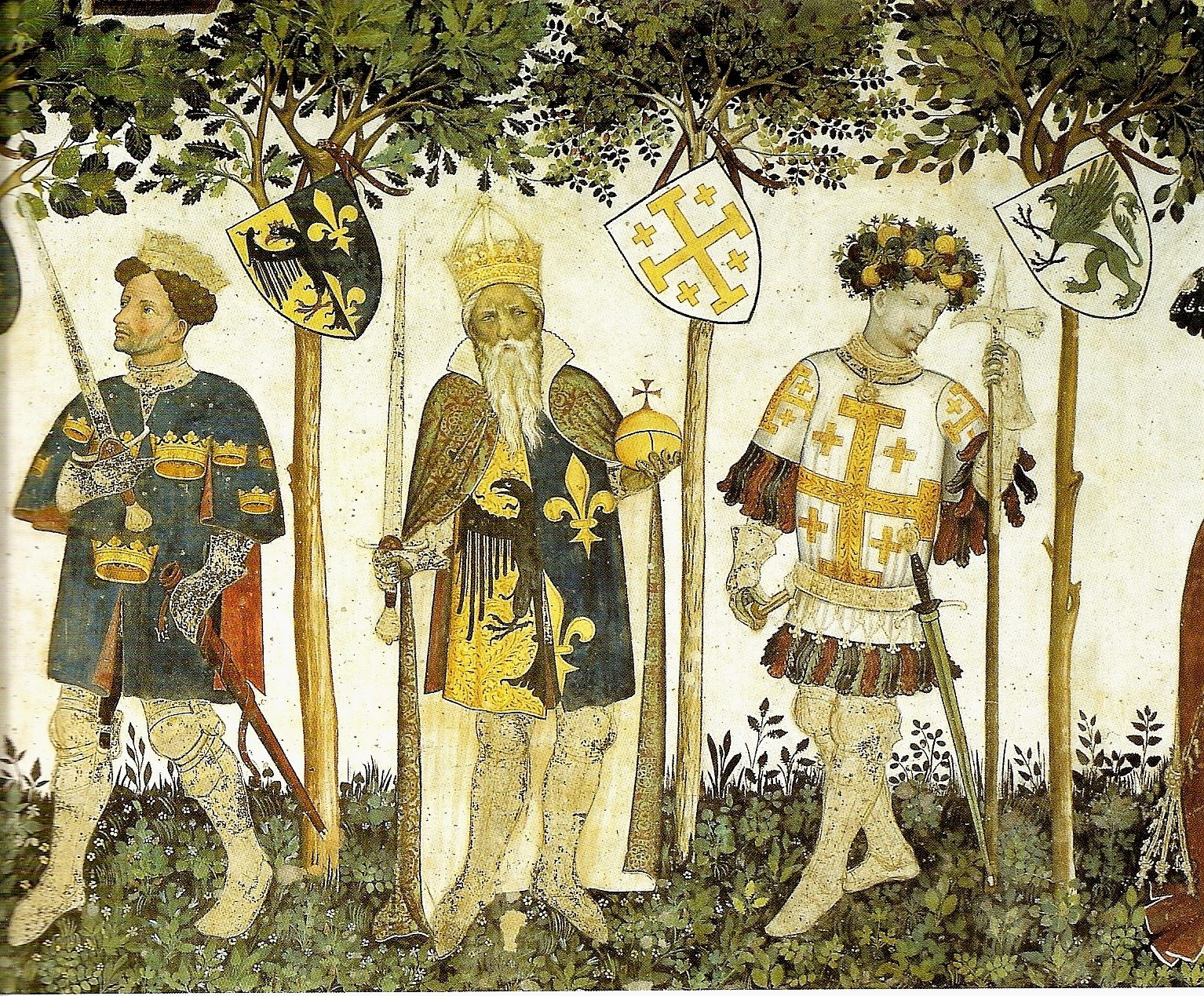
Morgan the Black from Other Records
It was mentioned earlier that Morgan the Black only appears in a single Arthurian source. Nonetheless, a reasonable argument can be made that he does appear in some other sources too, albeit not in a form that is so easily identifiable.
Historia Regum Britanniae
The most notable example of what appears to be another appearance of Morgan the Black is seen in Geoffrey of Monmouth’s Historia Regum Britanniae, written in c. 1137.
Although Geoffrey does not explicitly describe Arthur as having children, he does provide a reasonable amount of information regarding Britain during the century subsequent to Arthur’s rule. For instance, he provides the names of several major Welsh kings.
Regarding the activities of Athelfrith, Geoffrey writes:
“From thence this Saxon tyrant proceeded on his march to Bangor; but upon the news of his outrageous madness, the leaders of the Britons, viz. Blederic, duke of Cornwall, Margaduc, king of the Demetians, and Cadwan, of the Venedotians, came from all parts to meet him and joining battle with him, wounded him, and forced him to flee.”
According to this passage, Margaduc (usually spelt ‘Margadud’) was one of the three most prominent kings of the Britons at the time of this event, in about 616. He is called the king of the Demetians, that is, the Welsh of South Wales.
Identifying Margadud
In A Welsh Classical Dictionary, scholar Peter Bartrum records Margadud as ‘Fictitious’. He appears in Welsh translations of Geoffrey’s work as ‘Maredudd’, which is the regular Welsh form of the Latin spelling ‘Margadud’ used by Geoffrey.
However, aside from this, Margadud does not appear anywhere in Welsh tradition. There are no king lists or other records that speak of a ‘Margadud’ or ‘Maredudd’ who ruled South Wales in the early seventh century.
With this in mind, it is notable that the Welsh word for ‘black’ is ‘du’. Therefore, ‘Morgan the Black’ would be ‘Morgan Du’ in Welsh.
Given the evidence seen earlier for Morgan the Black being a very late son of Arthur’s and being born in the late-560s, if not a little later (after the Battle of Camlann), Morgan the Black is perfectly placed to be Geoffrey’s Margadud, both on chronological grounds and geographical grounds.
Recall that Le Petit Bruit stated that, although he ruled over Wales as a whole, Morgan lived in South Wales in particular. He would likely have been in his forties at the time in which Margadud is mentioned as the king of South Wales in Geoffrey’s HRB.
Therefore, it is virtually certain that the Margadud mentioned by Geoffrey is the same character as Morgan the Black from Le Petit Bruit, the son of King Arthur.
There are many examples in the medieval Welsh records of one legitimate name being corrupted into a different but equally legitimate name (e.g. ‘Maximus’ into ‘Maximianus’). Therefore, the fact that ‘Margadud’ is a genuine name in its own right does not prevent it from being a corruption of ‘Morgan Du’.
Annales Cambriae
The Annales Cambriae is a Latin chronicle written in the tenth century which records numerous events from the end of Roman Britain onwards. In this chronicle, the entry for 665 reads:
“The first celebration of Easter among the Saxons. The second battle of Badon. Morgan dies.”
The identity of the Morgan mentioned here has been the subject of debate for as long as scholars have studied this document. Could this be Morgan the Black, the son of King Arthur?
The fact that the father of this Morgan is not mentioned suggests that he was a significant figure in his own right. Most of the figures mentioned as dying in the Annales Cambriae are identified by their father or kingdom. The fact that Morgan is mentioned here with no explanation suggests that he was famous enough that his identity should have been obvious.
This would arguably match a son of the mighty King Arthur. It is also consistent with Geoffrey making Margadud one of the three most prominent kings of the Britons in the early seventh century.
Chronological Considerations
One potential issue with this is the date. If Morgan died in 665, could he really have been Morgan the Black, whose birth cannot have been much later than 570? This would make him very old at the time of his death. Nonetheless, the age of ninety-five is not impossibly old, as unlikely as it may be.
Another factor to bear in mind is that the dates of the entries in the Annales Cambriae are not always reliable. In fact, this is evident from this very same entry of 665. Notice that it mentions the ‘second battle of Badon’.
This appears to correspond to a battle mentioned in the Anglo-Saxon Chronicle, a battle which occurred at a place named ‘Beadan-head’ or ‘Biedan-Head’ in that chronicle. Yet in this document, the battle is placed in the year 675, a difference of ten years.
Similarly, the Annales Cambriae places the death of Bishop David in 601, yet more reliable chronicles place it in about 587, a difference of fourteen years.
It is entirely possible that Morgan’s death has simply been misdated by a few years. Reducing it by even just ten years would make it much more plausible, giving Morgan the Black an age of eighty-five at the time of his death.
Supporting the idea that Morgan the Black lived to an old age is the fact that Margadud (evidently Morgan Du, or Morgan the Black) is portrayed by Geoffrey of Monmouth as still being alive in the year in which Penda died, which was 655.
Therefore, there is every possibility that Morgan the Black, son of King Arthur, is the Morgan recorded as dying in 665 in the Annales Cambriae. There does not appear to be any other sufficiently important Morgan from that era with whom the figure from the chronicle can be identified.

Did Morgan the Black Really Exist?
Of course, the idea that a character mentioned in a minor work from 1309 could shed light on enigmatic details from the twelfth century HRB and the tenth century Annales Cambriae might seem objectionable at first. Why should we even entertain the possibility that Morgan the Black really was a historical figure?
One key reason is the simple fact that one of the most prominent candidates for the historical King Arthur really did have a son named Morgan.
The Arthurian candidate in question is Athrwys ap Meurig, or Athrwys son of Meurig. He was a king of the entire southeast region of Wales and part of what is now England in the post-Roman era, his domain comprising the kingdoms of Glamorgan, Gwent, and Ergyng.
The theory that Athrwys was the real King Arthur is an attractive possibility for a variety of reasons. For one thing, he ruled over the area with which Arthur is most closely associated in the legends. Furthermore, many of his family members can be identified with family members of King Arthur, such as Athrwys’ apparent maternal uncle Gwrfoddw and Arthur’s maternal uncle Gwrfoddw Hen.
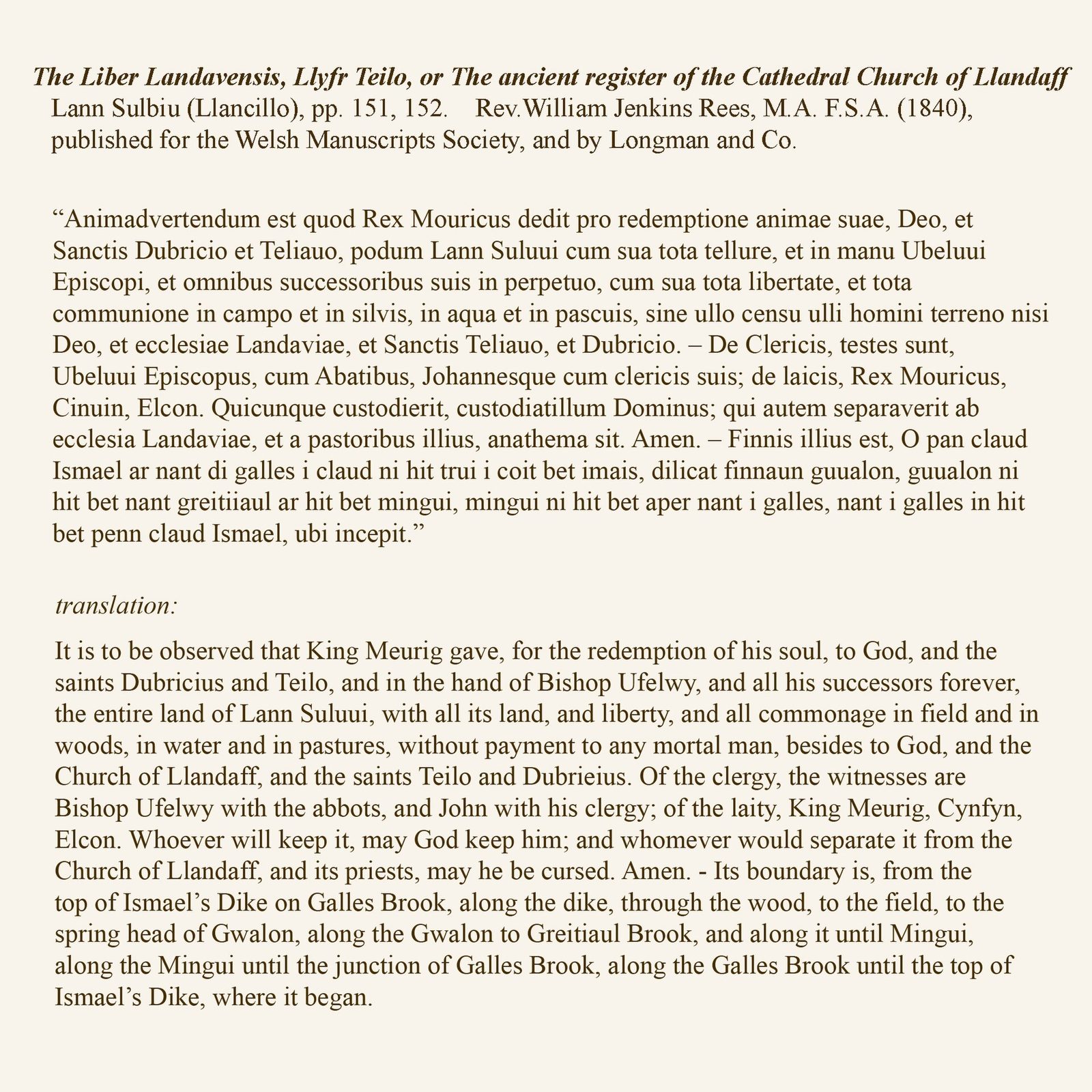
In the twelfth century Book of Llandaff, as well as numerous genealogical records from both before and after, Athrwys is recorded as having a son named Morgan. It goes without saying that if Athrwys’ identification with Arthur is correct, his historical son Morgan would obviously be the origin behind Morgan the Black in Le Petit Bruit.
Consequently, this would mean that Morgan the Black can be properly regarded as a historical figure.
Chronological Evidence
The identification of Morgan the Black with Morgan ap Athrwys is supported by chronological evidence. We have already seen that, as a very late son of Arthur and a student of Gawain, Morgan the Black evidently would have been born in approximately 570.
This fits very well with what we know about Morgan ap Athrwys. The Book of Llandaff reveals that the bishop active throughout Morgan’s reign was Bishop Oudoceus, and that this bishop continued to serve into the reign of Morgan’s son, Ithel.
The Oxford Dictionary of Saints, by scholar David Farmer, places his tenure as bishop from approximately 580 to 615. Therefore, Morgan ap Athrwys was evidently a king of the late-sixth, early-seventh century. This fits the other chronological evidence that we have seen concerning Morgan the Black himself and his likely alter ego, Margadud.
It should also be noted that Morgan’s son Ithel becoming king during the tenure of Bishop Oudoceus, which ended long before Penda’s death in 655, does not preclude the identification of Morgan with the Margadud whom Geoffrey portrays as still active at that late date. It may be that Ithel just ruled as a sub-king, while Morgan continued ruling as over-king through to Penda’s death in 655.
Alternatively, it may be that Morgan retired for many years until finally coming back as king near the end of his life, similar to what his great-grandfather Tewdrig had done.
Evidence That He Was a Late Son
As well as the match between the absolute dates of Morgan ap Athrwys and Morgan the Black, what about the fact that Morgan the Black was apparently a very late son of Arthur’s? Is there any evidence actively supporting this conclusion concerning Morgan ap Athrwys?
Briafael ap Llywarch
Interestingly, there is some evidence from this from a comparison between the Book of Llandaff and genealogical information seen in a document called the Jesus College MS 20. This document contains numerous pedigrees of the medieval Welsh kingdoms.
One of these genealogical records preserves the line of descent from a king named Pebiau who ruled Ergyng, a kingdom just outside southeast Wales. The line of descent goes from Pebiau down to a certain Briafael ap Llywarch. Briafael appears seven generations after King Pebiau.
The reason this is so interesting is because both Pepiau and Briafael appear in the Book of Llandaff. Pebiau is the grandfather of the famous Dubricius, who was born around 465. This would place the birth of Pebiau in around 420.
Counting forward seven generations, if we assume that each one was between twenty and twenty-five years in length, would bring us to c. 560-595 for the birth of Briafael ap Llywarch.
What This Means for the Dating of Morgan
Notably, Briafael ap Llywarch appears in the Book of Llandaff as a witness in the time of King Morgan. The reason this is so interesting is that Morgan was also a descendant of Pebiau, although through a different line.
Pebiau’s grandson Gwrgan Fawr was the great-grandfather of Morgan, placing Morgan five generations after Pebiau. The fact that Morgan was only five generations after Pebiau, yet one of his contemporary witnesses early in his reign was a seventh-generation descendant of the same, indicates that Morgan’s line of descent was unusually long for some reason.
The fact that Briafael was not old by the time he appears as a contemporary of Morgan is supported by the fact that his daughter Cenedlon is recorded as the ancestress, somehow, of the kings of Morgan’s dynasty. Yet it appears from the Book of Llandaff that Morgan’s wife was a woman named Rhiceneth (also spelled Ricceneth). This would suggest that Cenedlon daughter of Briafael was the wife of Ithel son of Morgan.
If we assume that Morgan was a very late son of his father Athrwys, that would account for the difference of two generations (an average of forty to fifty years) between his pedigree and that of Briafael.
The fact that it was not Athrwys who was a late son of his father is evidence by the fact that Athrwys’ nephew by his sister Anna was Samson of Dol, who was definitely born well within the first half of the sixth century.
Thus, the evidence suggests that the two-generation gap between the pedigree of Briafael and that of Morgan should be explained by Morgan being born very late in Athrwys’ life. With two generations being equivalent to about forty or fifty years, this would suggest that Morgan was born when Athrwys was about sixty or seventy years old rather than the expected twenty to twenty-five years old.
Therefore, the evidence strongly supports making Morgan a very late son of Athrwys, born right near the end of his life, exactly like Morgan the Black in Le Petit Bruit.
Evidence of Power
If Morgan ap Athrwys was Morgan the Black, the son of King Arthur, we would expect him to have been a very prominent king. Is there any evidence of this?
As it happens, there is an interesting piece of evidence to be found in a medieval Welsh poem entitled Cyfoesi Myrddin a Gwenddydd ei Chwaer (which translates to ‘The Conversation of Myrddin and His Sister Gwenddydd’). In this poem, Myrddin and Gwenddydd discuss the sequence of prominent rulers of Britain from the latter half of the sixth century onwards.
The first three kings mentioned in this sequence are Rhydderch Hael, Morgan Mawr, and Urien Rheged. As Peter Bartrum noted, this sequence appears to be in reverse order, since the records are absolutely clear that Rhydderch did not die until long after Urien.
That being the case, there was evidently a certain ‘Morgan Mawr’, or Morgan the Great, who was especially prominent between Urien and Rhydderch Hael, right at the end of the sixth century or the very beginning of the seventh. Who was this Morgan Mawr?
The Identity of Morgan Mawr
In the Historia Brittonum, we find a reference to Urien Rheged fighting the Angles alongside three other kings. One of them is ‘Morcant’, or Morgan. However, this same Morgan is then described as later murdering Urien out of envy for his superiority in military science.
It is evident that this Morgan was a prominent figure active in warfare in the late-sixth century. The fact that he not only fought alongside Urien, one of the most powerful kings of Britain in that era, but also killed him, is testament to this Morgan’s power and prominence.
Based on this, Bartrum suggests that the Historia Brittonum’s Morgan in the same as the Morgan Mawr mentioned in the Cyfoesi Myrddin a Gwenddydd ei Chwaer.
The poem refers to him as the ‘son of Sadyrnin’. Intriguingly, none of the medieval genealogies contain any reference to such a ‘Morgan ap Sadyrnin’, nor is there even any notable king called Sadyrnin in that period.
There were a few Morgans attested in late-sixth century Britain. However, only one of them had any connection to someone whose name was similar to ‘Sadyrnin’.
In the Book of Llandaff, Morgan ap Athrwys is recorded in association with an abbot named Saturnus, or Sadwrn. Based on records about another figure with this same name, this appears to be an acceptable alternative form of ‘Sadyrnin’ (or vice versa).
While Morgan ap Athrwys was, of course, not actually the son of this Sadwrn, the fact remains that he is the only Morgan in this era associated in any way with someone with a name like that. Furthermore, it must be admitted that it is easy to see how an abbot might have been remembered as Morgan’s honorary father, especially since Morgan was born shortly before the death of his father Athrwys, meaning that he must have had a guardian.
Therefore, the evidence strongly suggests that Morgan ap Athrwys can be identified with the Morgan Mawr (that is, Morgan the Great) mentioned as the prominent leader of the Britons between Urien and Rhydderch Hael in this Welsh poem.
Geographical Evidence
Further support of this identification is the fact that Le Petit Bruit specifically associates Morgan the Black with South Wales in particular. This was the very area in which Morgan ap Athrwys historically ruled.
One potential objection to this is the fact that Geoffrey’s Margadud is specifically called the king of Dimetia. This is the name for the kingdom of southwest Wales, not southeast Wales. Therefore, if Geoffrey’s Margadud really should be identified as Morgan the Black (which his name suggests that he should), then Morgan the Black cannot be Morgan the son of Athrwys.
However, this argument falls down when we examine how the term ‘Dimetia’, or ‘Dyfed’, was actually used in practice in medieval documents. Although it was the proper name for the kingdom of southwest Wales, it was also used to mean South Wales in general.
We see this in the Historia Regum Britanniae itself, in fact. Geoffrey refers to the city of Gloucester as being situated on the border between Dimetia and Loegria, which latter term Geoffrey uses to mean England. This usage of Dimetia clearly means South Wales in general.
Therefore, the fact that Geoffrey calls Margadud the king of Dimetia is not inconsistent with his identity as Morgan ap Athrwys.
Dynastic Evidence
Another piece of evidence in support of this identification is what Le Petit Bruit says regarding how long Morgan’s dynasty held onto the country. It was not a case of Arthur’s son ruling Wales after him but then dying and being replaced by a new dynasty immediately afterwards.
Rather, as we saw earlier, Le Petit Bruit states clearly that “Morgan himself held this privilege as did many of his successors until the time of Athelstan the Second.”
Since we identified Le Petit Bruit’s ‘Athelstan the First’ and his successor Alfred with certain rulers of the mid to late seventh century, this would suggest that Morgan’s dynasty supposedly continued until about the end of the seventh century at the very least, and potentially much further than that.
This matches Morgan ap Athrwys perfectly. His descendants continued to rule much of South Wales for the next few centuries.
Familial Evidence
There is at least one more piece of evidence that points towards the identification of Morgan the Black with the historical Morgan son of Athrwys.
Recall that Le Petit Bruit gives Morgan two brothers, Adeluf and Patrick. While there is no obvious equivalent to Patrick in the historical family of Athrwys, there was a son named Ithel. His name is also spelled ‘Iudhael’, ‘Ithael’, and occasionally ‘Idwal’.
The name ‘Adeluf’ is obviously superficially similar to ‘Ithel’. Apart from the suffix ‘uf’ at the end of the former, they are essentially the same. In fact, the author of Le Petit Bruit appears to have used ‘Adeluf’ as a substitute for various names to which it seemed similar. It is clearly inspired by the name of Aethelwulf, king of Wessex.
In any case, the fact that Morgan the Black and Morgan the son of Athrwys are recorded with brothers whose names are almost identical provides strong support to the conclusion that they are, in fact, the same Morgan.
Conclusion
In conclusion, Morgan the Black explicitly appears in only one source, Le Petit Bruit. Despite that, there is a lot to say about him. He was the son of King Arthur and was given Wales to rule, being associated particularly with South Wales. He was evidently born very late in Arthur’s life, being educated by Gawain, meaning that he was probably born in approximately 570. His dynasty continued ruling Wales until the conquests of a certain king remembered as Athelstan the Second.
We have see how Morgan the Black can almost certainly be identified with the Margadud mentioned by Geoffrey of Monmouth, and quite possibly with the Morgan recorded as dying in 665 in the Annales Cambriae. More crucially, he can be identified with Morgan the son of Athrwys, one of the prime candidates for the real King Arthur.
Sources
Bartrum, Peter, A Welsh Classical Dictionary, 1993
Barber, Chris, King Arthur: The Mystery Unravelled, 2016
Farmer, David, The Oxford Dictionary of Saints: Fifth Edition Revised, 2011
Howells, Caleb, King Arthur: The Man Who Conquered Europe, 2019
Putter, Ad, Arthur’s Children in Le Petit Bruit and the Post-Vulgate Cycle, 2012